Reverence for You, O Holy One, is the beginning of wisdom; a good understanding have all who practice it. Psalm 111 Nan C. Merrill
Reflection:
Psalm 111 is a psalm of praise. The last verse, “The fear of the Lord is the beginning of wisdom; all those who practice it have a good understanding.” (NRSVUE) moves the reader or hearer from celebration to action. In Psalm 112, the righteous will act as a light in the darkness. They can be described as acting: graciously, generously, mercifully, and as people who conduct their affairs with justice. These attributes (which were ascribed to God in Psalm 111) and actions are the fruit of wisdom.
Wisdom is more than being an intellectual; it is about being compassionate. Wisdom is knowledge that is applied lovingly. God is the source of wisdom, truth, and love. And when we approach God with awe, reverence, and worship, we come away changed, and maybe a little wiser. And we use this wisdom to treat ourselves and our neighbors graciously, generously, and lovingly.
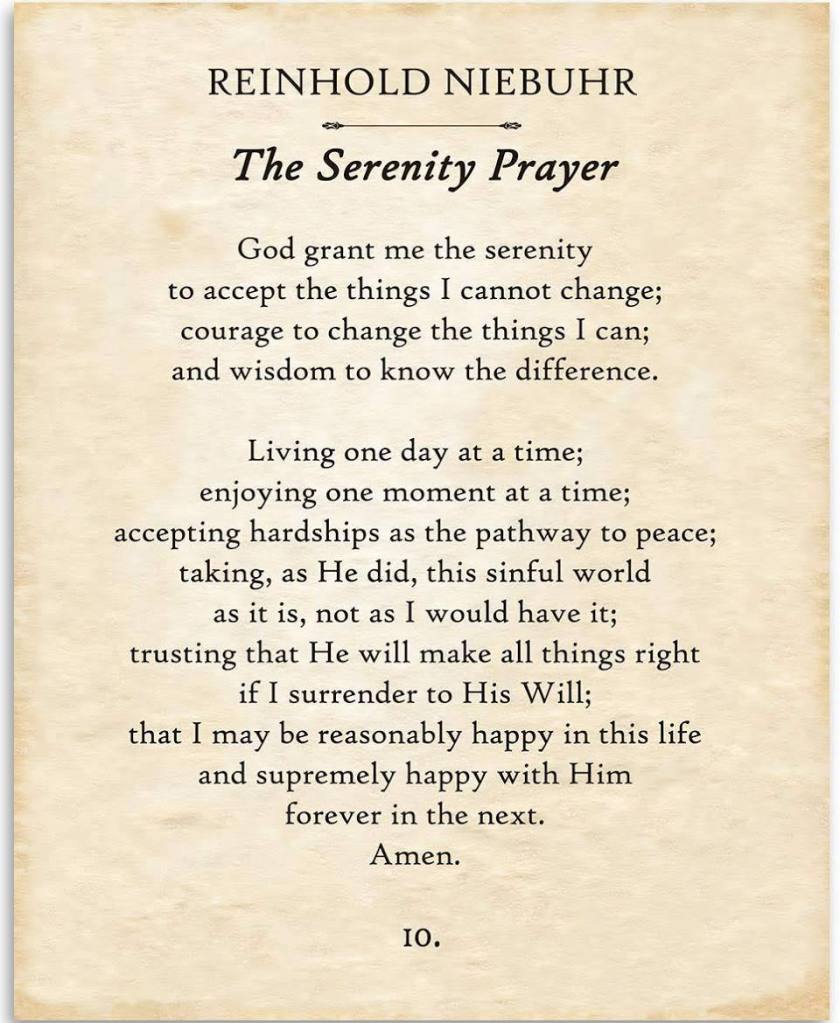
Many people pray the serenity prayer to ask for God’s guidance and wisdom. The Serenity Prayer is attributed to Reinhold Niebuhr and was adopted by Alcoholic Anonymous (AA) and other 12 step groups. The short version is as follows: God grant me the serenity to accept the things I can not change, courage to change the things I can, and the wisdom to know the difference.
Psalm reflections can be listened to on the Period Pastor Podcast series, Like One who Watches for the Morning.
I began writing Psalm reflections during Lent of 2020 shortly after we decided to close the church building, work from home, and worship via zoom. It is a practice I have continued since. Many churches use the Revised Common Lectionary (RLC) that rotates scripture on a three-year cycle (A, B, and C). Starting in Advent 2019, Third Church decided to worship with the texts from Year D, which is still not circulated as are years A, B, and C. Year D was created with the goal of including scriptures that were left out or not used as frequently as others. While we were using Psalms in year D, most other lectionary followers were using Year A. In Advent of 2020 we rejoined those who use the lectionary in year B. Advent of 2021 year C. Advent of 2022 year A. Advent of 2023 year B.
I use the Vanderbilt Divinity Library’s resource for lectionary readings to make text selections.
Year B Psalms
Advent – Transfiguration: 1st Sunday in Advent Psalm 80, 2nd Sunday in Advent Psalm 85, 3rdSunday in Advent Psalm 126, 4th Sunday in Advent Psalm 89, Christmas Eve or Christmas Day Psalm 96, Psalm 97, Psalm 98, 1st Sunday after Christmas, Psalm 148, New Year’s Day Psalm 8, Epiphany Psalm 72, 1st Sunday after Epiphany Psalm 29, 2nd Sunday after Epiphany Psalm 139, 3rd Sunday after Epiphany Psalm 62, 4th Sunday after Epiphany Psalm 111, 5th Sunday after Epiphany Psalm 147, Transfiguration Sunday (Sunday before Lent) Psalm 50
Lent: Ash Wednesday Psalm 51, 1st Sunday in Lent Psalm 25, 2nd Sunday in Lent Psalm 22, 3rdSunday in Lent Psalm 19, 4th Sunday in Lent Psalm 107, 5th Sunday in Lent Psalm 51 or Psalm 119:9-16, 6th Sunday in Lent (Palm or Passion Sunday) Psalm 118 or 31
Holy Week: Monday Psalm 36, Tuesday Psalm 71, Wednesday Psalm 70, Maundy Thursday Psalm 116, Good Friday Psalm 22, Holy Saturday Psalm 31
Easter: Easter Psalm 118 or 114, 2nd Sunday of Easter Psalm 133, 3rd Sunday of Easter Psalm 4, 4th Sunday of Easter Psalm 23, 5th Sunday of Easter Psalm 22, 6th Sunday of Easter Psalm 98, Ascension Psalm 47 or Psalm 93, 7th Sunday of Easter Psalm 1, Day of Pentecost Psalm 104
Season After Pentecost (Ordinary Time): 1st Sunday after Pentecost (Trinity Sunday) Psalm 29, 2nd Sunday after Pentecost Psalm 139 or Psalm 81, 3rd Sunday after Pentecost Psalm 138 or Psalm 130, 4th Sunday after Pentecost Psalm 20 or Psalm 92, 5th Sunday after Pentecost Psalm 9or Psalm 133 or Psalm 107, 6th Sunday after Pentecost Psalm 130 or Psalm 30, 7th Sunday after Pentecost Psalm 48 or Psalm 123, 8th Sunday after Pentecost Psalm 24 or Psalm 85, 9th Sunday after Pentecost Psalm 89 or Psalm 23, 10th Sunday after Pentecost Psalm 14 or Psalm 145, 11thSunday after Pentecost Psalm 51 or Psalm 78, 12th Sunday after Pentecost Psalm 130 or Psalm 34, 13th Sunday after Pentecost Psalm 111 or Psalm 34, 14th Sunday after Pentecost Psalm 84 or Psalm 34, 15th Sunday after Pentecost Psalm 45 or Psalm 15, 16th Sunday after Pentecost Psalm 125 or Psalm 146, 17th Sunday after Pentecost Psalm 19 or Psalm 116, 18th Sunday after Pentecost Psalm 1 or Psalm 54, 19th Sunday after Pentecost Psalm 124 or Psalm 19, 20th Sunday after Pentecost Psalm 26 or Psalm 8, 21st Sunday after Pentecost Psalm 22 or Psalm 90, 22ndSunday after Pentecost Psalm 104 or Psalm 91, 23rd Sunday after Pentecost Psalm 34 or Psalm 126, 24th Sunday after Pentecost Psalm 146 or 119, 25th Sunday after Pentecost Psalm 127 or Psalm 146, 26th Sunday after Pentecost Psalm 16, 27th Sunday after Pentecost (Christ the King) Psalm 132 or Psalm 93.
Sources and notes:
“Psalms 111 and 112 belong together. They are a pair, a kind of diptych. They correspond in form and language and deal with complementary topics. Psalm 111 is a praise of the works of the LORD by those who fear him. Indeed, it teaches that fear of the LORD is a work of the LORD. Psalm 112 is a commendation of the way and life of those who fear the LORD. The theme of Psalm 112 is set by the last verse of Psalm 111.” Mays p. 355
“The first word in each measure begins with the next letter of the Hebrew alphabet, twenty-two measures for twenty-two letters. In the Hebrew text each measure is composed of three words or bound expressions.” Mays p. 356
“The psalm nevertheless has an internal design. After the introductory verse 1 announces what is happening in the psalm, verse 2 establishes the theme of the whole; its subject is the great works of the LORD. Thematic words of the subject are repeated in verses 3, 4, 6, and 7 (work, wonderful deeds, works, works of his hands). The psalm descries the works of hte LORD as twofold, keeping the covenant of promise (v. 5) and establishing the covenant of commandments (v. 9).” Mays p. 356
Verse 10: ”This thesis about wisdom appears elsewhere in the Old Testament three times, always in the literature of instruction classified itself as wisdom (Provide. 1:7; 9:10; Job 28:28).” Mays p. 357
“The psalmist seems to know the words of the LORD through Scripture that can be studied. What is to be learned forms an important dimension of the psalm itself. The work of the LORD is honor and majesty, the attributes of a sovereign (45:3; 96:6; 145:5). The LORD is gracious and merciful (v. 4). The LORD remembers his covenant of promise forever and commands his covenant of precepts forever (vv. 5, 9). His name is holy and awesome (v. 9). The study of the works of the LORD nurtures the fear of the LORD in the heart. In this piety, Scripture study and praise inform had strengthen each other. Such praise, like the righteousness of the LORD, endures forever (vv. 3, 10). Mays p. 358
“True knowledge – wisdom – is not grounded in ourselves but in God, and it involves the embrace of God’s commitments and values. Thus wisdom will take concrete shape in righteousness, grace, and mercy (see vv. 3-4), and those who fear the Lord (Ps 112:1), therefore, will be “gracious, merciful, and righteous” (Ps 112:4)…” NIB p. 621
“The word translated “merciful” derives from the noun [Hebrew I don’t have the font for], whose literal meaning is “womb”. References to God’s [Hebrew I don’t have the font for], God’s “womb-love,” occurs no fewer than twenty times in the book of Psalms.” W pp. 111-112
“Thus it is a celebration of the foundational work of YHWH on behalf of the people of Israel. Its words of celebration preface the human response to YHWH called for in Psalm 112, and the wisdom words at the end of Psalm 111 provide the link to move the reader or hearer from celebration to action.” W p. 113
Alter Alter, Robert. 2007. The Book of Psalms: A Translation with Commentary New York: W. W. Norton & Company
WBC Allen, Leslie C. 1983. Word Biblical Commentary: Psalms 101-150. Vol. 21. Waco, TX: Word Books, Publisher.
Bonhoeffer, Dietrich. 1974. Psalms: The Prayer Book of the Bible. 8th ed. Minneapolis, MN: Augsburg Press.
Bourgeault, C. (2006). Chanting the psalms: A practical guide Audio Book. New Seeds.
Brueggemann, Walter. 2007. Praying the Psalms: Engaging Scripture and the Life of the Spirit. 2nd ed. Eugene, OR: Cascade.
Brueggemann Brueggemann, Walter. 2014. From Whom No Secrets Are Hid: Introducing the Psalms. Edited by Brent A. Strawn. 1st ed. Louisville, KY: Westminster John Knox Press.
Brueggemann, Walter. Davis Hanskins, Editor. 2022. Our Hearts Wait: Worshiping Through Praise and Lament in the Psalms Westminster John Knox Press, Louisville KY.
Brueggemann, Walter. (2002). Spirituality of the psalms. Augsburg Pub. House.
Brueggemann, Walter. (1984). The Message of the Psalms: A Theological Commentary. Minneapolis: Augsburg.
Chilson, Richard, ed. You Shall Not Want: A Spiritual Journey Based on the Psalms. Ave Maria Press, 2009.
Chittister Chittister, Joan. (2011). Songs of the heart: reflections on the psalms. John Garratt Publishing.
Cudjoe-Wilkes, G., Wilkes, A. J., & Moss, O. (2022). Psalms for black lives: Reflections for the work of Liberation. Upper Room Books.
WBC Craigie, Peter C. 1983. Psalms 1-50–Word Biblical Commentary. Vol. 19. Waco, TX: Word Books.
Creach Creach, Jerome Frederick Davis. 1998. Psalms: Interpretation Bible Studies. Louisville, KY: Westminster John Knox Press.
DAFLER, J. (2021). PSOBRIETY: A journey of recovery through the psalms. Louisville, KY: WESTMINSTER JOHN KNOX.
W de Claisse-Walford, Nancy L. WISDOM COMMENTARY: Psalms Bks. 4-5. Edited by Barbara E. Reid. Vol. 22. Collegeville, MN: Liturgical, 2020.
Green, Barbara. 1997. Like a Tree Planted: An Exploration of Psalms and Parables Through Metaphor. Collegeville, MN: Liturgical Press.
W Hopkins, Denise Dombkowski. WISDOM COMMENTARY: Psalms Bks. 2-3. Edited by Barbara E. Reid. Vol. 21. Collegeville, MN: Liturgical, 2016.
NIB Keck, Leander E. 2015. The New Interpreters Bible Commentary. Vol. 3. Nashville, TN: Abingdon Press.
Lewis, C. S. (2017). Reflections on the Psalms. Harper One, an imprint of Harper Collins Publishers.
Mays Mays, James Luther. 1994. Psalms. Louisville, KY: John Knox Press.
McCann McCann, J. C. (1993). A theological introduction to the book of Psalms: The Psalms as Torah. Nashville, TN: Abingdon Press.
McCann, J. C., & Howell, J. C. 2001. Preaching the Psalms. Nashville, TN: Abingdon Press.
Merrill, N. C. (2020). Psalms for praying an invitation to wholeness (10th Anniversary Edition ed.). London, England: Bloomsbury Publishing.
Miller Miller, Patrick D. 1986. Interpreting the Psalms. Philadelphia, PA: Fortress Press.
Morgan, Michael. 2010. The Psalter for Christian Worship Revised Edition. Westminster John Knox Press.
Schlimm Schlimm, Matthew Richard. 2018. 70 Hebrew Words Every Christian Should Know.Nashville, TN: Abington Press.
Spong Spong, M. (Ed.). (2020). The words of her mouth: Psalms for the struggle. Cleveland, OH: The Pilgrim Press.
WBC Tate, Marvin E. 1990. Word Biblical Commentary: Psalms 51-100. Edited by David Allan. Hubbard and Glenn W. Barker. Vol. 20. Waco, TX: Word.
Weems, Ann. 1995. Psalm of Lament. Westminster John Knox Pres
OTL Weiser, Artur. 1998. Old Testament Library: Psalms. Translated by Herbert Hartwell. 3rd ed. New York, NY: Manchester University Press.

 Period Pastor Pad