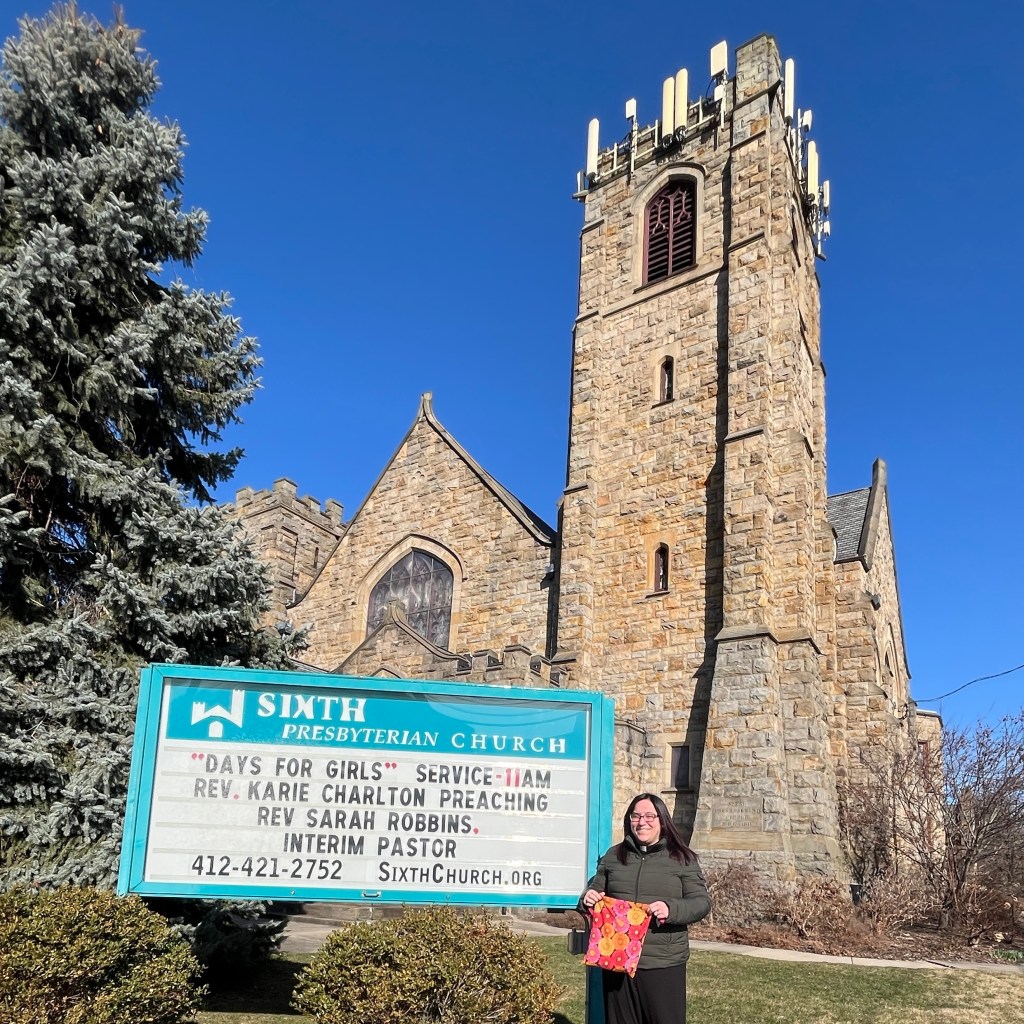
This sermon was done for my friends at Sixth Presbyterian Church. They stream their services on youtube.
It was wonderful to be with them this morning, especially to connect with Peter Gilmore, a member of my care team (those who shepherd candidates through the ordination process). He is an active member of the church and does lead worship often, but didn’t realize that I was the preacher until after he had committed to leading this service. It really felt like God had put this little moment together for us. My friend, Pam Howe, who was part of the Italian Pilgrimage group, is a member there too. And of course, Pastor Sarah and I and friends and colleagues in Pittsburgh Presbytery and we are planning to go on a pilgrimage together this spring.
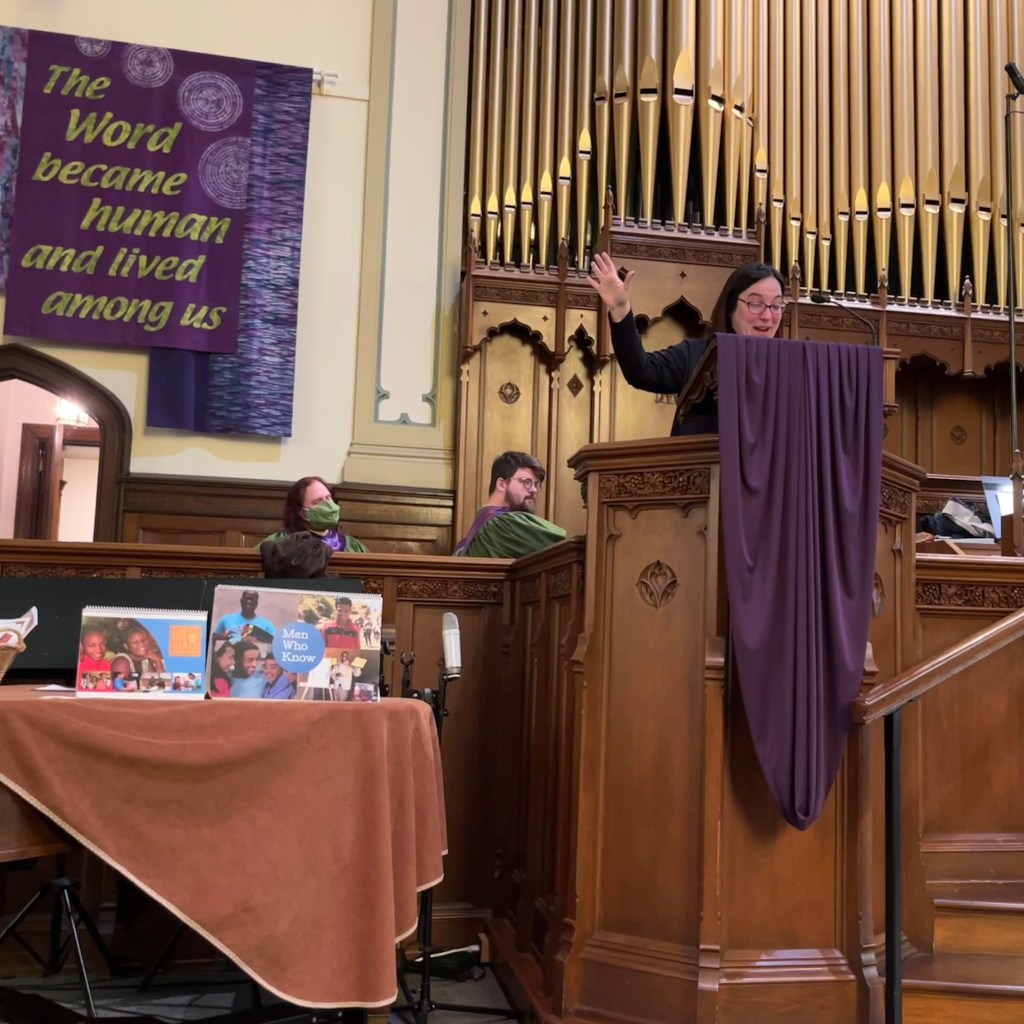
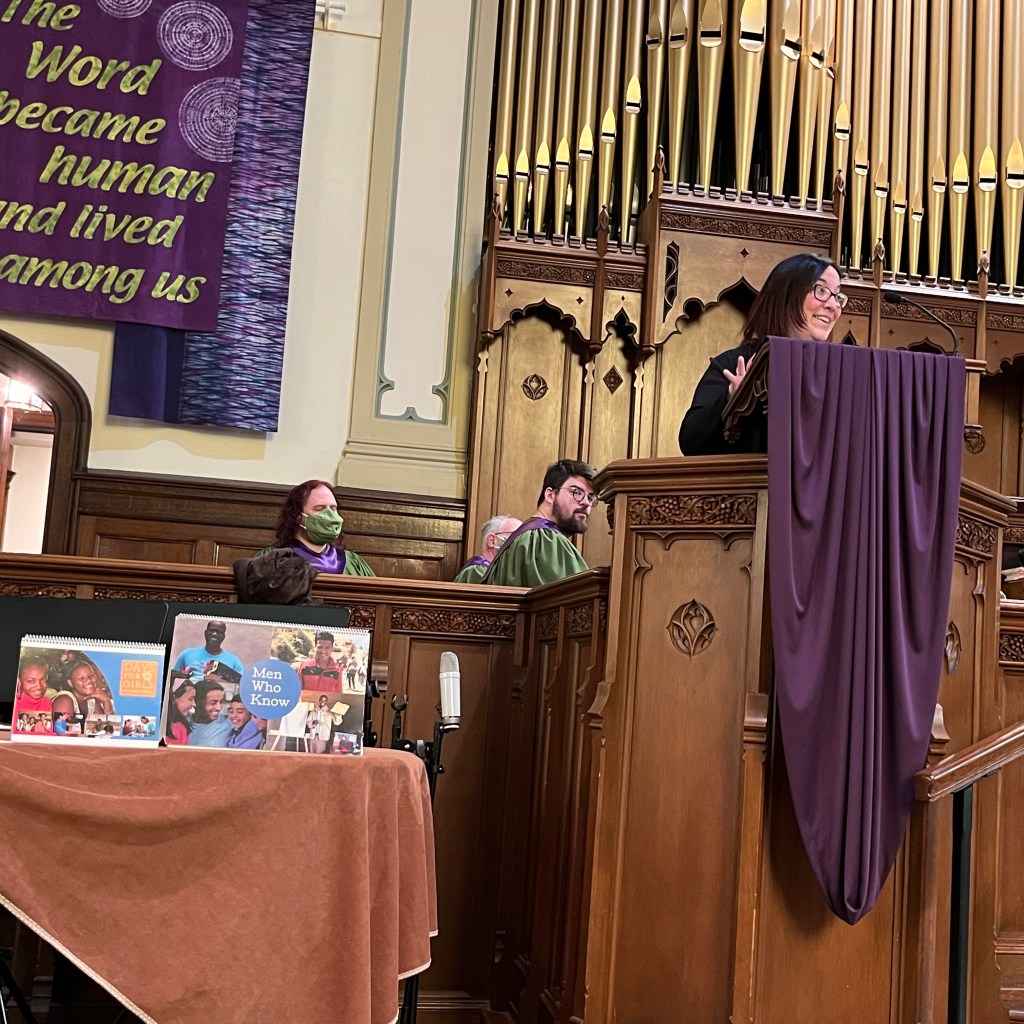
Below is the script that is most of what I said (I can’t help but deviate a little).
The Days for Girls Mission is simple: creating a more dignified, free and educated world through access to lasting menstrual health. Our tagline is: Every Girl. Everywhere. Period.
Each standard Days for Girls washable kit includes: 2 waterproof shields, 8 liners, 2 panties, 1 carry pouch, a 100% cotton wash cloth, a small bar of soap, and an ovulation chart and directions, all packaged in a drawstring bag. Those are the things you can see. What you might not notice immediately is that those kits also contain: dignity, education, and independence.
Women and girls around the world are vulnerable, especially when they are menstruating and don’t have a way to manage the flow. Periods are a social taboo in many parts of the world and each place has its unique social customs to navigate. In some places in our world, menstruating girls and women are separated from their families, their communities, and the safety those groups provide.
But there is hope. When girls have access to menstrual products, they stay in school longer. When girls finish school, they are less likely to marry at a young (childhood) age, they are more likely to delay having children until their bodies are fully developed, and they have healthier, happier children. Having access to these washable pads frees people from systemic poverty by giving girls more days in school and women more days at work. When women are educated, they improve the lives of their families and communities in all areas of health, wellness, and prosperity. This is social justice work.
Periods aren’t often talked about in public spaces so period poverty is an invisible problem. Every person I know who has had menstrual cycles has had at least one experience of not being able to afford what they needed or of not having access to products when they needed them. People with periods miss school or work when they don’t have access to products to help them manage their bleeding. Even people who can afford products sometimes have to leave school or work to purchase them. It’s important to advocate for period products to be free in easily accessible in schools, prisons, and public restrooms. Businesses can also become period positive workplaces by stocking bathrooms with period products, meeting WHO’s Global Water, Sanitation & Hygiene standards and recording in an employee handbook, benefits plan, or company policy that products will be made available to employees. Companies who have put this into practice have noticed higher productivity and less absenteeism.
Most places in the US that provide menstrual products typically provide disposables, but I think more of us should advocate for washable options to be available. Washable menstrual products are better for the environment, bodies, and in the long run save money. It is the smart girls’ choice.
When I’ve used washable pads, I’ve also noticed they don’t smell as bad a disposable. I like using a menstrual cup and being connected to my menstruation because I’m learning more about my body. And the more I share my experience with using a cup, or period underwear, or washable pads, I am destigmatizing menstruating bodies. I’ve noticed that by being open and honest about my own experiences, other people begin to share their experiences. And talking about periods becomes a pathway to talking about other sensitive issues. Talking about periods creates safe spaces.
There is a room (recently relocated to First United Methodist Church) where anyone can come and feel safe and loved no matter what it is they need to talk about. In many ways it’s a sanctuary, a safe place, a place full of love and support, and a place where sorrow and gratitude are held by the gathered community.
It took me a long time to realize our Days for Girls team was creating a safe space for people who needed because I was focused on inviting people in with the purpose of making kits and sending them to the people we were trying to help. Maybe I was too focused on helping other people to see what was happening with the people around me.
When I started this Days for Girls journey, I Imagined, me and Jesus, and the volunteers making kits to send to 12-year-old girls who would need these to improve the trajectory of their lives. It was a clear path. We make the kits, they go to girls about to get their first period, and then those girls don’t have to miss school because of their period. They can continue their education, delay marriage and the start of their family until after they have completed school. When girls are educated, their communities are lifted out of poverty.
We had great success in our first sewing day, but also a lot of half-finished kits, so we needed to do another sewing event, and then another. Eventually, we registered with DFG as the Pittsburgh Chapter and other people found us. Students who needed service hours, women from the community correction center and rehab centers, people with special needs, and others who needed service hours or just wanted to do good in the world. The sewing room was getting crowded.
The Days for Girls project became so much more than I imagined. I thought that the path was clear. It would be me, and Jesus, and the volunteers working on kits, raising money to go on a trip so I could place those kits into the hands of 12-year-old girls, changing their lives forever. But now, there is a crowd of people pressing on us from all sides and Jesus suddenly stops and says who touched me. What do you mean Jesus? With all of these other people in the sewing room making kits, of course someone touched you, we’re busy here. Keep sewing, keep ironing, keep packing, we have to get to that little girl. Remember Jesus? The plan is, make the kits, fundraise, get on a plane, put the kit in the hand of a 12-year-old girl, we don’t have time to stop. We have to help vulnerable women. We have to empower little girls. We have to enable them to break the system that holds them back. But Jesus stops. He looks around. Who touched me? What do you mean Jesus? Jesus says, someone touched me, I felt healing happen. No Jesus, you didn’t, we are on the way to healing the world. Remember the little girl. Jesus stops. No, someone was healed just now. Who touched me?
Who touched me? And for a moment I can see the room through Jesus’ eyes. The project that I thought was leading us to help a 12-year-old girl, is really two missions that connect. The mission is about the 12-year-old girl, but the mission is also about how we get to her and who is with us along the way. Centering women, healing, restoring community is the goal and it is the way to the goal.
Jesus asks who touched me to make us look around. He takes a moment to center the marginalized woman. He healed her physically, he listened to her and centered her for a moment in the social group, he praised her faith, he called her beloved daughter. Jesus is a wholistic healer. He models for us centering the marginalized, listening to the voice of the oppressed, honoring all persons as beloved members of our family. So, our Days for Girls mission hasn’t changed, but we have paused and looked around, realizing that those who are among us as partners in service need healing too.
In Luke, we are presented with two beautiful stories about women who had managed to find healing through Jesus. One about a little girl who is sick and eventually dies while waiting for her loved ones to bring Jesus to her. She is healed (and brought back to life) despite the laughter and scorn that greets Jesus when he finally arrives.
The other is about a woman who through sheer will, and persistence, reached out for something bigger than herself when all else seemed lost. She is healed on the way. Jesus’ ministry of healing and reconciliation is for all along the way and not just for some at the end of the journey. And healing, faith, and reconciliation are all things that look different for everyone. The community that is looking for healing is finding it in those who are seeking healing too. When Jesus asks who touched me, we might ask who else has realized she needs help? Who else knows she can’t do this life on her own? Who else needs a community and a higher power?
Ministry isn’t always what I think it is going to be. Sometimes ministry happens when ministry is interrupted. What we thought was going to be a mission project to empower women, became a mission project that empowers women who work to empower women. What we thought was a service project to help girls and women “out there” became a community of women working for healing, purpose, and love here in Pittsburgh. It is a group with the goal to help the 12-year-old girl at the receiving end of the kit, and it is a group with a goal to journey together to make the kit.
And together we have created a unique community where everyone is valued, encouraged, empowered, and most importantly, loved. It’s a community that no matter how you arrived, you leave different, maybe even healed.
My hope and prayer for you, is that you might see the multiple layers of ministry as they emerge. When you volunteer with Days for Girls or somewhere else, I hope you connect with each other, share stories, open your hearts, invite your neighbors, and mostly importantly remember that mission is also about those who travel the way with us.
Life is short and there is only a little time to gladden the hearts of those who travel the way with us. So be swift to love and make hast to be kind. Go forth into the world rejoicing in the power of the Holy Spirit.

 Period Pastor Pad