The earth is yours, O Giver of Life, in all its fulness and glory,
the world and all those who dwell therein;
For You have founded it upon the seas, and established it upon the rivers.
Who shall ascend your hill, O Gracious One? and who shall stand in your holy place?
All who have clean hands and pure hearts,
who do not lift up their souls to what is false, nor make vows deceitfully.
All these will be blessed by the Heart of Love, and renewed through forgiveness.
Such is the promise to those who seek Love’s face.
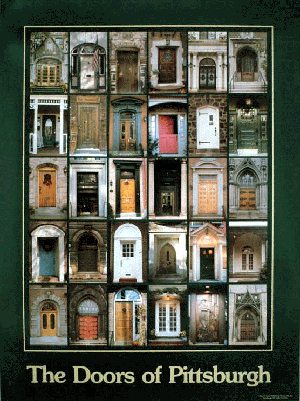
Lift up your heads, O gates! and be lifted up, O ancient doors!
that the Compassionate One may come in.
Who is the Compassionate One?
The Beloved, strong and steadfast, the Beloved, firm and sure!
Lift up your heads, O gates! and be lifted up, O ancient doors!
that the Compassionate One may come in!
Who is this Compassionate One?
The Beloved, Heart of your heart, Life of you Life,
this is the Compassionate One!
Nan C. Merrill Psalms for Praying
Reflection:
Who can enter the temple? Who can worship in the holy place? Those who obey the torah, the word of God. They will have clean hands and pure hearts. Having clean hands means we have not wronged our neighbor. Having a pure heart means that we love God. When stated simply, when we love God and others, we are worthy to be in the temple, and worthy for God to enter into our hearts.
But even using words like “obedience” and “worthiness” in a gentle way cause many of us to bristle. These words have been used by those in power in religious institutions to control and oppress people who are simply trying their best to do the right thing. Oppressive religious groups and cults insist on obedience to the leader as being the way to obey God. Their disciples’ worthiness is determined by how much they comply with leadership, and in extreme cases, how much abuse they withstand.
I want to be clear, you don’t have to do or be or believe “correctly” in order to earn love from God or from others. Have we found helpful practices and prayers that aid us in living life in a way that honors God? Sure. But keep in mind, there is no “one and only true way”. There are as many ways to worship God as there are beloved people of God. God is not taking attendance. God is not making a list and checking it twice to decide who is in and who is out. God is not dictating every minutia of your actions. God is love.
God loves you just the way you are. The best way to respond to that love is to simply be you. Sometimes, our response to God is simply to rest and know that we are loved. Sometimes, our response to God is to be compassionate towards others. Sometimes, our response to God is worship and community service. And these responses will be different for each of us.
My hope is that in reading this reflection you have found peace in God who calms the chaos. I hope that you can love yourself as God loves you. I hope you have love overflowing, and that your compassion will have no end.
Lift up your heads, O gates! and be lifted up, O ancient doors!
that the Compassionate One may come in!
Psalm reflections can be listened to on the Period Pastor Podcast series, Like One who Watches for the Morning. In the podcast I read both the NRSVUE and Nan C. Merrill’s Psalms for Praying in addition to the reflection you see here.
I began writing Psalm reflections during Lent of 2020 shortly after we decided to close the church building, work from home, and worship via zoom. It is a practice I have continued since. Many churches use the Revised Common Lectionary (RLC) that rotates scripture on a three-year cycle (A, B, and C). Starting in Advent 2019, Third Church decided to worship with the texts from Year D, which is still not circulated as are years A, B, and C. Year D was created with the goal of including scriptures that were left out or not used as frequently as others. While we were using Psalms in year D, most other lectionary followers were using Year A. In Advent of 2020 we rejoined those who use the lectionary in year B. Advent of 2021 year C. Advent of 2022 year A. Advent of 2023 year B.
I use the Vanderbilt Divinity Library’s resource for lectionary readings to make text selections.
Year B Psalms
Advent – Transfiguration: 1st Sunday in Advent Psalm 80, 2nd Sunday in Advent Psalm 85, 3rd Sunday in Advent Psalm 126, 4th Sunday in Advent Psalm 89, Christmas Eve or Christmas Day Psalm 96, Psalm 97, Psalm 98, 1st Sunday after Christmas, Psalm 148, New Year’s Day Psalm 8, Epiphany Psalm 72, 1st Sunday after Epiphany Psalm 29, 2nd Sunday after Epiphany Psalm 139, 3rd Sunday after Epiphany Psalm 62, 4th Sunday after Epiphany Psalm 111, 5th Sunday after Epiphany Psalm 147, Transfiguration Sunday (Sunday before Lent) Psalm 50
Lent: Ash Wednesday Psalm 51, 1st Sunday in Lent Psalm 25, 2nd Sunday in Lent Psalm 22, 3rd Sunday in Lent Psalm 19, 4th Sunday in Lent Psalm 107, 5th Sunday in Lent Psalm 51 or Psalm 119:9-16, 6th Sunday in Lent (Palm or Passion Sunday) Psalm 118 or 31
Holy Week: Monday Psalm 36, Tuesday Psalm 71, Wednesday Psalm 70, Maundy Thursday Psalm 116, Good Friday Psalm 22, Holy Saturday Psalm 31
Easter: Easter Psalm 118 or 114, 2nd Sunday of Easter Psalm 133, 3rd Sunday of Easter Psalm 4, 4th Sunday of Easter Psalm 23, 5th Sunday of Easter Psalm 22, 6th Sunday of Easter Psalm 98, Ascension Psalm 47 or Psalm 93, 7th Sunday of Easter Psalm 1, Day of Pentecost Psalm 104
Season After Pentecost (Ordinary Time): 1st Sunday after Pentecost (Trinity Sunday) Psalm 29, 2nd Sunday after Pentecost Psalm 139 or Psalm 81, 3rd Sunday after Pentecost Psalm 138 or Psalm 130, 4th Sunday after Pentecost Psalm 20 or Psalm 92, 5th Sunday after Pentecost Psalm 9 or Psalm 133 or Psalm 107, 6th Sunday after Pentecost Psalm 130 or Psalm 30, 7th Sunday after Pentecost Psalm 48 or Psalm 123, 8th Sunday after Pentecost Psalm 24 or Psalm 85, 9th Sunday after Pentecost Psalm 89 or Psalm 23, 10th Sunday after Pentecost Psalm 14 or Psalm 145, 11th Sunday after Pentecost Psalm 51 or Psalm 78, 12th Sunday after Pentecost Psalm 130 or Psalm 34, 13th Sunday after Pentecost Psalm 111 or Psalm 34, 14th Sunday after Pentecost Psalm 84 or Psalm 34, 15th Sunday after Pentecost Psalm 45 or Psalm 15, 16th Sunday after Pentecost Psalm 125 or Psalm 146, 17th Sunday after Pentecost Psalm 19 or Psalm 116, 18th Sunday after Pentecost Psalm 1 or Psalm 54, 19th Sunday after Pentecost Psalm 124 or Psalm 19, 20th Sunday after Pentecost Psalm 26 or Psalm 8, 21st Sunday after Pentecost Psalm 22 or Psalm 90, 22nd Sunday after Pentecost Psalm 104 or Psalm 91, 23rd Sunday after Pentecost Psalm 34 or Psalm 126, 24th Sunday after Pentecost Psalm 146 or 119, 25th Sunday after Pentecost Psalm 127 or Psalm 146, 26th Sunday after Pentecost Psalm 16, 27th Sunday after Pentecost (Christ the King) Psalm 132 or Psalm 93.
Sources and notes:
“Clean hands are those innocent of wrong against others. The pure heart this and wills only fealty to the LORD (73:1; Matt. 5:8). Those who do not lift up their should to what is false are faithful to the true God and to truth…. The “one who does not swear deceitfully” is faithful to the neighbor. The four items in two pairs characterize a person who is faithful to god and neighbor. …. They portray the rendered life, a life disciplined by the confession that the LORD is owner of all, including self and neighbor, and oriented toward the coming of the king of glory.” Mays p. 121
“In Israel the purpose of coming to the sanctuary was to seek blessing and righteousness. So verse 5 continues instruction by emphasizing that it is the righteous who receive blessing and righteousness (NRVS, “vindication”) from god. Blessing is the divine gift of provision for and support of life. righteousness is the divine gift of acceptance into and renewal of a relation with God that enables and encourages human righteousness in loving. There is an important circle involved. The creator gives life and relationship in the first place, but it is those who respond by practicing rightness in the living who receive a renewal and confirmation from God. They keep the circular movement initiated by God unbroken.” Mays pp. 121-122
“In Psalm 24 the liturgy at the gates assumes the proclamation of the LORD’s reign based on his foundation of the earth by his might over seas and rivers. The LORD arrives at the gates that are both the everlasting doors to his heavenly palace and the entrance to the precincts of the temple on Zion. Entrance is demanded as recognition of his glory.” Mays p. 122
“Creation was a battle, and the LORD’s victory revealed his glorious kingship.” Mays p. 122
“It is especially important for verses 3-6 that righteousness, justice, steadfast love, and faithfulness are said to be features of the reign of the LORD of hosts. That explains the necessity of the character of the righteous for those who go to stand in his royal presence.” Mays p. 123
“The psalm also announces that the LORD “comes” to us. The LORD stands at the door and knocks (Rev. 3:20). He has come to be present with us and for us. He comes as the victor who has prevailed against he chaos of unbeing and so is able to prevail against the chaos of evil. That is good news. Unless he were there for us with this blessing and righteousness, we would have nowhere to go to find help to sustain and set right our lives. Our existence depends on his creation; our blessing and righteousness depend on his coming.” Mays p. 124
“These two psalms [15 and 24] taken alone may offend, because they suggest that only obedient persons may enter into God’s presence. But it is important to recall that this spirituality reflects only the well-oriented community, one that has not yet addressed a theologically ambiguous or morally disruptive world. Life here is still to be comprehended in coherent categories. Since life is theologically secure, it s not inappropriate that access to God be measured in terms of conformity to what is known, trusted, and found reliable. In such a properly functioning world, such expectations have credibility and importance. There is as of yet, no crisis of nomos, no sense of approaching anomie. In that world, one does not sense that God is morally indifferent. How human persons obey or disobey matters decisively.” Breuggeman, The Message of the Psalms p. 42
Alter Alter, Robert. 2007. The Book of Psalms: A Translation with Commentary New York: W. W. Norton & Company
WBC Allen, Leslie C. 1983. Word Biblical Commentary: Psalms 101-150. Vol. 21. Waco, TX: Word Books, Publisher.
Bonhoeffer, Dietrich. 1974. Psalms: The Prayer Book of the Bible. 8th ed. Minneapolis, MN: Augsburg Press.
Bourgeault, C. (2006). Chanting the psalms: A practical guide Audio Book. New Seeds.
Brueggemann, Walter. 2007. Praying the Psalms: Engaging Scripture and the Life of the Spirit. 2nd ed. Eugene, OR: Cascade.
Brueggemann Brueggemann, Walter. 2014. From Whom No Secrets Are Hid: Introducing the Psalms. Edited by Brent A. Strawn. 1st ed. Louisville, KY: Westminster John Knox Press.
Brueggemann, Walter. Davis Hanskins, Editor. 2022. Our Hearts Wait: Worshiping Through Praise and Lament in the Psalms Westminster John Knox Press, Louisville KY.
Brueggemann, Walter. (2002). Spirituality of the psalms. Augsburg Pub. House.
Brueggemann, Walter. (1984). The Message of the Psalms: A Theological Commentary. Minneapolis: Augsburg.
Chilson, Richard, ed. You Shall Not Want: A Spiritual Journey Based on the Psalms. Ave Maria Press, 2009.
Chittister Chittister, Joan. (2011). Songs of the heart: reflections on the psalms. John Garratt Publishing.
Cudjoe-Wilkes, G., Wilkes, A. J., & Moss, O. (2022). Psalms for black lives: Reflections for the work of Liberation. Upper Room Books.
WBC Craigie, Peter C. 1983. Psalms 1-50–Word Biblical Commentary. Vol. 19. Waco, TX: Word Books.
Creach Creach, Jerome Frederick Davis. 1998. Psalms: Interpretation Bible Studies. Louisville, KY: Westminster John Knox Press.
DAFLER, J. (2021). PSOBRIETY: A journey of recovery through the psalms. Louisville, KY: WESTMINSTER JOHN KNOX.
W de Claisse-Walford, Nancy L. WISDOM COMMENTARY: Psalms Bks. 4-5. Edited by Barbara E. Reid. Vol. 22. Collegeville, MN: Liturgical, 2020.
Green, Barbara. 1997. Like a Tree Planted: An Exploration of Psalms and Parables Through Metaphor. Collegeville, MN: Liturgical Press.
W Hopkins, Denise Dombkowski. WISDOM COMMENTARY: Psalms Bks. 2-3. Edited by Barbara E. Reid. Vol. 21. Collegeville, MN: Liturgical, 2016.
NIB Keck, Leander E. 2015. The New Interpreters Bible Commentary. Vol. 3. Nashville, TN: Abingdon Press.
Lewis, C. S. (2017). Reflections on the Psalms. Harper One, an imprint of Harper Collins Publishers.
Mays Mays, James Luther. 1994. Psalms. Louisville, KY: John Knox Press.
McCann McCann, J. C. (1993). A theological introduction to the book of Psalms: The Psalms as Torah. Nashville, TN: Abingdon Press.
McCann, J. C., & Howell, J. C. 2001. Preaching the Psalms. Nashville, TN: Abingdon Press.
Merrill, N. C. (2020). Psalms for praying an invitation to wholeness (10th Anniversary Edition ed.). London, England: Bloomsbury Publishing.
Miller Miller, Patrick D. 1986. Interpreting the Psalms. Philadelphia, PA: Fortress Press.
Morgan, Michael. 2010. The Psalter for Christian Worship Revised Edition. Westminster John Knox Press.
Schlimm Schlimm, Matthew Richard. 2018. 70 Hebrew Words Every Christian Should Know. Nashville, TN: Abington Press.
Spong Spong, M. (Ed.). (2020). The words of her mouth: Psalms for the struggle. Cleveland, OH: The Pilgrim Press.
WBC Tate, Marvin E. 1990. Word Biblical Commentary: Psalms 51-100. Edited by David Allan. Hubbard and Glenn W. Barker. Vol. 20. Waco, TX: Word.
Weems, Ann. 1995. Psalm of Lament. Westminster John Knox Pres
OTL Weiser, Artur. 1998. Old Testament Library: Psalms. Translated by Herbert Hartwell. 3rd ed. New York, NY: Manchester University Press.

 Period Pastor Pad