Unless You, O Divine Creator, build the house, those who build it labor in vain.
Unless You watch over the city, the watchers stay awake in vain.
For it is in co-operating with You from evening to morning,
Eating the bread of Life and Grace, that we rest in peace throughout the night.
Reverence the sacred gift of life that nourishes all.
Who will grow in wisdom, abandoning themselves to the Chalice of Love?
Who will open themselves to the imprint of Love’s gifts upon their heart?
Unless You, O Divine Spirit, make your home within us,
we wander through life in vain.
Nan C. Merrill Psalms for Praying
Reflection:
Vocation is a word that’s hard to define, it’s more than occupation, more than employment; it is an activity I am compelled to do. This call is the feeling or pull in a direction that seems to come from something beyond myself, a higher power, the universe, God. I have understood that God is calling me towards vocation. For a time, this calling felt linked to my job and the work that I was paid to do; pastor. While I was actively being paid to fill a pastoral position, my duties included providing for the worship and life of a particular congregation and helping them to engage in the community around them. I was co-creating with God as I built relationships and programs for this worshiping community.
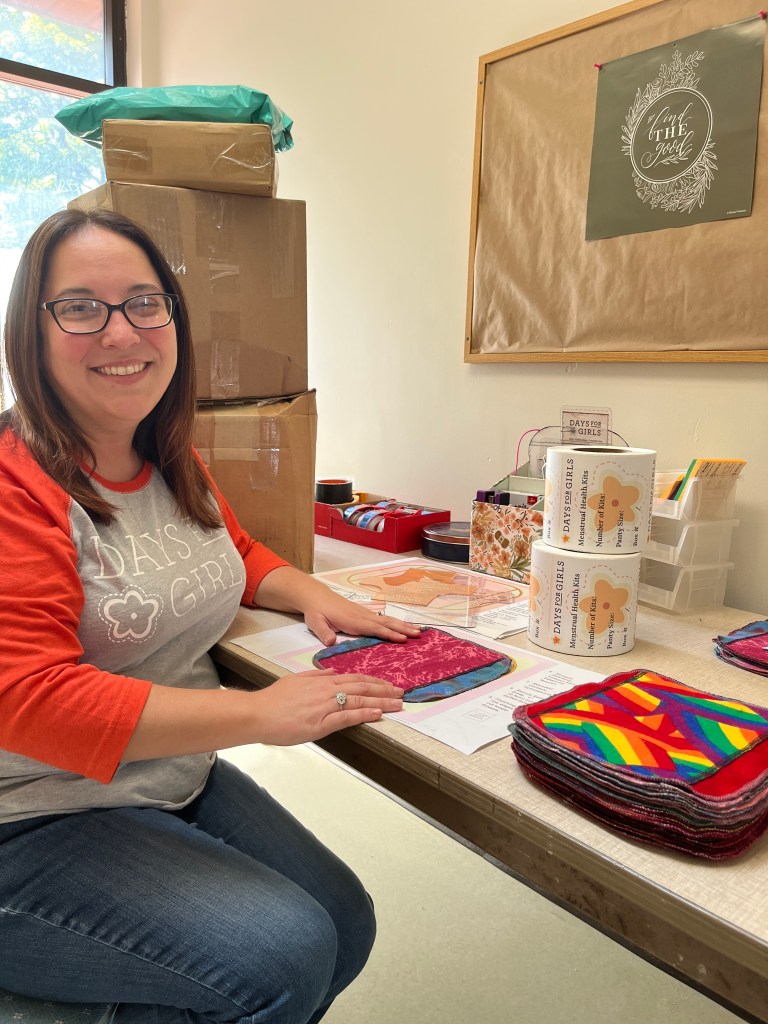
One of the building projects I worked on during my time as pastor, I continue to volunteer for in this “after pastor” unemployed season of my life. For me, Days for Girls, providing education, menstrual health resources, and washable pads to those who menstruate is work that I do not do in vain. Amid that building project there are other building projects: The building up of a community of women and men who want to co-create a better world. The building up of college students who are the bright hope of tomorrow. The building up of an interfaith community that sees the work we do for our neighbors as holy work.
My work with DfG gave me new language for vocation. Having a community that cares for one another is like having a box full of pins at the ready and a full bobbin. Living in a community doing what their higher power is calling them to do, well, that is like sewing for hours without having to seem rip a single stitch. Sewing and building community is linked for me.
Being part of DfG opened me up to a community of people who live out their vocations in different ways which allowed me to see new possibilities for how I can answer God’s call. I can see that the sacred gift of love and life God has given me can be expressed in a multitude of ways outside of the job of pastor. And now I feel called in a different way.
I’m called to travel and experience God in new ways; to be a pilgrim. I am called to education and advocacy efforts that make it possible for all people to be safe, healthy, and loved. I am called to use my energy, intelligence, imagination, and love to co-create with God. What exactly is it that I am co-creating, I have no idea, but what I do know is that God will be with me and God will be with us. We will not labor in vain.
Psalm reflections can be listened to on the Period Pastor Podcast series, Like One who Watches for the Morning. In the podcast I read both the NRSVUE and Nan C. Merrill’s Psalms for Praying in addition to the reflection you see here.
I began writing Psalm reflections during Lent of 2020 shortly after we decided to close the church building, work from home, and worship via zoom. It is a practice I have continued since. Many churches use the Revised Common Lectionary (RLC) that rotates scripture on a three-year cycle (A, B, and C). Starting in Advent 2019, Third Church decided to worship with the texts from Year D, which is still not circulated as are years A, B, and C. Year D was created with the goal of including scriptures that were left out or not used as frequently as others. While we were using Psalms in year D, most other lectionary followers were using Year A. In Advent of 2020 we rejoined those who use the lectionary in year B. Advent of 2021 year C. Advent of 2022 year A. Advent of 2023 year B.
I use the Vanderbilt Divinity Library’s resource for lectionary readings to make text selections.
Year B Psalms
Advent – Transfiguration: 1st Sunday in Advent Psalm 80, 2nd Sunday in Advent Psalm 85, 3rd Sunday in Advent Psalm 126, 4th Sunday in Advent Psalm 89, Christmas Eve or Christmas Day Psalm 96, Psalm 97, Psalm 98, 1st Sunday after Christmas, Psalm 148, New Year’s Day Psalm 8, Epiphany Psalm 72, 1st Sunday after Epiphany Psalm 29, 2nd Sunday after Epiphany Psalm 139, 3rd Sunday after Epiphany Psalm 62, 4th Sunday after Epiphany Psalm 111, 5th Sunday after Epiphany Psalm 147, Transfiguration Sunday (Sunday before Lent) Psalm 50
Lent: Ash Wednesday Psalm 51, 1st Sunday in Lent Psalm 25, 2nd Sunday in Lent Psalm 22, 3rd Sunday in Lent Psalm 19, 4th Sunday in Lent Psalm 107, 5th Sunday in Lent Psalm 51 or Psalm 119:9-16, 6th Sunday in Lent (Palm or Passion Sunday) Psalm 118 or 31
Holy Week: Monday Psalm 36, Tuesday Psalm 71, Wednesday Psalm 70, Maundy Thursday Psalm 116, Good Friday Psalm 22, Holy Saturday Psalm 31
Easter: Easter Psalm 118 or 114, 2nd Sunday of Easter Psalm 133, 3rd Sunday of Easter Psalm 4, 4th Sunday of Easter Psalm 23, 5th Sunday of Easter Psalm 22, 6th Sunday of Easter Psalm 98, Ascension Psalm 47 or Psalm 93, 7th Sunday of Easter Psalm 1, Day of Pentecost Psalm 104
Season After Pentecost (Ordinary Time): 1st Sunday after Pentecost (Trinity Sunday) Psalm 29, 2nd Sunday after Pentecost Psalm 139 or Psalm 81, 3rd Sunday after Pentecost Psalm 138 or Psalm 130, 4th Sunday after Pentecost Psalm 20 or Psalm 92, 5th Sunday after Pentecost Psalm 9 or Psalm 133 or Psalm 107, 6th Sunday after Pentecost Psalm 130 or Psalm 30, 7th Sunday after Pentecost Psalm 48 or Psalm 123, 8th Sunday after Pentecost Psalm 24 or Psalm 85, 9th Sunday after Pentecost Psalm 89 or Psalm 23, 10th Sunday after Pentecost Psalm 14 or Psalm 145, 11th Sunday after Pentecost Psalm 51 or Psalm 78, 12th Sunday after Pentecost Psalm 130 or Psalm 34, 13th Sunday after Pentecost Psalm 111 or Psalm 34, 14th Sunday after Pentecost Psalm 84 or Psalm 34, 15th Sunday after Pentecost Psalm 45 or Psalm 15, 16th Sunday after Pentecost Psalm 125 or Psalm 146, 17th Sunday after Pentecost Psalm 19 or Psalm 116, 18th Sunday after Pentecost Psalm 1 or Psalm 54, 19th Sunday after Pentecost Psalm 124 or Psalm 19, 20th Sunday after Pentecost Psalm 26 or Psalm 8, 21st Sunday after Pentecost Psalm 22 or Psalm 90, 22nd Sunday after Pentecost Psalm 104 or Psalm 91, 23rd Sunday after Pentecost Psalm 34 or Psalm 126, 24th Sunday after Pentecost Psalm 146 or 119, 25th Sunday after Pentecost Psalm 127 or Psalm 146, 26th Sunday after Pentecost Psalm 16, 27th Sunday after Pentecost (Christ the King) Psalm 132 or Psalm 93.
Sources and notes:
“Psalm 127 is the eighth in the collection of songs of ascents (see Psalms 120-134). It is composed of sayings that teach how dependent we mortals are on the LORD in the basic areas of ordinary life. Used as a song for pilgrims, the psalm acknowledges that dependence and discloses an important reason why the pilgrims make the journey to give thanks to the LORD (122:4).” Mays p. 400
“Eighth in the group of the fifteen Songs of Ascents, Psalm 127 is classified as a widow psalm, the first of three wisdom psalm s in the Songs of Ascents and one of six in book 5: Psalms 112, 119, 127, 128, 133, and 145. A wisdom psalm may be defined as one that “provides instruction in right living and right faith in the tradition of the other wisdom writings in the Hebrew Bible–Proverbs, Ecclesiastes, and Job. Additionally, Psalm 127 is on of only two psalms in the Psalter ascribed to Solomon, the other being Psalm 72. Its theme is found in the first verse of the psalm – “house” – a rich and multivalent word in biblical Hebrew, perhaps reflecting Solomon’s role in building the first Jerusalem temple.” W. pp 201-202
“Psalm 127 is most likely composed of two distinct proverbial sayings (vv. 1-2 and vv. 3-5), joined together by a common theme of building a “house”. Verse 5’s initial word “happy” marks it as a wisdom composition. “House” has a wide range of meanings in the Hebrew Bible. It can refer to family dwellings (Gen 19:2; Judg 11:31; 2 Kgs 4:2), to whole households (Gen 46:27; Ruth 1:8; Josh 7:18), to the whole people of Israel (Exod 40:38; 1 Kgs 20:31; Exek 36:22), to ruling dynasties (2 Sam 3:1; 7:11; 1 Kgs 16:3), and to the temple in Jerusalem (2 Kgs 22:3; Ezra 6:15; Jer 7:2).” W p. 202
“What we build and keep watch over, what we rise early for and stay up late tending matters only if God is involved. Children are indeed a “building project” of life. But as we see more couples struggling with infertility, more persons choosing a single lifestyle, more broken families, and more nonconventional relationships, we are called to expand the term “children” to include far more than our biological offspring. My “child” might be my niece or nephew who can no longer live with a biological parent; a project to provide adequate food an shelter to homeless women and children; weekly visits with folks in assisted living facilities; tutoring young students who struggle to learn; fostering a child who needs a stable home life; mentoring the teen who lives down the street and seems to have lost his way. These children, these “building projects,” are the sources of one’s happiness in life (v.5) for which God gives restful sleep (v 2).” W p. 205
Alter Alter, Robert. 2007. The Book of Psalms: A Translation with Commentary New York: W. W. Norton & Company
WBC Allen, Leslie C. 1983. Word Biblical Commentary: Psalms 101-150. Vol. 21. Waco, TX: Word Books, Publisher.
Bonhoeffer, Dietrich. 1974. Psalms: The Prayer Book of the Bible. 8th ed. Minneapolis, MN: Augsburg Press.
Bourgeault, C. (2006). Chanting the psalms: A practical guide Audio Book. New Seeds.
Brueggemann, Walter. 2007. Praying the Psalms: Engaging Scripture and the Life of the Spirit. 2nd ed. Eugene, OR: Cascade.
Brueggemann Brueggemann, Walter. 2014. From Whom No Secrets Are Hid: Introducing the Psalms. Edited by Brent A. Strawn. 1st ed. Louisville, KY: Westminster John Knox Press.
Brueggemann, Walter. Davis Hanskins, Editor. 2022. Our Hearts Wait: Worshiping Through Praise and Lament in the Psalms Westminster John Knox Press, Louisville KY.
Brueggemann, Walter. (2002). Spirituality of the psalms. Augsburg Pub. House.
Brueggemann, Walter. (1984). The Message of the Psalms: A Theological Commentary. Minneapolis: Augsburg.
Chilson, Richard, ed. You Shall Not Want: A Spiritual Journey Based on the Psalms. Ave Maria Press, 2009.
Chittister Chittister, Joan. (2011). Songs of the heart: reflections on the psalms. John Garratt Publishing.
Cudjoe-Wilkes, G., Wilkes, A. J., & Moss, O. (2022). Psalms for black lives: Reflections for the work of Liberation. Upper Room Books.
WBC Craigie, Peter C. 1983. Psalms 1-50–Word Biblical Commentary. Vol. 19. Waco, TX: Word Books.
Creach Creach, Jerome Frederick Davis. 1998. Psalms: Interpretation Bible Studies. Louisville, KY: Westminster John Knox Press.
DAFLER, J. (2021). PSOBRIETY: A journey of recovery through the psalms. Louisville, KY: WESTMINSTER JOHN KNOX.
W de Claisse-Walford, Nancy L. WISDOM COMMENTARY: Psalms Bks. 4-5. Edited by Barbara E. Reid. Vol. 22. Collegeville, MN: Liturgical, 2020.
Green, Barbara. 1997. Like a Tree Planted: An Exploration of Psalms and Parables Through Metaphor. Collegeville, MN: Liturgical Press.
W Hopkins, Denise Dombkowski. WISDOM COMMENTARY: Psalms Bks. 2-3. Edited by Barbara E. Reid. Vol. 21. Collegeville, MN: Liturgical, 2016.
NIB Keck, Leander E. 2015. The New Interpreters Bible Commentary. Vol. 3. Nashville, TN: Abingdon Press.
Lewis, C. S. (2017). Reflections on the Psalms. Harper One, an imprint of Harper Collins Publishers.
Mays Mays, James Luther. 1994. Psalms. Louisville, KY: John Knox Press.
McCann McCann, J. C. (1993). A theological introduction to the book of Psalms: The Psalms as Torah. Nashville, TN: Abingdon Press.
McCann, J. C., & Howell, J. C. 2001. Preaching the Psalms. Nashville, TN: Abingdon Press.
Merrill, N. C. (2020). Psalms for praying an invitation to wholeness (10th Anniversary Edition ed.). London, England: Bloomsbury Publishing.
Miller Miller, Patrick D. 1986. Interpreting the Psalms. Philadelphia, PA: Fortress Press.
Morgan, Michael. 2010. The Psalter for Christian Worship Revised Edition. Westminster John Knox Press.
Schlimm Schlimm, Matthew Richard. 2018. 70 Hebrew Words Every Christian Should Know. Nashville, TN: Abington Press.
Spong Spong, M. (Ed.). (2020). The words of her mouth: Psalms for the struggle. Cleveland, OH: The Pilgrim Press.
WBC Tate, Marvin E. 1990. Word Biblical Commentary: Psalms 51-100. Edited by David Allan. Hubbard and Glenn W. Barker. Vol. 20. Waco, TX: Word.
Weems, Ann. 1995. Psalm of Lament. Westminster John Knox Pres
OTL Weiser, Artur. 1998. Old Testament Library: Psalms. Translated by Herbert Hartwell. 3rd ed. New York, NY: Manchester University Press.

 Period Pastor Pad