Enter into the Silence, into the Heart of Truth;
For therein lies the Great Mystery where life is ever unfolding;
Herein the Divine Plan is made known, the Plan all are invited to serve.
Listen for the Music of the Spheres in the resounding Silence of the universe.
May balance and harmony be your aim as you are drawn into the Heart of Love.
Those who follow the way of Love with calm and faith-filled intent,
Know that all is working toward healing and wholeness.
And may the healing power of Love lift you from the limitations of fear and ignorance
into the arms of freedom.
May the peace of the Spirit bless you, and lead you on life’s journey.
Be not afraid of the Silence, for Wisdom’s Voice is heard there!
As you follow the Light, you become gentle and kind,
you come to live in the Light and see through Love’s eyes.
Children enter the world radiating the Spirit–learn from them of innocence and simplicity;
Learn to co-operate with the unseen realms, to see beyond the veil.
Wise are those who learn through silence; lear then to listen well.
For beyond the silence and stillness within,
you will come to know a profound and dazzling Silence–
Herein lies the Music of the Spheres, the harmony of creation.
Enter into the Sacred Altar within, converse with the Beloved in sweet communion.
Blessings of the Great Silence be with you as you help to rebuild the heart of the world with love!
Nan C. Merrill Psalms for Praying
14 This is my resting place forever;
here I will reside, for I have desired it.
15 I will abundantly bless its provisions;
I will satisfy its poor with bread.
16 Its priests I will clothe with salvation,
and its faithful will shout for joy.
Reflection:
Where does God dwell?
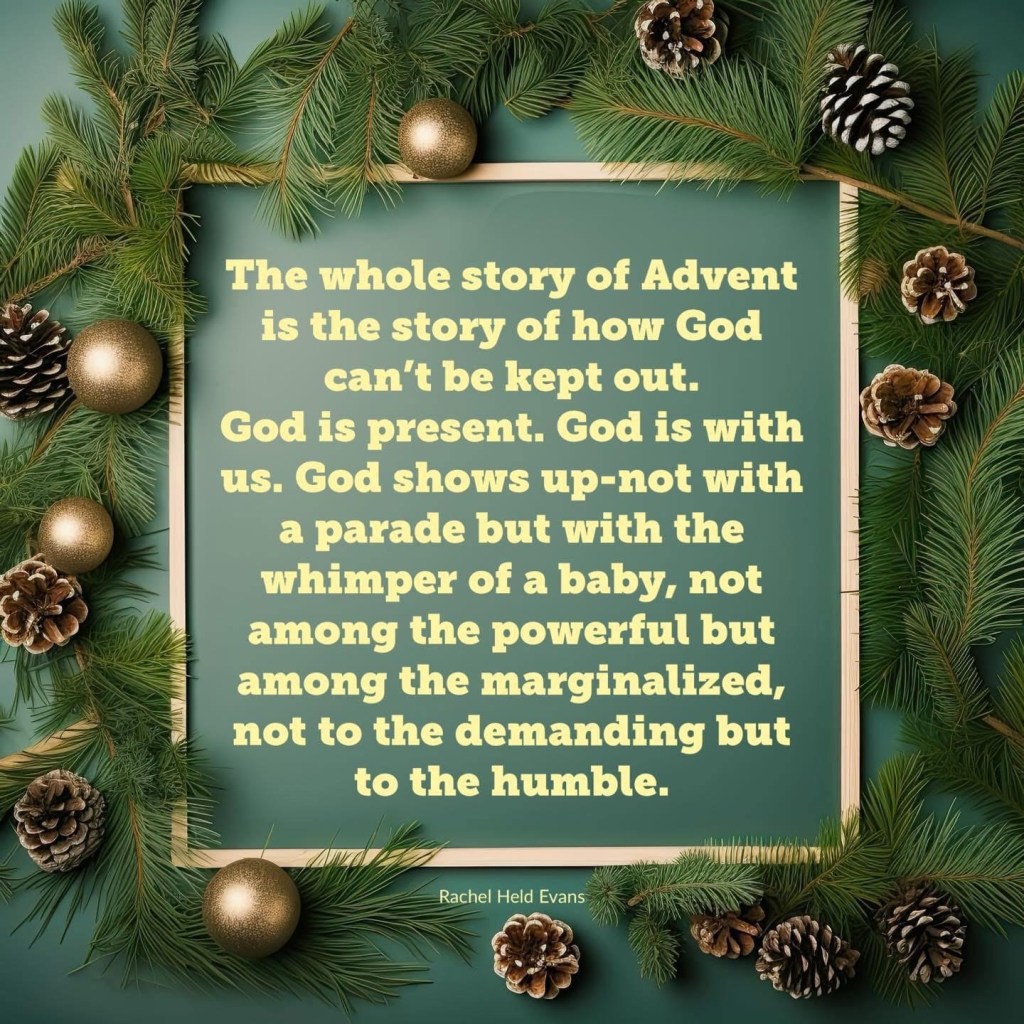
In the Christian church, advent is the season that prepares for the incarnation, the time when we see that God dwells with us (Emmanuel) in human form, in the one we call Jesus. Christians are also taught that God lives in our hearts and in all of creation. How this is possible is a great mystery that people have been trying to describe or understand. While no one has landed on the “right answer” if there even is one, I’ll offer some thoughts on the music of the spheres as a way to think of the vibrations that we feel on a deep level resonating in us and in the universe.
One of the ways we express the idea of divine presence is with the phrase, music of the spheres, which Nan Merrill mentions in her psalm and is a phrase I’ve heard in hymns and other church liturgy.
Outside of the Christian tradition, philosophers and scientists have theorized how we are connected with the universe this way, Musica universalis or music of the spheres ” is a philosophical concept that regards proportions in the movements of celestial bodies—the Sun, Moon, and planets—as a form of music. The theory, originating in ancient Greece, was a tenet of Pythagoreanism, and was later developed by 16th-century astronomer Johannes Kepler. Kepler did not believe this “music” to be audible, but felt that it could nevertheless be heard by the soul.”
Psalm 132: 14, 16 affirms that God is residing with us, in the entire universe, and in specific spaces where we are most aware of the divine presence. But the important part is verse 15, God is dwelling with us to bless the marginalized and to provide for their needs. God’s presence is for the benefit of those who suffer. My hope is that those of us who seek a connection with the divine will find it in each other and in meeting each other’s needs.
Psalm reflections can be listened to on the Period Pastor Podcast series, Like One who Watches for the Morning. In the podcast I read both the NRSVUE and Nan C. Merrill’s Psalms for Praying in addition to the reflection you see here.
I began writing Psalm reflections during Lent of 2020 shortly after we decided to close the church building, work from home, and worship via zoom. It is a practice I have continued since. Many churches use the Revised Common Lectionary (RLC) that rotates scripture on a three-year cycle (A, B, and C). Starting in Advent 2019, Third Church decided to worship with the texts from Year D, which is still not circulated as are years A, B, and C. Year D was created with the goal of including scriptures that were left out or not used as frequently as others. While we were using Psalms in year D, most other lectionary followers were using Year A. In Advent of 2020 we rejoined those who use the lectionary in year B. Advent of 2021 year C. Advent of 2022 year A. Advent of 2023 year B.
I use the Vanderbilt Divinity Library’s resource for lectionary readings to make text selections.
Year B Psalms
Advent – Transfiguration: 1st Sunday in Advent Psalm 80, 2nd Sunday in Advent Psalm 85, 3rd Sunday in Advent Psalm 126, 4th Sunday in Advent Psalm 89, Christmas Eve or Christmas Day Psalm 96, Psalm 97, Psalm 98, 1st Sunday after Christmas, Psalm 148, New Year’s Day Psalm 8, Epiphany Psalm 72, 1st Sunday after Epiphany Psalm 29, 2nd Sunday after Epiphany Psalm 139, 3rd Sunday after Epiphany Psalm 62, 4th Sunday after Epiphany Psalm 111, 5th Sunday after Epiphany Psalm 147, Transfiguration Sunday (Sunday before Lent) Psalm 50
Lent: Ash Wednesday Psalm 51, 1st Sunday in Lent Psalm 25, 2nd Sunday in Lent Psalm 22, 3rd Sunday in Lent Psalm 19, 4th Sunday in Lent Psalm 107, 5th Sunday in Lent Psalm 51 or Psalm 119:9-16, 6th Sunday in Lent (Palm or Passion Sunday) Psalm 118 or 31
Holy Week: Monday Psalm 36, Tuesday Psalm 71, Wednesday Psalm 70, Maundy Thursday Psalm 116, Good Friday Psalm 22, Holy Saturday Psalm 31
Easter: Easter Psalm 118 or 114, 2nd Sunday of Easter Psalm 133, 3rd Sunday of Easter Psalm 4, 4th Sunday of Easter Psalm 23, 5th Sunday of Easter Psalm 22, 6th Sunday of Easter Psalm 98, Ascension Psalm 47 or Psalm 93, 7th Sunday of Easter Psalm 1, Day of Pentecost Psalm 104
Season After Pentecost (Ordinary Time): 1st Sunday after Pentecost (Trinity Sunday) Psalm 29, 2nd Sunday after Pentecost Psalm 139 or Psalm 81, 3rd Sunday after Pentecost Psalm 138 or Psalm 130, 4th Sunday after Pentecost Psalm 20 or Psalm 92, 5th Sunday after Pentecost Psalm 9 or Psalm 133 or Psalm 107, 6th Sunday after Pentecost Psalm 130 or Psalm 30, 7th Sunday after Pentecost Psalm 48 or Psalm 123, 8th Sunday after Pentecost Psalm 24 or Psalm 85, 9th Sunday after Pentecost Psalm 89 or Psalm 23, 10th Sunday after Pentecost Psalm 14 or Psalm 145, 11th Sunday after Pentecost Psalm 51 or Psalm 78, 12th Sunday after Pentecost Psalm 130 or Psalm 34, 13th Sunday after Pentecost Psalm 111 or Psalm 34, 14th Sunday after Pentecost Psalm 84 or Psalm 34, 15th Sunday after Pentecost Psalm 45 or Psalm 15, 16th Sunday after Pentecost Psalm 125 or Psalm 146, 17th Sunday after Pentecost Psalm 19 or Psalm 116, 18th Sunday after Pentecost Psalm 1 or Psalm 54, 19th Sunday after Pentecost Psalm 124 or Psalm 19, 20th Sunday after Pentecost Psalm 26 or Psalm 8, 21st Sunday after Pentecost Psalm 22 or Psalm 90, 22nd Sunday after Pentecost Psalm 104 or Psalm 91, 23rd Sunday after Pentecost Psalm 34 or Psalm 126, 24th Sunday after Pentecost Psalm 146 or 119, 25th Sunday after Pentecost Psalm 127 or Psalm 146, 26th Sunday after Pentecost Psalm 16, 27th Sunday after Pentecost (Christ the King) Psalm 132 or Psalm 93.
Sources and notes:
Psalm 132 can be linked to the events recorded in 2 Samuel 7.
“Psalm 132 calls to our remembrance two important elements of identity for ancient Israelites: a dwelling place for God and the kingship of David–temple and court. The prayer of verses 1-10 and the response of assurance in verses 11-18 give hope to the post exilic pilgrims to Jerusalem that God is indeed dwelling among them. Temple and court may be foreign concepts to Christians today, but J. Clinton McCann suggests that we see in the words of Psalm 132 a reminder that God’s presence among us is real and concrete, occupying both time and space.” W. p 223
“… Psalm 132 brings the past to the present and the present to the past reminds us that God’s presence among us occupies both time and space. Each of us is heir to a particular past and present, a particular time and space in which we experience the ebb and flow of God’s absence and presence. In the times when God seems absent the memory of God’s presence in the past, in one time and space, can give us the strength to move through the absence to presence once again in this time and this space. But what about those who are emotionally and physically abused, those who live in constant despair and fear, the hungry, the homeless? For those who live in the “privileged” world, perhaps the words of Psalm 132 can be a reminder that “all Israel” is included in the promises of the psalm: all are entitled to “shout for joy” (vv. 9 and 16) and to have “provisions” and “bread” (v. 15). The words of Psalm 132 can be a clarion cry to envision a “dwelling place” or multiple “dwelling places” for YHWH realized among all people.” W pp. 223-224
In the context of the songs of assets, Psalm 132 can have two functions. First, it stated the theological reason why Zion is the city “to which the tribes of the LORD go up” (122:4). The LORD rose up and went to this city as his “resting place” (v. 8). The pilgrims follow where their LORD has gone. “Resting place” is a term distinctive to this psalm as a destination of Zion. It means destination, goal of journey. “Finding a resting place” is coming home (84:3; Lam 1:3). Because Zion is all that for the LORD for the pilgrims it is also destination, culmination, coming home (see Psaml 84). Because the LORD has made Zion the place of blessing (vv. 15-16; see 133:3), the pilgrims come seeking the provisions and bread and salvation and joy to be found in the Presence. The psalm says that blessing is the gift of God; they come to receive.” Mays p. 411
“Second, the psalm serves the pilgrims as a liturgy of prayer and promise. It gives the clear impression that it belongs to a time when there was no successor to David on the throne of Judah. Zion is there, but the anointed of the LORD is not.” Mays p. 411
Alter Alter, Robert. 2007. The Book of Psalms: A Translation with Commentary New York: W. W. Norton & Company
WBC Allen, Leslie C. 1983. Word Biblical Commentary: Psalms 101-150. Vol. 21. Waco, TX: Word Books, Publisher.
Bonhoeffer, Dietrich. 1974. Psalms: The Prayer Book of the Bible. 8th ed. Minneapolis, MN: Augsburg Press.
Bourgeault, C. (2006). Chanting the psalms: A practical guide Audio Book. New Seeds.
Brueggemann, Walter. 2007. Praying the Psalms: Engaging Scripture and the Life of the Spirit. 2nd ed. Eugene, OR: Cascade.
Brueggemann Brueggemann, Walter. 2014. From Whom No Secrets Are Hid: Introducing the Psalms. Edited by Brent A. Strawn. 1st ed. Louisville, KY: Westminster John Knox Press.
Brueggemann, Walter. Davis Hanskins, Editor. 2022. Our Hearts Wait: Worshiping Through Praise and Lament in the Psalms Westminster John Knox Press, Louisville KY.
Brueggemann, Walter. (2002). Spirituality of the psalms. Augsburg Pub. House.
Brueggemann, Walter. (1984). The Message of the Psalms: A Theological Commentary. Minneapolis: Augsburg.
Chilson, Richard, ed. You Shall Not Want: A Spiritual Journey Based on the Psalms. Ave Maria Press, 2009.
Chittister Chittister, Joan. (2011). Songs of the heart: reflections on the psalms. John Garratt Publishing.
Cudjoe-Wilkes, G., Wilkes, A. J., & Moss, O. (2022). Psalms for black lives: Reflections for the work of Liberation. Upper Room Books.
WBC Craigie, Peter C. 1983. Psalms 1-50–Word Biblical Commentary. Vol. 19. Waco, TX: Word Books.
Creach Creach, Jerome Frederick Davis. 1998. Psalms: Interpretation Bible Studies. Louisville, KY: Westminster John Knox Press.
DAFLER, J. (2021). PSOBRIETY: A journey of recovery through the psalms. Louisville, KY: WESTMINSTER JOHN KNOX.
W de Claisse-Walford, Nancy L. WISDOM COMMENTARY: Psalms Bks. 4-5. Edited by Barbara E. Reid. Vol. 22. Collegeville, MN: Liturgical, 2020.
Green, Barbara. 1997. Like a Tree Planted: An Exploration of Psalms and Parables Through Metaphor. Collegeville, MN: Liturgical Press.
W Hopkins, Denise Dombkowski. WISDOM COMMENTARY: Psalms Bks. 2-3. Edited by Barbara E. Reid. Vol. 21. Collegeville, MN: Liturgical, 2016.
NIB Keck, Leander E. 2015. The New Interpreters Bible Commentary. Vol. 3. Nashville, TN: Abingdon Press.
Lewis, C. S. (2017). Reflections on the Psalms. Harper One, an imprint of Harper Collins Publishers.
Mays Mays, James Luther. 1994. Psalms. Louisville, KY: John Knox Press.
McCann McCann, J. C. (1993). A theological introduction to the book of Psalms: The Psalms as Torah. Nashville, TN: Abingdon Press.
McCann, J. C., & Howell, J. C. 2001. Preaching the Psalms. Nashville, TN: Abingdon Press.
Merrill, N. C. (2020). Psalms for praying an invitation to wholeness (10th Anniversary Edition ed.). London, England: Bloomsbury Publishing.
Miller Miller, Patrick D. 1986. Interpreting the Psalms. Philadelphia, PA: Fortress Press.
Morgan, Michael. 2010. The Psalter for Christian Worship Revised Edition. Westminster John Knox Press.
Schlimm Schlimm, Matthew Richard. 2018. 70 Hebrew Words Every Christian Should Know. Nashville, TN: Abington Press.
Spong Spong, M. (Ed.). (2020). The words of her mouth: Psalms for the struggle. Cleveland, OH: The Pilgrim Press.
WBC Tate, Marvin E. 1990. Word Biblical Commentary: Psalms 51-100. Edited by David Allan. Hubbard and Glenn W. Barker. Vol. 20. Waco, TX: Word.
Weems, Ann. 1995. Psalm of Lament. Westminster John Knox Pres
OTL Weiser, Artur. 1998. Old Testament Library: Psalms. Translated by Herbert Hartwell. 3rd ed. New York, NY: Manchester University Press.

 Period Pastor Pad