In You, O my Beloved, do I take refuge;
Let me never feel separated from You!
In your compassion come and refresh me; listen to my cry, answer my plea!
Be to me a rock, a tower of strength, a strong arm to uphold me,
as I abandon myself into your hands.
Be a very Presence to me as fear grips me, as I grow old and my friends leave me.
For You, O Friend, are my hope, my strength, since I was but a child.
Upon You have I trusted from my birth,
You, whom I knew before my mother’s womb.
I continually sing praises to You!
I have been burden to many; now in You alone will I trust.
I am filled with gratitude and sing your praises all the day.
Do not abandon me in my old age;
desert me not when my strength is spent, or when my mind plays tricks with me.
For fears rise up to confuse me, doubts and forgetfulness band together,
And say, “the Beloved no longer dwells with you; there is no one to stand by you.”
O Friend, be not far from me;
O Beloved, come and enfold me in your Presence!
Help me to release my fears.
Hear my prayer that theses fears may be transformed,
O You, who are my Counselor.
As I surrender myself into your hands, I praise You more and more.
I tell others of your goodness, of your compassion and grace all the day;
for your glory is beyond my understanding.
As I grow in inner peace and serenity,
I sing songs of thanksgiving to You, my Friend!
You who have done wondrous things, O Beloved, who is like You?
You who have seen me through my fears, strengthen me again;
From the depths of despair You renew my spirit,
You increase my trust, and You comfort me.
I praise you in the Silence of my heart, for your steadfast Love, O my Beloved!
I offer my prayers out to others, extending your Love.
My heart leas for joy, as I whisper to You in the night–
my soul also, which You renew within me is also glad.
And I tell my friends as well as strangers of your abounding grace and kindness.
For my fears have diminished, my strength has returned;
I will live my remaining years in peace.
Blessed be the Beloved, who dwells in all hearts!
Nan C. Merrill Psalms for Praying
Reflection:
Is this a complaint or a psalm of praise? Yes. It is both. It is a model of how faith is lived out amidst adversity. The psalmist is righteous and trusts in God, but the current situation is far from ideal. The psalmist needs a God who hears and believes her.
The Wisdom Commentary suggests the story of Susanna in the Apocrypha as inter text for Psalm 71. “Psalm 71 moves from petition and complaint to trust and praise three times: from vv. 1-4 to vv. 5-8 from vv. 9-13 to vv. 15-17; and from v. 18 to vv. 19-24, showing the persistence of the psalmist’s faith. This same persistence takes center stage in the Susanna story.” W p. 215
Psalm 71 is one of eight psalms that does not have a superscription. Anonymous is often a woman’s name, but there is no proof for or against that here. But, this psalm does fit Susanna’s story. She is raped, accused by her rapists of adultery with a strong man they couldn’t detain, sentenced to death, but then spared at the last moment. The Holy Spirit stirred in a man named Daniel and he insisted on questioning her accusers separately and it was found out that they were lying. They were executed and she was spared.
Susanna has a reputation for being righteous but is not believed.
I would love to make a sign that says, “Believe Women! Susanna 1:42-43”, for the next Women’s March. This text (along with Psalm 71:12-16) would preach in that context.
Speaking of political action, Rep. Lindsay Powell is introducing FACE legislation at the state level (Pennsylvania). If she is your rep., please reach out and tell her you support this legislation. You can reach out to your rep. and ask that they support FACE too. You can find your PA state elected officials and their contact information here. You can call in or email something like this “I’m asking [insert your elected official] to support Rep. Powell’s forthcoming legislation for the FACE Act on a statewide level to protect reproductive health access.”
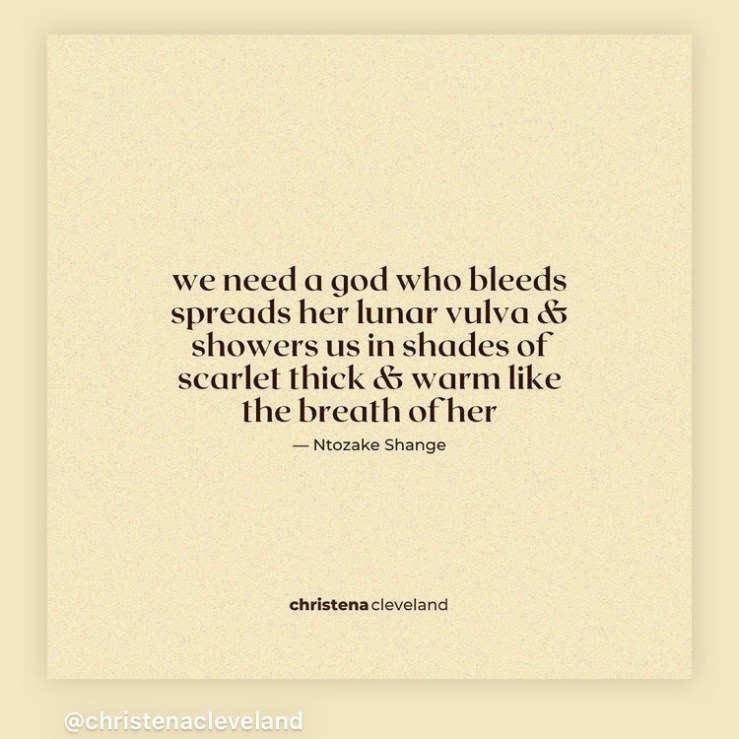
I need a God who believes women.
But more than that, I need a God who is not the old white man version of God.
Christena Cleveland‘s book “God is a Black Woman” is a book I would highly recommend. Christen goes on a pilgrimage to see Black Madonnas (and I love a pilgrimage story) but more than that she discovers the Black Sacred Feminine. I read it in the summer of 2023 and it helped me to understand feminism and God in a new way. Here is the description from her website: “For years, theologian, social psychologist, and activist Christena Cleveland spoke about “racial reconciliation” to congregations, justice organizations, and colleges. Yet over time, she felt she could no longer trust in the God she’d been taught to worship—a God who, she realized, did not affirm a Black woman like Christena. Her crisis of faith sent her on an intellectual and spiritual journey through history and across France, on a 400-mile walking pilgrimage to the ancient shrines of Black Madonnas where she discovered the healing power of the Sacred Black Feminine. In recounting her mystical journey, Christena reveals how America’s collective idea of God as a white man has perpetuated hurt, disillusionment, and racial and gender oppression. Integrating her stirring personal story, womanist ideology, as well as theological, historical, and social science research, she invites us to dismantle the cultural “whitemalegod” and encounter the Sacred Black Feminine, giving us a new and hopeful path for connecting with the divine and honoring the sacredness of all Black people.”
Check out other psalm reflections in the links below or find more of my writing published in Presbyterian Outlook or listen to my experiments in podcasting on the Period Pastor Podcast. Follow me @periodpastor
I began writing Psalm reflections during Lent of 2020. Shortly after, we decided to close the church building, work from home, and worship via zoom. Many churches use the Revised Common Lectionary (RLC) that rotates scripture on a three-year cycle (A, B, and C). Starting in Advent 2019, the church decided to worship with the texts from Year D, which is still not circulated as are years A, B, and C. Year D was created with the goal of including scriptures that were left out or not used as frequently as others. While we were using Psalms in year D, most other lectionary followers were using Year A. In Advent of 2020 we rejoined those who use the lectionary in year B. Advent of 2021 year C. When we returned to in person worship, we took the psalm reflections out of the order of worship. I continued to write them for the blog. Advent of 2022 year A. I left church work in July of 2023 but continued the practice of writing psalm reflections. Advent of 2023 year B.
I use the Vanderbilt Divinity Library’s resource for lectionary readings to make text selections.
1st Sunday in Advent Psalm 25, 2nd Sunday in Advent instead of a Psalm the lectionary gives Luke 1:68-79, 3rd Sunday in Advent instead of a Psalm the lectionary gives Isaiah 12:2-6, 4th Sunday in Advent Luke 1:46b-55 or Psalm 80, Christmas Eve or Christmas Day Psalm 96, Psalm 97, Psalm 98, 1st Sunday after Christmas, Psalm 148, New Year’s Day Psalm 8, 2nd Sunday after Christmas Psalm 147, Epiphany Psalm 72, 1st Sunday after Epiphany Psalm 29, 2nd Sunday after Epiphany Psalm 36, 3rd Sunday after Epiphany Psalm 19, 4th Sunday after Epiphany Psalm 71, 5th Sunday after Epiphany Psalm 138, 6th Sunday after Epiphany Psalm 1, 7th Sunday after Epiphany Psalm 37, Transfiguration Sunday (Sunday before Lent) Psalm 99
Lent: Ash Wednesday Psalm 51, 1st Sunday in Lent Psalm 91, 2nd Sunday in Lent Psalm 27, 3rd Sunday in Lent Psalm 63, 4th Sunday in Lent Psalm 32, 5th Sunday in Lent Psalm 126, 6th Sunday in Lent (Palm or Passion Sunday) Psalm 118 or 31
Easter: Easter Psalm 118 or Psalm 114, 2nd Sunday of Easter Psalm 118 or Psalm 150, 3rd Sunday of Easter Psalm 30, 4thSunday of Easter Psalm 23, 5th Sunday of Easter Psalm 148, 6th Sunday of Easter Psalm 67, Ascension Psalm 47 or Psalm 93, 7th Sunday of Easter Psalm 97, Day of Pentecost Psalm 104
Season After Pentecost (Ordinary Time): 1st Sunday after Pentecost (Trinity Sunday) Psalm 8, 2nd Sunday after Pentecost Psalm 42 and Psalm 43 or Psalm 22, 3rd Sunday after Pentecost Psalm 77 or Psalm 16, 4th Sunday after Pentecost Psalm 30 or Psalm 66, 5th Sunday after Pentecost Psalm 82 or Psalm 25, 6th Sunday after Pentecost Psalm 52 or Psalm 15, 7thSunday after Pentecost Psalm 85 or Psalm 138, 8th Sunday after Pentecost Psalm 107 or Psalm 49, 9th Sunday after Pentecost Psalm 50 or Psalm 33, 10th Sunday after Pentecost Psalm 80 or Psalm 82, 11th Sunday after Pentecost Psalm 71or Psalm 103, 12th Sunday after Pentecost Psalm 81 or Psalm 112, 13th Sunday after Pentecost Psalm 139 or Psalm 1, 14thSunday after Pentecost Psalm 14 or Psalm 51, 15th Sunday after Pentecost Psalm 79 or Psalm 113, 16th Sunday after Pentecost Psalm 91 or Psalm 146, 17th Sunday after Pentecost Psalm 137 or Psalm 37, 18th Sunday after Pentecost Psalm 66 or Psalm 111, 19th Sunday after Pentecost Psalm 119 or Psalm 121, 20th Sunday after Pentecost Psalm 65 or Psalm 84, 21st Sunday after Pentecost Psalm 119 or Psalm 32, 22nd Sunday after Pentecost Psalm 145 or Psalm 98 or Psalm 17, 23rdSunday after Pentecost Psalm 98, 24th Sunday after Pentecost Psalm 46.
Sources and notes:
“The structure of Psalm 71 represents the reality that faith lives amid adversity. Praise is not the celebration of the powerful and the prosperous; rather, it is the language and the lifestyle of those who know at all times and invert circumstance that their lies belong to God and that their futures depend on God.” NIB p. 499
“Though a prayer for help, the psalm majors in assertions of trust, so much that confidence in God outweighs the concern with trouble. …. the LORD not only is an other who is out there but has reality and power in my hope and trust, is present to me in and through hope.” Mays pp. 234-235
“Because Psalm 71 is one of eight psalms that lack a superscription, many interpreters assume that it must be coupled with Psalm 70, which precedes it (see also Pss 9-10; 42-43). Similar praises tie the two psalms together, as does the repetition of words froth root “shame”, “disappointment” (reading with JPS) in 70:2; 71:13, 24. The story of Susanna in the Apocrypha was suggested as inter text for Psalm 70 and can function similarly for Psalm 71. Psalm 71 moves from petition and complaint to trust and praise three times: from vv. 1-4 to vv. 5-8 from vv. 9-13 to vv. 15-17; and from v. 18 to vv. 19-24, showing the persistence of the psalmist’s faith. This same persistence takes center stage in the Susanna story.” W p. 215
Someday, I’ll be brave and preach on Susanna. I really wish her story was included in the Bible.
“Psalm 71 reinforces this idea of life dependent on God by referring to God fourteen times, often with the possessive, showing an intimate relationship: “my rock”, “my fortress”, “my God”. This God is righteous, as the bracketing of Psalm 71 by God’s “righteousness” in vv. 2 and 24 asserts. God can be counted on to do the right thing in every situation and bring about justice.” W pp. 217-218
“More than most, this psalm is composed using familiar formulaic phrases and motifs.” Mays p. 234
“Psalm 71 repeats sentences and motifs that appear in Psalms 22 and 31… Because both are used in the telling of the passion story, Psalm 71 has also been associated with the passion of Jesus and the services of Holy Week.” Mays p. 234
Holy Week = Jesus is portent for many (v. 7) “It should be noted that we are all portents for someone.” Mays p. 236
“Because of the psalmist’s trust, hope, and faithful witness in the midst of threat and suffering, and perhaps because of the similarities between Psalm 71 and Psalms 22 and 31, Psalm 71 has customarily been associated with Jesus’ passion and traditionally is used during Holy Week. It is also traditionally used during the season of Epiphany, for which the theme of the proclamation of God’s righteousness (vv. 15-19, 24) makes it very appropriate. The psalmist also does the equivalent of what Christians customarily do during gate season of Epiphany: We remember our baptisms. To remember our baptisms is to profess to the wold that God claims us at birth and that we shall always belong to God (see vv. 5-6).” NIB p. 499
“In the Old Testament the community can be viewed as old in times of decline an young in times of renewal (Hos. 2:17; 7:9; Jer. 2:2; Isa. 46:4). The psalm has been read corporately by the community of faith aware of its need of regeneration (the Masoretic text preserves a first person plural reading of v. 20).” Mays p. 235
“… advanced age has at least one major advantage: a long memory of God’s presence and of being taught to understand the ways of God (vv 6, 17). Hope in God (v 5) may become a more vital element of life for those who are both devout and old. These are the people who can tell a new generation about the mighty deeds of God (vv 16-18), if they will listen. They are people of wisdom whose knowledge and skill are essential. They are also the people who know the enduring wisdom is a gift from God.” WBC p. 218
“More than most prayers for help, this one is focused on praise. The psalmist describes his life as occupied with praise and looks to a future whose days are full of praise (vv. 6,8, 14-19, 22-24). When the psalmist speaks of singing praise to harp and lyre, a skill belonging to a special group (v. 22), and looks back on a divinely given teaching to proclaim the wondrous deeds of Israel’s salvation history (v. 17), the possibility is raised that the psalm is written as a prayer of one of the guild of temple singers. A psalmist whose work was to compose prayers for others and perform them for others here prays for himself.” Mays p. 235
“The speakers in the group of psalms to which 71 seems to belong identify their personal welfare with that of the nation (Pss 22:23-25c; 102:22-23). I the singular reading of these verses is adopted, they should be understood as statements of confidence, expressing praise for past deliverance and assurances about the future (cf. LXX; KJV; RSV). In the plural, however, v 19 is a hymn-like expression of praise, and v 20 is an acknowledgment of he troubles which Yahweh has allowed his people to see (the exile?), followed by supplications for renewal of life and deliverance from the depths of the netherworld (“depths of the earth” refers to the netherworld). The literal meaning of the language should not be pressed, but when read as the prayer of a speaker in advanced age it points to a resurrection-like restoration of life (with regard to the nation and the exile, cf. Exek 37:1-14; Isa 26:19-21). It is clear from other contexts that the language of the netherworld and the revival of life can be used in relation to the calamitous troubles of the living.” WBC p. 216
“In Sheol, life continued at minimal levels of vitality, devoid of praise or joy. The suppliant in Ps 71 speaks as one already in the depth of Sheol–though expecting to lie to old age! The plural reading evidently points to the nation’s similar condition because of the oppression of he exile.” WBC p. 216
Alter, Robert. 2007. The Book of Psalms: A Translation with Commentary New York: W. W. Norton & Company
WBC Allen, Leslie C. 1983. Word Biblical Commentary: Psalms 101-150. Vol. 21. Waco, TX: Word Books, Publisher.
Bonhoeffer, Dietrich. 1974. Psalms: The Prayer Book of the Bible. 8th ed. Minneapolis, MN: Augsburg Press.
Bourgeault, C. (2006). Chanting the psalms: A practical guide Audio Book. New Seeds.
Brueggemann, Walter. 2007. Praying the Psalms: Engaging Scripture and the Life of the Spirit. 2nd ed. Eugene, OR: Cascade.
Brueggemann, Walter. 2014. From Whom No Secrets Are Hid: Introducing the Psalms. Edited by Brent A. Strawn. 1st ed. Louisville, KY: Westminster John Knox Press.
Brueggemann, Walter. Davis Hanskins, Editor. 2022. Our Hearts Wait: Worshiping Through Praise and Lament in the Psalms Westminster John Knox Press, Louisville KY.
Brueggemann, Walter. (2002). Spirituality of the psalms. Augsburg Pub. House.
Brueggemann, Walter. (1984). The Message of the Psalms: A Theological Commentary. Minneapolis: Augsburg.
Chilson, Richard, ed. You Shall Not Want: A Spiritual Journey Based on the Psalms. Ave Maria Press, 2009.
Chittister, Joan. (2011). Songs of the heart: reflections on the psalms. John Garratt Publishing.
Cudjoe-Wilkes, G., Wilkes, A. J., & Moss, O. (2022). Psalms for black lives: Reflections for the work of Liberation. Upper Room Books.
WBC Craigie, Peter C. 1983. Psalms 1-50–Word Biblical Commentary. Vol. 19. Waco, TX: Word Books.
Creach, Jerome Frederick Davis. 1998. Psalms: Interpretation Bible Studies. Louisville, KY: Westminster John Knox Press.
DAFLER, J. (2021). PSOBRIETY: A journey of recovery through the psalms. Louisville, KY: WESTMINSTER JOHN KNOX.
W de Claisse-Walford, Nancy L. WISDOM COMMENTARY: Psalms Bks. 4-5. Edited by Barbara E. Reid. Vol. 22. Collegeville, MN: Liturgical, 2020.
Green, Barbara. 1997. Like a Tree Planted: An Exploration of Psalms and Parables Through Metaphor. Collegeville, MN: Liturgical Press.
W Hopkins, Denise Dombkowski. WISDOM COMMENTARY: Psalms Bks. 2-3. Edited by Barbara E. Reid. Vol. 21. Collegeville, MN: Liturgical, 2016.
NIB Keck, Leander E. 2015. The New Interpreters Bible Commentary. Vol. 3. Nashville, TN: Abingdon Press.
Lewis, C. S. (2017). Reflections on the Psalms. Harper One, an imprint of Harper Collins Publishers.
Mays, James Luther. 1994. Psalms. Louisville, KY: John Knox Press.
McCann, J. C. (1993). A theological introduction to the book of Psalms: The Psalms as Torah. Nashville, TN: Abingdon Press.
McCann, J. C., & Howell, J. C. 2001. Preaching the Psalms. Nashville, TN: Abingdon Press.
Merrill, N. C. (2020). Psalms for praying an invitation to wholeness (10th Anniversary Edition ed.). London, England: Bloomsbury Publishing.
Miller, Patrick D. 1986. Interpreting the Psalms. Philadelphia, PA: Fortress Press.
Morgan, Michael. 2010. The Psalter for Christian Worship Revised Edition. Westminster John Knox Press.
Schlimm, Matthew Richard. 2018. 70 Hebrew Words Every Christian Should Know. Nashville, TN: Abington Press.
Spong, M. (Ed.). (2020). The words of her mouth: Psalms for the struggle. Cleveland, OH: The Pilgrim Press.
WBC Tate, Marvin E. 1990. Word Biblical Commentary: Psalms 51-100. Edited by David Allan. Hubbard and Glenn W. Barker. Vol. 20. Waco, TX: Word.
Weems, Ann. 1995. Psalm of Lament. Westminster John Knox Pres
OTL Weiser, Artur. 1998. Old Testament Library: Psalms. Translated by Herbert Hartwell. 3rd ed. New York, NY: Manchester University Press.

 Period Pastor Pad