Blessed are those who walk hand in hand with goodness,
who stand beside virtue, who sit in the seat of truth;
For their delight is in the Spirit of Love,
and in Love’s heart they dwell day and night.
They are like trees planted by streams of water, that yield fruit in due season,
and their leaves flourish;
And in all they do, they give life.
the unloving are not so; they are like dandelions with the wind blows away.
Turning from the Heart of Love they will know suffering and pain.
They will be isolated from wisdom;
for Love knows the way of truth,
the way of ignorance will perish as
Love’s penetrating Light breaks through hearts filled with illusions:
forgiveness is the way.
Nan C. Merrill Psalms for Praying
Paraphrase Of The First Psalm by Robert Burns
The man, in life wherever plac’d
Hath happiness in store,
Who walks not in the wicked’s way,
Nor learns their guilty lore!
Nor from the seat of scornful pride
Casts forth his eyes abroad,
But with humility and awe
Still walks before his God
That man shall flourish like the trees,
Which by the streamlets grow;
The fruitful top is spread on high,
And firm the root below.
But he whose blossom buds in guilt
Shall to the ground be cast,
And, like the rootless stubble, tost
Before the sweeping blast
For why? that God the good adore,
Hath given them peace and rest,
But hath decreed that wicked men
Shall ne’er be truly blest.
Reflection:
Psalm 1 is like a beatitude. It invites us to receive torah (divine teaching) from the psalms. It states that this way of life, these moral teachings, these virtues, are what has held the praying community together and will continue to be their way of life. Like the tree, we are to be connected to a life source; to be intertwined with family, friends, and neighbors; to give and receive; to provide a place to rest; and in all things, to love.
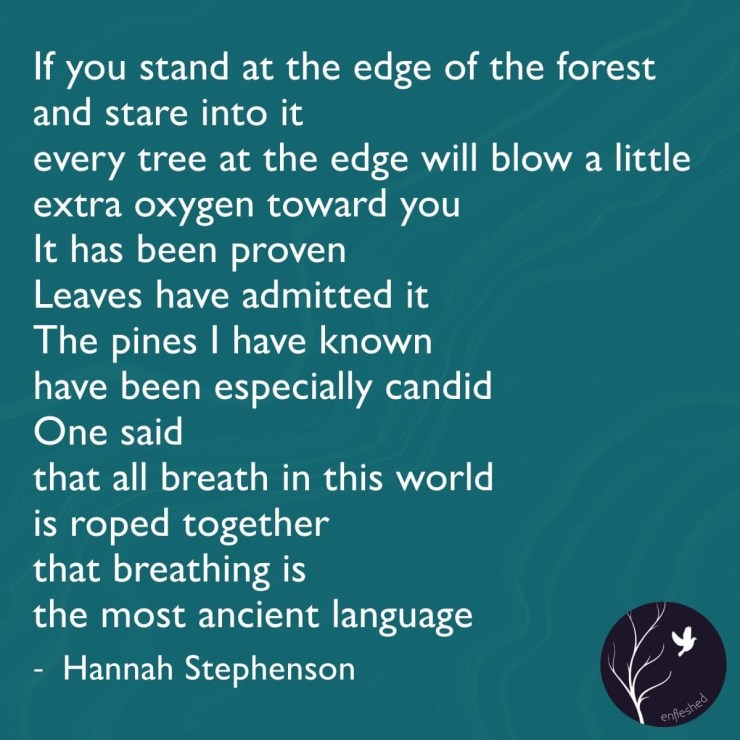
When we are connected to the divine, the source of life, we are connected to one another. Those who forget this connection are doomed to suffer alone without support and without love. No one really means to choose that. The good news is that our connection to the divine is a near to us as our breath and we can reconnect when we remember to whom we belong. It is our breath that connects us with all of creation and with the loving creator. A simple yet ancient reminder built into our very bodies that we are one.
Check out other psalm reflections in the links below or find more of my writing published in Presbyterian Outlook or listen to my experiments in podcasting on the Period Pastor Podcast. Follow me @periodpastor
I began writing Psalm reflections during Lent of 2020. Shortly after, we decided to close the church building, work from home, and worship via zoom. Many churches use the Revised Common Lectionary (RLC) that rotates scripture on a three-year cycle (A, B, and C). Starting in Advent 2019, the church decided to worship with the texts from Year D, which is still not circulated as are years A, B, and C. Year D was created with the goal of including scriptures that were left out or not used as frequently as others. While we were using Psalms in year D, most other lectionary followers were using Year A. In Advent of 2020 we rejoined those who use the lectionary in year B. Advent of 2021 year C. When we returned to in person worship, we took the psalm reflections out of the order of worship. I continued to write them for the blog. Advent of 2022 year A. I left church work in July of 2023 but continued the practice of writing psalm reflections. Advent of 2023 year B.
I use the Vanderbilt Divinity Library’s resource for lectionary readings to make text selections.
1st Sunday in Advent Psalm 25, 2nd Sunday in Advent instead of a Psalm the lectionary gives Luke 1:68-79, 3rd Sunday in Advent instead of a Psalm the lectionary gives Isaiah 12:2-6, 4th Sunday in Advent Luke 1:46b-55 or Psalm 80, Christmas Eve or Christmas Day Psalm 96, Psalm 97, Psalm 98, 1st Sunday after Christmas, Psalm 148, New Year’s Day Psalm 8, 2nd Sunday after Christmas Psalm 147, Epiphany Psalm 72, 1st Sunday after Epiphany Psalm 29, 2nd Sunday after Epiphany Psalm 36, 3rd Sunday after Epiphany Psalm 19, 4th Sunday after Epiphany Psalm 71, 5th Sunday after Epiphany Psalm 138, 6th Sunday after Epiphany Psalm 1, 7th Sunday after Epiphany Psalm 37, Transfiguration Sunday (Sunday before Lent) Psalm 99
Lent: Ash Wednesday Psalm 51, 1st Sunday in Lent Psalm 91, 2nd Sunday in Lent Psalm 27, 3rd Sunday in Lent Psalm 63, 4th Sunday in Lent Psalm 32, 5th Sunday in Lent Psalm 126, 6th Sunday in Lent (Palm or Passion Sunday) Psalm 118 or 31
Easter: Easter Psalm 118 or Psalm 114, 2nd Sunday of Easter Psalm 118 or Psalm 150, 3rd Sunday of Easter Psalm 30, 4thSunday of Easter Psalm 23, 5th Sunday of Easter Psalm 148, 6th Sunday of Easter Psalm 67, Ascension Psalm 47 or Psalm 93, 7th Sunday of Easter Psalm 97, Day of Pentecost Psalm 104
Season After Pentecost (Ordinary Time): 1st Sunday after Pentecost (Trinity Sunday) Psalm 8, 2nd Sunday after Pentecost Psalm 42 and Psalm 43 or Psalm 22, 3rd Sunday after Pentecost Psalm 77 or Psalm 16, 4th Sunday after Pentecost Psalm 30 or Psalm 66, 5th Sunday after Pentecost Psalm 82 or Psalm 25, 6th Sunday after Pentecost Psalm 52 or Psalm 15, 7thSunday after Pentecost Psalm 85 or Psalm 138, 8th Sunday after Pentecost Psalm 107 or Psalm 49, 9th Sunday after Pentecost Psalm 50 or Psalm 33, 10th Sunday after Pentecost Psalm 80 or Psalm 82, 11th Sunday after Pentecost Psalm 71or Psalm 103, 12th Sunday after Pentecost Psalm 81 or Psalm 112, 13th Sunday after Pentecost Psalm 139 or Psalm 1, 14thSunday after Pentecost Psalm 14 or Psalm 51, 15th Sunday after Pentecost Psalm 79 or Psalm 113, 16th Sunday after Pentecost Psalm 91 or Psalm 146, 17th Sunday after Pentecost Psalm 137 or Psalm 37, 18th Sunday after Pentecost Psalm 66 or Psalm 111, 19th Sunday after Pentecost Psalm 119 or Psalm 121, 20th Sunday after Pentecost Psalm 65 or Psalm 84, 21st Sunday after Pentecost Psalm 119 or Psalm 32, 22nd Sunday after Pentecost Psalm 145 or Psalm 98 or Psalm 17, 23rdSunday after Pentecost Psalm 98, 24th Sunday after Pentecost Psalm 46.
Sources and notes:
“The Book of Psalms begins with a beatitude. Not a prayer or a hymn, but a statement about human existence. Here at the threshold of the Psalter we are asked to consider the teaching that the way life is lived is decisive for how it turns out. This opening beatitude also serves as an introduction to the book. Its location as the first psalm is not accidental; the psalm is there to invite us to read and use the entire book as a guide to a blessed life.” Mays p. 40
“This first beatitude prompts the reader to think of the entire book as instruction for life and commends a kind of conduct that uses the Psalter in that way.” Mays p. 41
“…Psalm 1 invites us to expect and receive torah from the psalms, that is, to read them as Scripture. …. Indeed, Psalm 1 wants the whole to be read as instruction–instruction in prayer, in praise, in God’s way with us and our way under God.” Mays p. 42
Psalm 1 sets up the expectation that the righteous will prosper and the wicked will not. “The prayers testify that the righteous meet affliction rather than fulfillment in life.” Mays p. 44
“Placing first a psalm that is to be used outside the practice of worship indicates that the whole collection of Psalms was more than just some poems used for liturgy (though they never ceased to be that as well).” Creach p. 22
“…with a beatitude, good fortune is recognized as the natural outgrowth of life deemed “wise” by those who seek God’s kingdom, not as a result of the words of someone with power to “bless.” So perhaps a better translation of ashre is “happy” or “fortunate.”” Creach p. 23
“The wicked are those who deny, as the hymn writer has said, “God is the ruler yet.”” Creach p. 24
“The wicked are those who lose sight of their place as created beings, and arrogantly see the creature (i.e., themselves; see Rom. 1:18-32) as something more than it is. From this base of self-delusion, all manner of evil actions arise. Such a stance in life always leads to a fall, the psalmist asserts.” Creach p. 25
“…the fivefold organization of the Psalter seems to indicate a close association with the Torah in a narrow sense. However, torah as psalm 1 uses the word is not limited to one document. Torah communicates the body of all instruction from God, in whatever form (a sermon, or even a personal experience, to name two examples). The placement of psalm 1 at the head of the Psalter, therefore, may mean that those who put the book together inter readers to receive torah (divine instruction) from the psalms that follow. In time, the book of Psalms would become scripture, and would stand alongside the Pentateuch (Genesis – Deuteronomy) and the rest of the Old Testament as a written collection of God’s revelation. One of the teaching points of Psalm 1 is that attention to scripture and trust in scripture as a guide to life are requisites for righteousness. The righteous who love and live torah will find their happiness there too.” Creach pp. 25-26
Psalm 1 trees planted by water. Psalms 52 and 92 trees planted in the temple. “This is a typical Old Testament way of speaking about the Temple. It is probably not so much historical as poetic. That is, this language comes from the idea that the Temple is a paradise. The Temple was for ancient Israelites a kind of “oasis for the soul”. In the Temple, God’s presence and power could be felt, the chaotic world made sense, and God’s ultimate purpose for the world could be envisioned. The passages cited above imagine the righteous like one of the trees planted firmly before the throne of God. The righteous always have in their sights the will of God and God’s rule over the world. Psalm 1:3 draws upon the trees-in-paradise image, and perhaps the trees-planted-in-temple image as well.” Creach p. 27
“Two observations can be drawn from the simile of the righteous who are like trees planted in and around the Temple. Both rely on the assumption that Psalm 1 understands the stability that the righteous derive from meditation on torah. First, torah does for the believer what the Jerusalem Temple did: provides access to the presence of God, reveals the order of God’s kingdom, and depicts the long-term wisdom of following the path of the righteous instead of the wicked. Second, since this psalm was probably written after the Jerusalem Temple was destroyed (in 587 B.C. by the Babylonians), the psalm may imply that torah has replaced the Temple.” Creach pp. 27-28
“For the psalmist, that foundation is to delight in and to meditate upon torah, to be constantly open to God’s instruction. Taking such a stand or such a stance enables one to live with purpose and integrity in a world of confession… It enables one to live with hope in a world full of despair, and it enables one to perceive the mystery of life where others may perceive only the misery of life.” McCann p. 35
“It has everything to do with delighting in and meditation on torah; it has everything to do with being open to God’s instruction; it has everything to do with being open to God’s presence in the face of unimaginable option and open to God’s power to transform the most hopeless of situations. In short, it has everything to do with having a “place to stand”.” McCann p. 36
“Psalm 1 does not bargain or allow for ambiguity. It is the voice of a community that is familiar with risks, dangers, costs, and boundaries. It fully appreciates the givenness of God’s world and has confidence that the torah is the only thinkable response to the givenness of creation. It probably is also a tract for socialization, by which the adult community firmly conditions the young into a “right” morality. This community trusts its morality to be a way to fend off trouble. It is life and death, and the young had better lean it while there is still time (cf. Prov. 8:32-36).” Brueggemann The Message of the Psalms p. 39
“…the tree’s apparent lack of mobility, its inability to make moral decisions, makes it a poor symbol for human subjects, a facet of the metaphor to be discarded. But it is equally possible that this irritating rub is part of the truthful communication it subtly offers us. The tree may also remind us that we are less in charge than we may like to think. …. A tree is very interdependent, receiving and giving. We may feel a little more in charge of our own destiny than is good for us. The tree metaphor asks us to ponder the possibility. …. The trees, healthy and thwarted, invite us to ponder our capacities for receiving as well as giving, for reabsorbing vitality as well as promoting it.” Green pp. 34-35
Alter, Robert. 2007. The Book of Psalms: A Translation with Commentary New York: W. W. Norton & Company
WBC Allen, Leslie C. 1983. Word Biblical Commentary: Psalms 101-150. Vol. 21. Waco, TX: Word Books, Publisher.
Bonhoeffer, Dietrich. 1974. Psalms: The Prayer Book of the Bible. 8th ed. Minneapolis, MN: Augsburg Press.
Bourgeault, C. (2006). Chanting the psalms: A practical guide Audio Book. New Seeds.
Brueggemann, Walter. 2007. Praying the Psalms: Engaging Scripture and the Life of the Spirit. 2nd ed. Eugene, OR: Cascade.
Brueggemann, Walter. 2014. From Whom No Secrets Are Hid: Introducing the Psalms. Edited by Brent A. Strawn. 1st ed. Louisville, KY: Westminster John Knox Press.
Brueggemann, Walter. Davis Hanskins, Editor. 2022. Our Hearts Wait: Worshiping Through Praise and Lament in the Psalms Westminster John Knox Press, Louisville KY.
Brueggemann, Walter. (2002). Spirituality of the psalms. Augsburg Pub. House.
Brueggemann, Walter. (1984). The Message of the Psalms: A Theological Commentary. Minneapolis: Augsburg.
Chilson, Richard, ed. You Shall Not Want: A Spiritual Journey Based on the Psalms. Ave Maria Press, 2009.
Chittister, Joan. (2011). Songs of the heart: reflections on the psalms. John Garratt Publishing.
Cudjoe-Wilkes, G., Wilkes, A. J., & Moss, O. (2022). Psalms for black lives: Reflections for the work of Liberation. Upper Room Books.
WBC Craigie, Peter C. 1983. Psalms 1-50–Word Biblical Commentary. Vol. 19. Waco, TX: Word Books.
Creach, Jerome Frederick Davis. 1998. Psalms: Interpretation Bible Studies. Louisville, KY: Westminster John Knox Press.
DAFLER, J. (2021). PSOBRIETY: A journey of recovery through the psalms. Louisville, KY: WESTMINSTER JOHN KNOX.
W de Claisse-Walford, Nancy L. WISDOM COMMENTARY: Psalms Bks. 4-5. Edited by Barbara E. Reid. Vol. 22. Collegeville, MN: Liturgical, 2020.
Green, Barbara. 1997. Like a Tree Planted: An Exploration of Psalms and Parables Through Metaphor. Collegeville, MN: Liturgical Press.
W Hopkins, Denise Dombkowski. WISDOM COMMENTARY: Psalms Bks. 2-3. Edited by Barbara E. Reid. Vol. 21. Collegeville, MN: Liturgical, 2016.
NIB Keck, Leander E. 2015. The New Interpreters Bible Commentary. Vol. 3. Nashville, TN: Abingdon Press.
Lewis, C. S. (2017). Reflections on the Psalms. Harper One, an imprint of Harper Collins Publishers.
Mays, James Luther. 1994. Psalms. Louisville, KY: John Knox Press.
McCann, J. C. (1993). A theological introduction to the book of Psalms: The Psalms as Torah. Nashville, TN: Abingdon Press.
McCann, J. C., & Howell, J. C. 2001. Preaching the Psalms. Nashville, TN: Abingdon Press.
Merrill, N. C. (2020). Psalms for praying an invitation to wholeness (10th Anniversary Edition ed.). London, England: Bloomsbury Publishing.
Miller, Patrick D. 1986. Interpreting the Psalms. Philadelphia, PA: Fortress Press.
Morgan, Michael. 2010. The Psalter for Christian Worship Revised Edition. Westminster John Knox Press.
Schlimm, Matthew Richard. 2018. 70 Hebrew Words Every Christian Should Know. Nashville, TN: Abington Press.
Spong, M. (Ed.). (2020). The words of her mouth: Psalms for the struggle. Cleveland, OH: The Pilgrim Press.
WBC Tate, Marvin E. 1990. Word Biblical Commentary: Psalms 51-100. Edited by David Allan. Hubbard and Glenn W. Barker. Vol. 20. Waco, TX: Word.
Weems, Ann. 1995. Psalm of Lament. Westminster John Knox Pres
OTL Weiser, Artur. 1998. Old Testament Library: Psalms. Translated by Herbert Hartwell. 3rd ed. New York, NY: Manchester University Press.

 Period Pastor Pad