O Love, my Beloved, How powerful is your Name in all the earth!
You, whose glory is sung in heaven by the angels and saints,
Who with he innocence and spontaneity of a child,
Confound those who are mighty and proud,
You comfort the unloving and fearful.
When I look up at the heavens, at the work of Love’s creation, at the infinite variety of your Plan,
What is woman that You rejoice in her, And man that You delight in him?
You have made us in your image, You fill us with your Love;
You have made us co-creators of the earth! guardians of the planet!
to care for all your creatures, to tend the land, the sea, and the air we breathe;
all You have made, You have placed in our hands.
O Love, my Beloved, How powerful is your Name in all the earth!
Nan C. Merrill Psalms for Praying
Reflection:
You have made us co-creators of the earth! guardians of the planet!
to care for all your creatures, to tend the land, the sea, and the air we breathe;
all You have made, You have placed in our hands.
Some translations of psalm 8 say that God has made people the rulers, given them dominion over the earth and its creatures, and laid everything in creation under their feet. Words matter. These words sound like we’ve been given power, authority, and control; that we were chosen for this special purpose, a divine right to rule or conquer and do what we please. White Christian Nationalism in the USA derives its power and authority from verses taken out of context and ideologies that support the idea that those in power were given that power by divine order.
But that is not the intention of the psalmist. Throughout the psalms, dominion and power are to be used to care for and protect the most vulnerable, not to dominate and abuse them. Our dominion over creation is in place because of our capacity to care for and protect the earth and all of the creatures. In some ways, we can be like God, co-creators and guardians of all that God has made and of the ongoing creation that enfolds around us.
I pray that God will comfort the unloving and fearful, especially those engage in the particular brand of white christian nationalism plaguing our county and our world. I hope that they will see that true power is being able to care for others and for all of creation. True power is Love.
O Love, my Beloved, How powerful is your Name in all the earth!
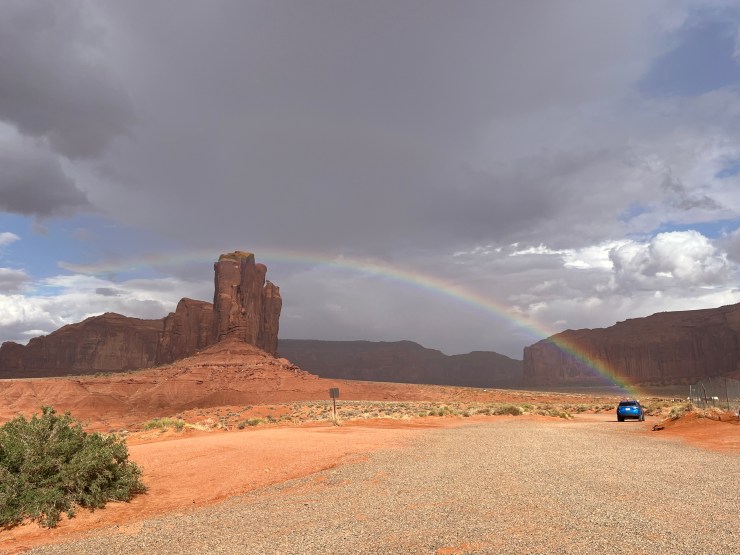
I chose this image because of how small that car looks compared to the monument and the rainbow. The car isn’t far from where I’m standing so it’s not even a fair comparison as it is actually much smaller than the monument than it appears here. My husband and I visited Monument Valley in June of 2025 and felt so small compared to the monuments, the storm, and the resulting rainbow. We were in awe of the beauty of creation and how small we felt in the midst of it. And more than anything, we felt the importance of protecting this particular place and hope that others can experience it. It is my prayer that we can expand that feeling to caring for all of creation.
Check out other psalm reflections in the links below or find more of my writing published in Presbyterian Outlook or listen to my experiments in podcasting on the Period Pastor Podcast. Follow me @periodpastor
I began writing Psalm reflections during Lent of 2020. Shortly after, we decided to close the church building, work from home, and worship via zoom. Many churches use the Revised Common Lectionary (RLC) that rotates scripture on a three-year cycle (A, B, and C). Starting in Advent 2019, the church decided to worship with the texts from Year D, which is still not circulated as are years A, B, and C. Year D was created with the goal of including scriptures that were left out or not used as frequently as others. While we were using Psalms in year D, most other lectionary followers were using Year A. In Advent of 2020 we rejoined those who use the lectionary in year B. Advent of 2021 year C. When we returned to in person worship, we took the psalm reflections out of the order of worship. I continued to write them for the blog. Advent of 2022 year A. I left church work in July of 2023 but continued the practice of writing psalm reflections. Advent of 2023 year B.
I use the Vanderbilt Divinity Library’s resource for lectionary readings to make text selections.
1st Sunday in Advent Psalm 25, 2nd Sunday in Advent instead of a Psalm the lectionary gives Luke 1:68-79, 3rd Sunday in Advent instead of a Psalm the lectionary gives Isaiah 12:2-6, 4th Sunday in Advent Luke 1:46b-55 or Psalm 80, Christmas Eve or Christmas Day Psalm 96, Psalm 97, Psalm 98, 1st Sunday after Christmas, Psalm 148, New Year’s Day Psalm 8, 2nd Sunday after Christmas Psalm 147, Epiphany Psalm 72, 1st Sunday after Epiphany Psalm 29, 2nd Sunday after Epiphany Psalm 36, 3rd Sunday after Epiphany Psalm 19, 4th Sunday after Epiphany Psalm 71, 5th Sunday after Epiphany Psalm 138, 6th Sunday after Epiphany Psalm 1, 7th Sunday after Epiphany Psalm 37, Transfiguration Sunday (Sunday before Lent) Psalm 99
Lent: Ash Wednesday Psalm 51, 1st Sunday in Lent Psalm 91, 2nd Sunday in Lent Psalm 27, 3rd Sunday in Lent Psalm 63, 4th Sunday in Lent Psalm 32, 5th Sunday in Lent Psalm 126, 6th Sunday in Lent (Palm or Passion Sunday) Psalm 118 or 31
Easter: Easter Psalm 118 or Psalm 114, 2nd Sunday of Easter Psalm 118 or Psalm 150, 3rd Sunday of Easter Psalm 30, 4th Sunday of Easter Psalm 23 or 114, 5th Sunday of Easter Psalm 148, 6th Sunday of Easter Psalm 67 or 109, Ascension Psalm 47 or Psalm 93, 7th Sunday of Easter Psalm 97 or Psalm 2, Day of Pentecost Psalm 104
Season After Pentecost (Ordinary Time): 1st Sunday after Pentecost (Trinity Sunday) Psalm 8, 2nd Sunday after Pentecost Psalm 42 and Psalm 43 or Psalm 22, 3rd Sunday after Pentecost Psalm 77 or Psalm 16, 4th Sunday after Pentecost Psalm 30 or Psalm 66, 5th Sunday after Pentecost Psalm 82 or Psalm 25, 6th Sunday after Pentecost Psalm 52 or Psalm 15, 7thSunday after Pentecost Psalm 85 or Psalm 138, 8th Sunday after Pentecost Psalm 107 or Psalm 49, 9th Sunday after Pentecost Psalm 50 or Psalm 33, 10th Sunday after Pentecost Psalm 80 or Psalm 82, 11th Sunday after Pentecost Psalm 71or Psalm 103, 12th Sunday after Pentecost Psalm 81 or Psalm 112, 13th Sunday after Pentecost Psalm 139 or Psalm 1, 14thSunday after Pentecost Psalm 14 or Psalm 51, 15th Sunday after Pentecost Psalm 79 or Psalm 113, 16th Sunday after Pentecost Psalm 91 or Psalm 146, 17th Sunday after Pentecost Psalm 137 or Psalm 37, 18th Sunday after Pentecost Psalm 66 or Psalm 111, 19th Sunday after Pentecost Psalm 119 or Psalm 121, 20th Sunday after Pentecost Psalm 65 or Psalm 84, 21st Sunday after Pentecost Psalm 119 or Psalm 32, 22nd Sunday after Pentecost Psalm 145 or Psalm 98 or Psalm 17, 23rdSunday after Pentecost Psalm 98, 24th Sunday after Pentecost Psalm 46.
Sources and notes:
previous reflection:
Holy God, powerful and beautiful is your love in all the earth!
God suffers with us. God co-creates with us.
Not because we are anything special, but because God loves us.
God confounds the proud and comforts the fearful.
Not because we are anything special, but because God loves us.
God creates all sorts of variety for us to enjoy and care for.
Not because we are anything special, but because God loves us.
God chose to dwell with us and to work in and through and with us.
Not because we are anything special, but because God loves us.
God, help us to be more like you.
Not because we are anything special, but because we love you.
Holy God, powerful and beautiful is your love in all the earth!
“Psalm 8 is the first hymn of praise in the Psalter. It interrupts the sequence of prayers for salvation to say something very important about the God to whom the prayers are made: The LORD is the cosmic sovereign whose majesty is visible in the whole world. The psalm also discloses why the salvation of those who pray is so important for the reign of God: As human beings, they have an office in God’s kingdom.” Mays p. 65
“The LORD who is sovereign over the congregation that sings the hymn possesses a cosmic majesty evident in all the earth. The psalm does not imply that the sovereign self of God is apparent in the visible world. There is no pantheism here. The majesty to be seen is that of the name of the LORD. The content of “name” is the works and words of the one whose identity and will are expressed through them. The psalm sees in all the earth the work of the word of the LORD and views the work of the LORD as the word of the LORD’s sovereignty. The body of the hymn praises the LORD as creator, but there and here the language distinguishes between creator and creation while marveling at the majesty of the one discernible in the other.” Mays p. 65
“In the psalm, the question [what is man?] is not an invitation to philosophical reasoning or scientific research. In all the appearances of Psalm 8 in the Old Testament, including this one, the psalm’s purpose is to acknowledge the finiteness of a human being, his unimportance and limits (144:3-4; Job 7:17; 15:14). The recognition is evoked here by contemplation of the vast depth of the night sky with its moon and myriad mysterious stars, an experience to which people of many times and places have testified. The experience is not, however, that of being “lost in the cosmos”; rather, it is of awe and wonder at the marvelous majesty of God, who can make and has made a royal regent of this mere moral. The question is asked in the psalm to serve the purpose of the hymn, praise of the LORD.” Mays p. 68
Creach notes that this text is often used to abuse (dominate) the earth because people are to have ‘dominion’, but that is not the intention or proper interpretation as “humans serve not as owners over creation, but as tenants” p. 73 or we could think of ourselves as having a “sublease” p.75. If we took care of the earth as the owner would, we would be lovingly caring and protecting all of it.
“…dominion without the recognition of God’s claim on us and on the earth becomes domination.” NIB p. 327
“The movement from Psalms 3-7 to Psalm 8 suggests at least that the royal status and vocation of humanity are not diminished by suffering. In fact, as regards the human, we may conclude that to be created in the “image of God” inevitably means that we will suffer. As regards God, we may conclude that divine partnership with humanity inevitably involves God suffering. These same conclusions are articulated in the book of Job.” NIB p. 327
“At its center is an affirmation of human power and authority. At its boundaries are affirmations of praise to God. The center (v.5) and the boundaries (vv. 1,9) must be read together; either taken alone will miss the point. Human power is always bounded and surrounded by divine praise. Doxology gives dominion its context and legitimacy. The two must be held together. Praise of God without human authority is addiction and “leaving it all to God,” which this psalm does not urge. But to use human power without the context of praise of God is to profane human regency over creation and so usurp more than has been granted. Human persons are to rule, but they are not to receive the ultimate loyalty of creation. Such loyalty must be directed only to God.” Brueggemann, The Message of the Psalms pp. 37-38
“This psalm struggles with a delicacy not raised in the other statements on creation we have considered. It recognizes that humankind is the crown and pinnacle of creation, but even human power is shaped and qualified by doxology. Finally, it is glad and submitting doxology the receives and confirms the well-oriented creation of God. These psalms of creation provide a sure and bold beginning point for the full world of psalmic faith.” Brueggemann, The Message of the Psalms p. 38
Alter, Robert. 2007. The Book of Psalms: A Translation with Commentary New York: W. W. Norton & Company
WBC Allen, Leslie C. 1983. Word Biblical Commentary: Psalms 101-150. Vol. 21. Waco, TX: Word Books, Publisher.
Bonhoeffer, Dietrich. 1974. Psalms: The Prayer Book of the Bible. 8th ed. Minneapolis, MN: Augsburg Press.
Bourgeault, C. (2006). Chanting the psalms: A practical guide Audio Book. New Seeds.
Brueggemann, Walter. 2007. Praying the Psalms: Engaging Scripture and the Life of the Spirit. 2nd ed. Eugene, OR: Cascade.
Brueggemann, Walter. 2014. From Whom No Secrets Are Hid: Introducing the Psalms. Edited by Brent A. Strawn. 1st ed. Louisville, KY: Westminster John Knox Press.
Brueggemann, Walter. Davis Hanskins, Editor. 2022. Our Hearts Wait: Worshiping Through Praise and Lament in the Psalms Westminster John Knox Press, Louisville KY.
Brueggemann, Walter. (2002). Spirituality of the psalms. Augsburg Pub. House.
Brueggemann, Walter. (1984). The Message of the Psalms: A Theological Commentary. Minneapolis: Augsburg.
Chilson, Richard, ed. You Shall Not Want: A Spiritual Journey Based on the Psalms. Ave Maria Press, 2009.
Chittister, Joan. (2011). Songs of the heart: reflections on the psalms. John Garratt Publishing.
Cudjoe-Wilkes, G., Wilkes, A. J., & Moss, O. (2022). Psalms for black lives: Reflections for the work of Liberation. Upper Room Books.
WBC Craigie, Peter C. 1983. Psalms 1-50–Word Biblical Commentary. Vol. 19. Waco, TX: Word Books.
Creach, Jerome Frederick Davis. 1998. Psalms: Interpretation Bible Studies. Louisville, KY: Westminster John Knox Press.
DAFLER, J. (2021). PSOBRIETY: A journey of recovery through the psalms. Louisville, KY: WESTMINSTER JOHN KNOX.
W de Claisse-Walford, Nancy L. WISDOM COMMENTARY: Psalms Bks. 4-5. Edited by Barbara E. Reid. Vol. 22. Collegeville, MN: Liturgical, 2020.
Green, Barbara. 1997. Like a Tree Planted: An Exploration of Psalms and Parables Through Metaphor. Collegeville, MN: Liturgical Press.
W Hopkins, Denise Dombkowski. WISDOM COMMENTARY: Psalms Bks. 2-3. Edited by Barbara E. Reid. Vol. 21. Collegeville, MN: Liturgical, 2016.
NIB Keck, Leander E. 2015. The New Interpreters Bible Commentary. Vol. 3. Nashville, TN: Abingdon Press.
Lewis, C. S. (2017). Reflections on the Psalms. Harper One, an imprint of Harper Collins Publishers.
Mays, James Luther. 1994. Psalms. Louisville, KY: John Knox Press.
McCann, J. C. (1993). A theological introduction to the book of Psalms: The Psalms as Torah. Nashville, TN: Abingdon Press.
McCann, J. C., & Howell, J. C. 2001. Preaching the Psalms. Nashville, TN: Abingdon Press.
Merrill, N. C. (2020). Psalms for praying an invitation to wholeness (10th Anniversary Edition ed.). London, England: Bloomsbury Publishing.
Miller, Patrick D. 1986. Interpreting the Psalms. Philadelphia, PA: Fortress Press.
Morgan, Michael. 2010. The Psalter for Christian Worship Revised Edition. Westminster John Knox Press.
Schlimm, Matthew Richard. 2018. 70 Hebrew Words Every Christian Should Know. Nashville, TN: Abington Press.
Spong, M. (Ed.). (2020). The words of her mouth: Psalms for the struggle. Cleveland, OH: The Pilgrim Press.
WBC Tate, Marvin E. 1990. Word Biblical Commentary: Psalms 51-100. Edited by David Allan. Hubbard and Glenn W. Barker. Vol. 20. Waco, TX: Word.
Weems, Ann. 1995. Psalm of Lament. Westminster John Knox Pres
OTL Weiser, Artur. 1998. Old Testament Library: Psalms. Translated by Herbert Hartwell. 3rd ed. New York, NY: Manchester University Press.

 Period Pastor Pad