O Compassionate Teacher, You are our merciful Counselor;
in the Silence You make yourself known to all who take time to listen.
Would that those in power would heed your Voice:
“How long will you misuse power that oppresses the poor?
When will you learn that to act justly and with integrity
will bring mutual blessing to all?
Do you not know that to give succor to the poor and
to free people to succeed will bring you more joy than All your bank accounts?”
Arise! Awaken to the new dawn!
Come into the Light; shed darkness like skin on a snake!
For the foundations of the cosmos are shaking with injustice.
I say, “Within you dwells the Beloved, the Breath of your breath;
Open your heart in the Silence and know the One in the many.”
Arise! Join in the new creation!
Let harmony reign among all the nations!
Nan C. Merrill Psalms for Praying
Reflection:
The psalmist is critiquing God. The quotation of God’s speech asking other gods to do justice is held up by the psalmist to God. The psalmist wants God to do what God is asking the other gods to do; to take care of those who need help. Make yourself known by taking care of the oppressed. Hey God, remember that time you told other gods to help the marginalized. Well, the marginalized need your help. Please do what you know is right.
At the same time, the psalmist is reminding all of us to do what we know is right; to help the marginalized.
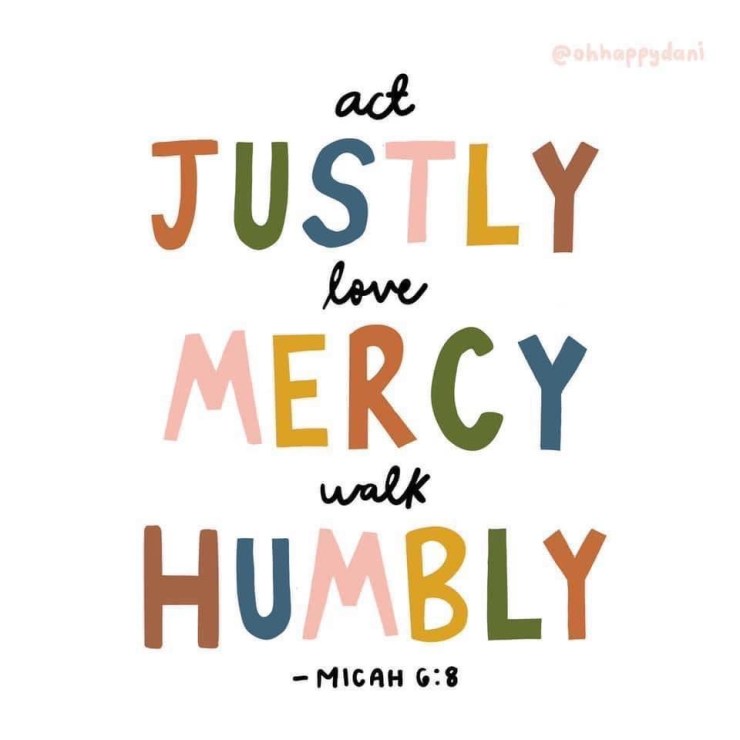
Psalm 82 is a liturgy that we should read over and over again. Because we worship in the midst of a world where nations and societies are still ruled by false gods; self-made, power, money, “America First”, and so many other notions that play into our fears making us hate our neighbors. This liturgy reminds us that we worship the God of justice, mercy, and love. We must honor God by living justly, loving mercy, and walking humbly with God and neighbor. Our thoughts and prayers should lead us to action; the bringing about the kin-dom of God; the overturning of systems and laws that oppress; and the building of a just and peaceful society.
Building a just and peaceful society must involve political action and policy. Write to and call your representatives about what matters: people fed, medical attention provided, clean air and water, unpolluted land, and all of us allowed to love and live in peace. There is more joy in a world where everyone has enough than there is in our world, where the wealthy cannot be satisfied and everyone else goes without basic necessities. We can build this new world together.
I wonder what God is calling each of us to do, to hold up our corner of the kin-dom of God.
Here are a few organizations that I have worked with recently that are helping the marginalized: Days for Girls, Global Links, and DTCare. If you know of other organizations that are doing good work and could use donations (especially if they have lost their government funding) please comment those links below so we can all help where we can.
For a few Pittsburgh specific organizations, check out my previous reflection written for Third Church in 2020:
The worship of God must and shall bring justice to the weak and in doing so, reveals that the powers that control our society are failed gods. We live in a society in which the rights of the needy are violated and neglected. Ideas that shape middle class values are unmasked as failed gods (Mays pp. 270-271). We live in a city where the same neighborhood that houses prestigious universities is a food desert, and our failure to provide food security for our neighbors reveals that the false god of higher education doesn’t really make us better people living in a better world. Here is a link to food deserts in Pittsburgh as identified in the Pittsburgh Post-Gazette . We live in a city where the racist practice of redlining keeps our neighborhoods segregated, and our delusion that we live in a “good” neighborhood because of our own work is revealed as the false god of work ethic. Hard work doesn’t pull someone out of a system that keeps people in poverty because of the color of their skin. We worship in a place we consider the most livable city, but our prosperity and hospitality are revealed as false, because this city is only livable if you are white, cis-gendered, heterosexual, and wealthy (Organizations like SisTers PGH exist because people who are “different” experience violence and hardship). Our failure to provide safety and basic human dignity reveals the false idol that we live in Mr. Roger’s neighborhood. And yes, Mr. Rogers lived here, but the neighborhood he created was based on the kingdom of God, where believers worship the God of Justice and Mercy and then go out and love their neighbors by supporting the weak, helping the afflicted and honoring all persons as beloved children of God. But we are no better than the failed gods of Psalm 82.
Psalm 82 is a liturgy that we should read over and over again. Because we worship in the midst of a world where nations and societies are still ruled by false gods (Mays p. 271). This liturgy reminds us that we worship the God of Justice and Mercy, and we must honor God by living justly, loving mercy, and walking humbly with God and neighbor. Our thoughts and prayers should lead us to action; the bringing about the kingdom of God; the overturning of systems and laws that oppress; and the building of a just and peaceful society.
We are fortunate to have opportunities to participate in mission projects that focus on relieving some of the unjust, oppressive, and evil systems in our city. Through our connections with PCUSA, we can join others already working for changes in our city. Garfield Farms feeds neighbors who live in a food desert, as does Feed the Hood, which operates in many locations, including our Third Church kitchen. Our friends at Open Hand Ministries provide a pathway to homeownership to people who live in places where that is still difficult. And more than ownership of a house on a block, they encourage community building in the neighborhoods. Many of the new worshiping communities in our presbytery are affirming of LGBTQIA+ including our friends at The Commonwealth of Oakland.
My point is that we are already connected to people doing good work in our community through our common faith. We can see examples of how other PCUSA churches are worshiping and working for the God of justice and peace. We have even supported all of the organizations I’ve mentioned with Third Church funds and/or building usage. And while that is a much needed support, it does not require much of us as individuals.
I wonder what God is calling Third Church to do, and what God is calling each of us to do, to hold up our corner of the kingdom of God.
Check out other psalm reflections in the links below or find more of my writing published in Presbyterian Outlook or listen to my experiments in podcasting on the Period Pastor Podcast. Follow me @periodpastor
I began writing Psalm reflections during Lent of 2020. Shortly after, we decided to close the church building, work from home, and worship via zoom. Many churches use the Revised Common Lectionary (RLC) that rotates scripture on a three-year cycle (A, B, and C). Starting in Advent 2019, the church decided to worship with the texts from Year D, which is still not circulated as are years A, B, and C. Year D was created with the goal of including scriptures that were left out or not used as frequently as others. While we were using Psalms in year D, most other lectionary followers were using Year A. In Advent of 2020 we rejoined those who use the lectionary in year B. Advent of 2021 year C. When we returned to in person worship, we took the psalm reflections out of the order of worship. I continued to write them for the blog. Advent of 2022 year A. I left church work in July of 2023 but continued the practice of writing psalm reflections. Advent of 2023 year B.
I use the Vanderbilt Divinity Library’s resource for lectionary readings to make text selections.
1st Sunday in Advent Psalm 25, 2nd Sunday in Advent instead of a Psalm the lectionary gives Luke 1:68-79, 3rd Sunday in Advent instead of a Psalm the lectionary gives Isaiah 12:2-6, 4th Sunday in Advent Luke 1:46b-55 or Psalm 80, Christmas Eve or Christmas Day Psalm 96, Psalm 97, Psalm 98, 1st Sunday after Christmas, Psalm 148, New Year’s Day Psalm 8, 2nd Sunday after Christmas Psalm 147, Epiphany Psalm 72, 1st Sunday after Epiphany Psalm 29, 2nd Sunday after Epiphany Psalm 36, 3rd Sunday after Epiphany Psalm 19, 4th Sunday after Epiphany Psalm 71, 5th Sunday after Epiphany Psalm 138, 6th Sunday after Epiphany Psalm 1, 7th Sunday after Epiphany Psalm 37, Transfiguration Sunday (Sunday before Lent) Psalm 99
Lent: Ash Wednesday Psalm 51, 1st Sunday in Lent Psalm 91, 2nd Sunday in Lent Psalm 27, 3rd Sunday in Lent Psalm 63, 4th Sunday in Lent Psalm 32, 5th Sunday in Lent Psalm 126, 6th Sunday in Lent (Palm or Passion Sunday) Psalm 118 or 31
Easter: Easter Psalm 118 or Psalm 114, 2nd Sunday of Easter Psalm 118 or Psalm 150, 3rd Sunday of Easter Psalm 30, 4thSunday of Easter Psalm 23 or 114, 5th Sunday of Easter Psalm 148, 6th Sunday of Easter Psalm 67 or 109, Ascension Psalm 47 or Psalm 93, 7th Sunday of Easter Psalm 97 or Psalm 2, Day of Pentecost Psalm 104
Season After Pentecost (Ordinary Time): 1st Sunday after Pentecost (Trinity Sunday) Psalm 8, 2nd Sunday after Pentecost Psalm 42 and Psalm 43 or Psalm 22, 3rd Sunday after Pentecost Psalm 77 or Psalm 16, 4th Sunday after Pentecost Psalm 30 or Psalm 66, 5th Sunday after Pentecost Psalm 82 or Psalm 25, 6th Sunday after Pentecost Psalm 52 or Psalm 15, 7thSunday after Pentecost Psalm 85 or Psalm 138, 8th Sunday after Pentecost Psalm 107 or Psalm 49, 9th Sunday after Pentecost Psalm 50 or Psalm 33, 10th Sunday after Pentecost Psalm 80 or Psalm 82, 11th Sunday after Pentecost Psalm 71or Psalm 103, 12th Sunday after Pentecost Psalm 81 or Psalm 112, 13th Sunday after Pentecost Psalm 139 or Psalm 1, 14thSunday after Pentecost Psalm 14 or Psalm 51, 15th Sunday after Pentecost Psalm 79 or Psalm 113, 16th Sunday after Pentecost Psalm 91 or Psalm 146, 17th Sunday after Pentecost Psalm 137 or Psalm 37, 18th Sunday after Pentecost Psalm 66 or Psalm 111, 19th Sunday after Pentecost Psalm 119 or Psalm 121, 20th Sunday after Pentecost Psalm 65 or Psalm 84, 21st Sunday after Pentecost Psalm 119 or Psalm 32, 22nd Sunday after Pentecost Psalm 145 or Psalm 98 or Psalm 17, 23rdSunday after Pentecost Psalm 98, 24th Sunday after Pentecost Psalm 46.
Sources and notes:
“…Psalm 82 was composed for performance in liturgy…. The psalm is a prayer that calls on God to do what the trial scene portrays: dispense with the gods and take over the judgement of earth as its rightful and supreme sovereign.” Mays p. 269
“Psalm 82 is in fact one of the songs in the Psalter that celebrates the reign of the LORD. It portrays God’s reign, not as a state or condition of things, but as something that is happening, an unfinished story.” Mays p. 269
God holds court with other gods, finds them guilty, and condemn them to death. “The charge against the gods is not that they are idols or nonexistent but that they have failed to put down wickedness and bring justice. Their failure, says the psalm, makes the foundation of the world unstable, a mythopoeic way of saying that their failure threatens the creation, the achievement on which the LORD’s rule is based (see 24:1-2). So the LORD as reigning deity removes them from office and condemns them to death. This portrayal of the assembly of the gods is unlike any other because it announces the permanent adjournment of the assembly and the execution of its constituency: the psalm announces the death of the gods. It is a way of saying in the face of a polytheistic worldview, “I beloved in God the Father Almighty.” The notion of the council is used to dramatize a profound shift in understanding reality. The context for human life is not the careers of the gods of the nations but the reign of the LORD.” Mays pp. 269-270
“It becomes an axiom of Old Testament theology that the worship of the LORD must and shall bring justice to the weak. On the other hand, the forces and powers that control a society in which rights of the needy are violated and neglected are umasked as failed gods.” Mays pp. 270-271
“The concluding prayer is important. It calls on God to replace the false gods and set things right in the world by his rule. The court saying provides a revelation of what is happening in history; the false gods are being uncovered and condemned. Bu the congregation worships in the midst of a world where nations and societies are still ruled by false gods.” Mays p. 271
“Psalm 82 joins the other Asaph psalms (50, 73-81, 83) in raising the urgent question of theodicy, perhaps in response to Babylonian exile. Though these psalms perceive God’s absence, diving speech is imagined, nonetheless. (cp. 50:7-15, 16b -21; 75:3-4, 11; 81:6-16). God quotations are not confined to the Asaph psalms; eighteen psalms include quotations form God, and these quotations function in different ways. In Psalm 82 the God quotation pushed God to grant to closing petition in v. 8 instead of warning or instructing the congregation as in Psalms 50, 75, 81, 95. In Psalm 82, vv. 1 and 8 are spoken by the psalmist and bracket the God in quotation in vv. 2-7. Paying attention to how the psalmist dialogues with God’s speech in Psalm 82 by framing it with his own reveals that the psalmist quotes the divine voice in order to quarrel with it.” W p. 307
v.7 “If the [gods] are human judges this would make no senes, since humans are already mortal.” W p. 309
“The rhetorical question God poses in v. 2 functions as an accusation against these divine kings, and the imperatives in vv. 3-4 flesh out the nature of their wrongdoing: they pervert justice by failing to protect the “weak,” “orphan,” “lowly,” and “needy,” groups that warrant royal empathy and action.” W p. 309
“… the doing of justice that God demands of the divine kings in vv. 2-4 is precisely what the psalmist demands of God on earth in v. 8 “judge!”” W p. 311
“Like Psalms 79 and 80, Psalm 82 critiques God’s unfaithfulness. None of the se three psalmist lets God off the hook when raising the theodicy question. God’s response to the critique in both cases is not recorded, but it will determine the future of the relationship between God and Israel, a relationship that has been badly ruptured.” W p. 311
“God’s hiddenness suggests the story of Esther as inter text for Psalm 82. The book of Esther, whose name comes from the root “hide”, does not mention the name of God…” W p. 311
“Esther badly prays for a reversal of this situation in the words of Psalm 82 and comes to experience such reversal. The king’s decree in Esther 8:11 allows the Jews to defend themselves and “annihilate” (7:4) anyone who attacks them. The Jews rejoice and another reversal occurs: “may peoples of the country professed to be Jews, because the fear of the Jews had fallen upon them” (8:17; cp. 9:2, 3). The marginalized are now the feared. The notion of justice as protection the marginalized is found in the practices of the festival of Purim, which celebrates the victory of the Jews over their enemies. Gifts of food are exchanged and sent to the poor (Esth 9:22; 10:3). An imagined superscription for Psalm 82 might be: “A psalm, when Esther learned the there people would be annihilated.” ” W p. 313
v 1. “Like the psalms of supplication, this poem is concerned with the infuriating preponderance of injustice in the world. It differs from them, however, not only because God is the principal speaker (from verse 2 through verse 7) but also because the psalm is frankly mythological in character. Alternatively, one could describe it as a poem about the transition from mythology to a monotheistic frame of reference because in the end the gods are rudely demoted from their divine status.” Alter p. 291
v. 1″The efforts of traditional commentators to understand ‘elohim her was “judges” are unconvincing. God speaks out in the assembly of lesser gods and rebukes them for doing a wretched job in the administration of justice on earth.” Alter p. 291
“6. As for Me, I had thought. God confesses to have been taken in by the polytheistic illusion. He imagined that these sundry gods entrusted with the administration of justice eon earth would prove or justify their divine status by doing the job properly. In the event, he was sadly disappointed.” Alter p. 292
v. 8 “In the ancient world, the multiplicity of nations is associated with a multiplicity of gods: Each nation has its patron god (see, for example, Jephthah’s words to the Amorite king about YHWH and the Amorite deity Cemosh in Judges 11:24) as well as a variety of gods and goddesses presiding over the various realms of nature. Bu that order has now proven to be judicially and morally bankrupt, and it is the God of Israel alone Who holds in estate (the verb could also be construed as future, “will hold estate”) all the nations of earth.” Alter p. 293
Alter, Robert. 2007. The Book of Psalms: A Translation with Commentary New York: W. W. Norton & Company
WBC Allen, Leslie C. 1983. Word Biblical Commentary: Psalms 101-150. Vol. 21. Waco, TX: Word Books, Publisher.
Bonhoeffer, Dietrich. 1974. Psalms: The Prayer Book of the Bible. 8th ed. Minneapolis, MN: Augsburg Press.
Bourgeault, C. (2006). Chanting the psalms: A practical guide Audio Book. New Seeds.
Brueggemann, Walter. 2007. Praying the Psalms: Engaging Scripture and the Life of the Spirit. 2nd ed. Eugene, OR: Cascade.
Brueggemann, Walter. 2014. From Whom No Secrets Are Hid: Introducing the Psalms. Edited by Brent A. Strawn. 1st ed. Louisville, KY: Westminster John Knox Press.
Brueggemann, Walter. Davis Hanskins, Editor. 2022. Our Hearts Wait: Worshiping Through Praise and Lament in the Psalms Westminster John Knox Press, Louisville KY.
Brueggemann, Walter. (2002). Spirituality of the psalms. Augsburg Pub. House.
Brueggemann, Walter. (1984). The Message of the Psalms: A Theological Commentary. Minneapolis: Augsburg.
Chilson, Richard, ed. You Shall Not Want: A Spiritual Journey Based on the Psalms. Ave Maria Press, 2009.
Chittister, Joan. (2011). Songs of the heart: reflections on the psalms. John Garratt Publishing.
Cudjoe-Wilkes, G., Wilkes, A. J., & Moss, O. (2022). Psalms for black lives: Reflections for the work of Liberation. Upper Room Books.
WBC Craigie, Peter C. 1983. Psalms 1-50–Word Biblical Commentary. Vol. 19. Waco, TX: Word Books.
Creach, Jerome Frederick Davis. 1998. Psalms: Interpretation Bible Studies. Louisville, KY: Westminster John Knox Press.
DAFLER, J. (2021). PSOBRIETY: A journey of recovery through the psalms. Louisville, KY: WESTMINSTER JOHN KNOX.
W de Claisse-Walford, Nancy L. WISDOM COMMENTARY: Psalms Bks. 4-5. Edited by Barbara E. Reid. Vol. 22. Collegeville, MN: Liturgical, 2020.
Green, Barbara. 1997. Like a Tree Planted: An Exploration of Psalms and Parables Through Metaphor. Collegeville, MN: Liturgical Press.
W Hopkins, Denise Dombkowski. WISDOM COMMENTARY: Psalms Bks. 2-3. Edited by Barbara E. Reid. Vol. 21. Collegeville, MN: Liturgical, 2016.
NIB Keck, Leander E. 2015. The New Interpreters Bible Commentary. Vol. 3. Nashville, TN: Abingdon Press.
Lewis, C. S. (2017). Reflections on the Psalms. Harper One, an imprint of Harper Collins Publishers.
Mays, James Luther. 1994. Psalms. Louisville, KY: John Knox Press.
McCann, J. C. (1993). A theological introduction to the book of Psalms: The Psalms as Torah. Nashville, TN: Abingdon Press.
McCann, J. C., & Howell, J. C. 2001. Preaching the Psalms. Nashville, TN: Abingdon Press.
Merrill, N. C. (2020). Psalms for praying an invitation to wholeness (10th Anniversary Edition ed.). London, England: Bloomsbury Publishing.
Miller, Patrick D. 1986. Interpreting the Psalms. Philadelphia, PA: Fortress Press.
Morgan, Michael. 2010. The Psalter for Christian Worship Revised Edition. Westminster John Knox Press.
Schlimm, Matthew Richard. 2018. 70 Hebrew Words Every Christian Should Know. Nashville, TN: Abington Press.
Spong, M. (Ed.). (2020). The words of her mouth: Psalms for the struggle. Cleveland, OH: The Pilgrim Press.
WBC Tate, Marvin E. 1990. Word Biblical Commentary: Psalms 51-100. Edited by David Allan. Hubbard and Glenn W. Barker. Vol. 20. Waco, TX: Word.
Weems, Ann. 1995. Psalm of Lament. Westminster John Knox Pres
OTL Weiser, Artur. 1998. Old Testament Library: Psalms. Translated by Herbert Hartwell. 3rd ed. New York, NY: Manchester University Press.

 Period Pastor Pad