Sing praises to the Beloved of all hearts!
Spring praises, all you who would honor Love,
sing praises to the Architect of the universe!
Bless the Holy One from this time fore and forever more!
Aspire to know the Unknowable, to enter fully into the Great Mystery,
to be fertile ground to the Heart-seed of Love.
Aspire to gifts of Spirit, be open to Grace and express gratitude!
Who is like the Blessed One, the One who is Infinite Love, Power, and Wisdom,
Who enters into human hearts and brings comfort to those in need?
Yes, those who call upon the Merciful One, are lifted up and blessed with new life;
They wear a crown of joy, as they recognize their Oneness with Spirit.
Come, all who suffer and hare heavy-laden, open your hearts to Love!
Sing praises to the Heart of all hearts!
Nan C. Merrill Psalms for Praying
Reflection:
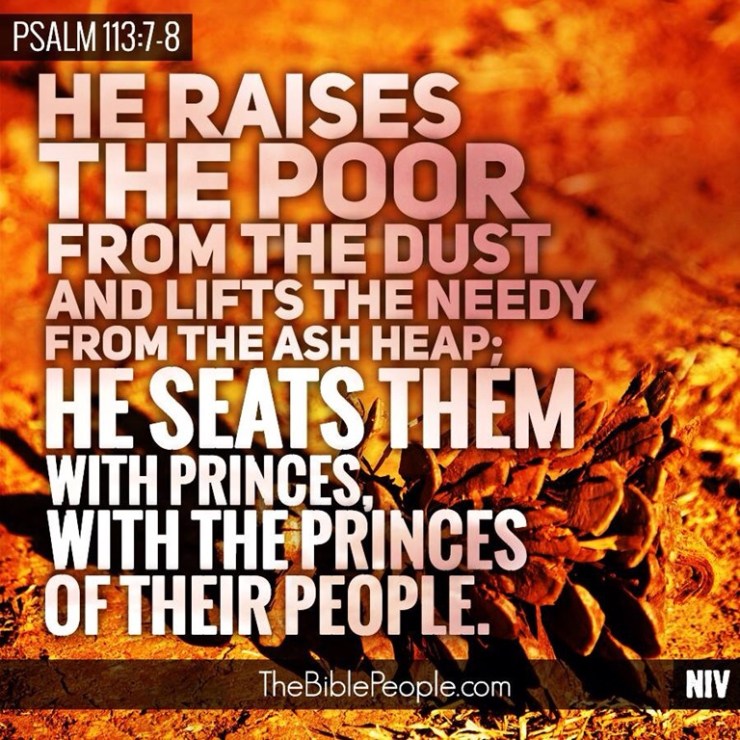
In this psalm of praise God is so high above us and yet, God cares enough for humanity to reach down and raise up the poor and oppressed. No one, no person, no other god, is at once completely superior to us and yet is with us in our lowest state.
God acts to support the powerless against the powerful. If the one who is enthroned above all others can look down to the weakest of us with love and help, we should be able to too. Our blessings, good luck, and privileged positions should fill us with gratitude and generosity, and inspire us to help those less fortunate.
The world needs to think about what life is like from the bottom up. Our greatness should not be measured by billionaires getting richer, but by the poor and oppressed having all of their needs met. The wealth of a country shouldn’t be measured in how many people have too much, but in how those with little have enough to not only survive but thrive.
May we all aspire to be part of God’s great reversal. Bring down the greedy and powerful and uplift the poor and oppressed.
Check out other psalm reflections in the links below or find more of my writing published in Presbyterian Outlook or listen to my experiments in podcasting on the Period Pastor Podcast. Follow me @periodpastor
I began writing Psalm reflections during Lent of 2020. Shortly after, we decided to close the church building, work from home, and worship via zoom. Many churches use the Revised Common Lectionary (RLC) that rotates scripture on a three-year cycle (A, B, and C). Starting in Advent 2019, the church decided to worship with the texts from Year D, which is still not circulated as are years A, B, and C. Year D was created with the goal of including scriptures that were left out or not used as frequently as others. While we were using Psalms in year D, most other lectionary followers were using Year A. In Advent of 2020 we rejoined those who use the lectionary in year B. Advent of 2021 year C. When we returned to in person worship, we took the psalm reflections out of the order of worship. I continued to write them for the blog. Advent of 2022 year A. I left church work in July of 2023 but continued the practice of writing psalm reflections. Advent of 2023 year B.
I use the Vanderbilt Divinity Library’s resource for lectionary readings to make text selections.
1st Sunday in Advent Psalm 25, 2nd Sunday in Advent instead of a Psalm the lectionary gives Luke 1:68-79, 3rd Sunday in Advent instead of a Psalm the lectionary gives Isaiah 12:2-6, 4th Sunday in Advent Luke 1:46b-55 or Psalm 80, Christmas Eve or Christmas Day Psalm 96, Psalm 97, Psalm 98, 1st Sunday after Christmas, Psalm 148, New Year’s Day Psalm 8, 2nd Sunday after Christmas Psalm 147, Epiphany Psalm 72, 1st Sunday after Epiphany Psalm 29, 2nd Sunday after Epiphany Psalm 36, 3rd Sunday after Epiphany Psalm 19, 4th Sunday after Epiphany Psalm 71, 5th Sunday after Epiphany Psalm 138, 6th Sunday after Epiphany Psalm 1, 7th Sunday after Epiphany Psalm 37, Transfiguration Sunday (Sunday before Lent) Psalm 99
Lent: Ash Wednesday Psalm 51, 1st Sunday in Lent Psalm 91, 2nd Sunday in Lent Psalm 27, 3rd Sunday in Lent Psalm 63, 4th Sunday in Lent Psalm 32, 5th Sunday in Lent Psalm 126, 6th Sunday in Lent (Palm or Passion Sunday) Psalm 118 or 31
Easter: Easter Psalm 118 or Psalm 114, 2nd Sunday of Easter Psalm 118 or Psalm 150, 3rd Sunday of Easter Psalm 30, 4th Sunday of Easter Psalm 23 or 114, 5th Sunday of Easter Psalm 148, 6th Sunday of Easter Psalm 67 or 109, Ascension Psalm 47 or Psalm 93, 7th Sunday of Easter Psalm 97 or Psalm 2, Day of Pentecost Psalm 104
Season After Pentecost (Ordinary Time): 1st Sunday after Pentecost (Trinity Sunday) Psalm 8, 2nd Sunday after Pentecost Psalm 42 and Psalm 43 or Psalm 22, 3rd Sunday after Pentecost Psalm 77 or Psalm 16, 4th Sunday after Pentecost Psalm 30 or Psalm 66, 5th Sunday after Pentecost Psalm 82 or Psalm 25, 6th Sunday after Pentecost Psalm 52 or Psalm 15, 7th Sunday after Pentecost Psalm 85 or Psalm 138, 8th Sunday after Pentecost Psalm 107 or Psalm 49, 9th Sunday after Pentecost Psalm 50 or Psalm 33, 10th Sunday after Pentecost Psalm 80 or Psalm 82, 11th Sunday after Pentecost Psalm 71or Psalm 103, 12th Sunday after Pentecost Psalm 81 or Psalm 112, 13th Sunday after Pentecost Psalm 139 or Psalm 1, 14th Sunday after Pentecost Psalm 14 or Psalm 51, 15th Sunday after Pentecost Psalm 79 or Psalm 113, 16th Sunday after Pentecost Psalm 91 or Psalm 146, 17th Sunday after Pentecost Psalm 137 or Psalm 37, 18th Sunday after Pentecost Psalm 66 or Psalm 111, 19th Sunday after Pentecost Psalm 119 or Psalm 121, 20th Sunday after Pentecost Psalm 65 or Psalm 84, 21st Sunday after Pentecost Psalm 119 or Psalm 32, 22nd Sunday after Pentecost Psalm 145 or Psalm 98 or Psalm 17, 23rdSunday after Pentecost Psalm 98, 24th Sunday after Pentecost Psalm 46.
Sources and notes:
“Psalm 113 is a hymn of praise composed as a symmetric statement of the majestic and mercy of the LORD. After a call to praise (vv. 1-3), the body of the hymn describes he exaltation (vv. 4-6) and the condescension (7-9) of “the LORD our God.” In the Hebrew text it opens and closes with “Hallelujah.”” Mays p. 361
“The LORD is a god who is capable of both transcendence and immanence, free to make himself high and low. No human power can do that. No other god does that. The combination of opposites is beautifully depicted in the portrait of the victorious warrior who comes as gentle shepherd in Isaiah 40:9-12. The combination into one personality is a hallmark of the God of the Bible.” Mays p. 362
“Verses 7-9 cite two illustrations of what happens when the Incomparable acts upon closed continuities of finite human life. Each case shows both the compassion of the LORD for the helpless and the change that occurs in human arrangements because of his mercy.” Mays p. 362
“Psalm 113 is the first in the cycle of psalms called the Hallel (Psalms 113-118), which were sung at all the joyous festivals celebrated in early Judaism. The cycle found a special place in the liturgy of Passover, and one can see why Psalm 113 makes an appropriate overture to the celebration of Exodus. In that context, it is Israel who are poor and weak and prompted by the prophets; they can think of Zion as the barren woman who needs the help of the LORD (Isa. 54:1). The God who uses his superiority to help the inferior, who interferes in the settled circumstances of society and family to create new and surprising possibilities, is precisely the God praised at Passover. The psalm would have been the first sung by Jesus and the disciples in the celebration of their last supper, with profound implications for the occasion and its consequences.” Mays pp. 362-363
“In traditional commentary the psalm has been interpreted as a connecting link between Hannah and the Virgin Mary, with good intratextual reason. The psalm contains both phrases and motifs that appear in 1 Samuel 2 (compare especially vv. 2, 4-8). Mary’s Magnificat does the same; in joy over the child in her womb she praises the God whose power is expressed in a compassion that reverses the fixed extremes of the human order (Luke 1:46-55). For the apostle Paul it is clear that this incomparable God is at work in the incarnation (Phil. 2:6-8) and the creation of the church (I Cor. 1:26-29).” Mays p. 363
“Psalm 113 is the first psalm in the Egyptian Hallel. In modern Jewish life Psalms 113-114 are recited before the Passover meal and Psalms 115-118 at its conclusion. Psalm 113 is sung at the blessing of the first Passover cup of wine. It calls its hearers to praise the name of the Lord for all of the Lord’s goodness to the people and is an apt introduction to the Passover story, which is then recounted in the following Psalm 114.” W pp. 122-123
“The story of God’s care for Hannah thus becomes a model for God’s care for Israel. The barren woman is a common theme in the Hebrew Bible–Sarah, Rebekah, Rachel, Tamar, and Hannah. Each of their stories has to do with the future of God’s covenant relationship with Israel.” W p. 125
“Psalm 113 ends with the same word with which it begins–hallelujah–framing the psalm with words of praise. The psalm is a call to a community of believers to praise a transcendent God who cares enough for humankind to look down, reach down, and raise up the poor and needy of the earth. The answer to the question “Who is like the LORD our God?” can be nothing more and nothing less than “No one.”” W p. 126
v. 7-9 “This part of the psalm echoes the song of Hannah (1 Sam. 2:1-10, especially vv. 7-8). That song in all its concreteness sounds like a celebration of a helpless, powerless peasant community that regards Yahweh as its only friend and ally against powerful, exploitative enemies–Egyptian, Canaanite, Philistine, or whatever. The references in verses 7-8 of Psalm 113 are not simply to specific individuals; this is a “class action suit” arguing that Yahweh’s central business is the enhancement of the powerless against the powerful. The supreme example of this inversion is the brith given to the barren (v. 9).” Brueggemann, The Message of the Psalms p. 162
“The one who sits enthroned in splendor is known to be peculiarly allied with the broken-hearted, who cannot help themselves (Isa. 57:15). …. Such praise requires the nations to notice all of life in a new way, from the bottom up, clear to the throne.” Brueggemann, The Message of the Psalms p. 162
Alter, Robert. 2007. The Book of Psalms: A Translation with Commentary New York: W. W. Norton & Company
WBC Allen, Leslie C. 1983. Word Biblical Commentary: Psalms 101-150. Vol. 21. Waco, TX: Word Books, Publisher.
Bonhoeffer, Dietrich. 1974. Psalms: The Prayer Book of the Bible. 8th ed. Minneapolis, MN: Augsburg Press.
Bourgeault, C. (2006). Chanting the psalms: A practical guide Audio Book. New Seeds.
Brueggemann, Walter. 2007. Praying the Psalms: Engaging Scripture and the Life of the Spirit. 2nd ed. Eugene, OR: Cascade.
Brueggemann, Walter. 2014. From Whom No Secrets Are Hid: Introducing the Psalms. Edited by Brent A. Strawn. 1st ed. Louisville, KY: Westminster John Knox Press.
Brueggemann, Walter. Davis Hanskins, Editor. 2022. Our Hearts Wait: Worshiping Through Praise and Lament in the Psalms Westminster John Knox Press, Louisville KY.
Brueggemann, Walter. (2002). Spirituality of the psalms. Augsburg Pub. House.
Brueggemann, Walter. (1984). The Message of the Psalms: A Theological Commentary. Minneapolis: Augsburg.
Chilson, Richard, ed. You Shall Not Want: A Spiritual Journey Based on the Psalms. Ave Maria Press, 2009.
Chittister, Joan. (2011). Songs of the heart: reflections on the psalms. John Garratt Publishing.
Cudjoe-Wilkes, G., Wilkes, A. J., & Moss, O. (2022). Psalms for black lives: Reflections for the work of Liberation. Upper Room Books.
WBC Craigie, Peter C. 1983. Psalms 1-50–Word Biblical Commentary. Vol. 19. Waco, TX: Word Books.
Creach, Jerome Frederick Davis. 1998. Psalms: Interpretation Bible Studies. Louisville, KY: Westminster John Knox Press.
DAFLER, J. (2021). PSOBRIETY: A journey of recovery through the psalms. Louisville, KY: WESTMINSTER JOHN KNOX.
W de Claisse-Walford, Nancy L. WISDOM COMMENTARY: Psalms Bks. 4-5. Edited by Barbara E. Reid. Vol. 22. Collegeville, MN: Liturgical, 2020.
Green, Barbara. 1997. Like a Tree Planted: An Exploration of Psalms and Parables Through Metaphor. Collegeville, MN: Liturgical Press.
W Hopkins, Denise Dombkowski. WISDOM COMMENTARY: Psalms Bks. 2-3. Edited by Barbara E. Reid. Vol. 21. Collegeville, MN: Liturgical, 2016.
NIB Keck, Leander E. 2015. The New Interpreters Bible Commentary. Vol. 3. Nashville, TN: Abingdon Press.
Lewis, C. S. (2017). Reflections on the Psalms. Harper One, an imprint of Harper Collins Publishers.
Mays, James Luther. 1994. Psalms. Louisville, KY: John Knox Press.
McCann, J. C. (1993). A theological introduction to the book of Psalms: The Psalms as Torah. Nashville, TN: Abingdon Press.
McCann, J. C., & Howell, J. C. 2001. Preaching the Psalms. Nashville, TN: Abingdon Press.
Merrill, N. C. (2020). Psalms for praying an invitation to wholeness (10th Anniversary Edition ed.). London, England: Bloomsbury Publishing.
Miller, Patrick D. 1986. Interpreting the Psalms. Philadelphia, PA: Fortress Press.
Morgan, Michael. 2010. The Psalter for Christian Worship Revised Edition. Westminster John Knox Press.
Schlimm, Matthew Richard. 2018. 70 Hebrew Words Every Christian Should Know. Nashville, TN: Abington Press.
Spong, M. (Ed.). (2020). The words of her mouth: Psalms for the struggle. Cleveland, OH: The Pilgrim Press.
WBC Tate, Marvin E. 1990. Word Biblical Commentary: Psalms 51-100. Edited by David Allan. Hubbard and Glenn W. Barker. Vol. 20. Waco, TX: Word.
Weems, Ann. 1995. Psalm of Lament. Westminster John Knox Pres
OTL Weiser, Artur. 1998. Old Testament Library: Psalms. Translated by Herbert Hartwell. 3rd ed. New York, NY: Manchester University Press.

 Period Pastor Pad