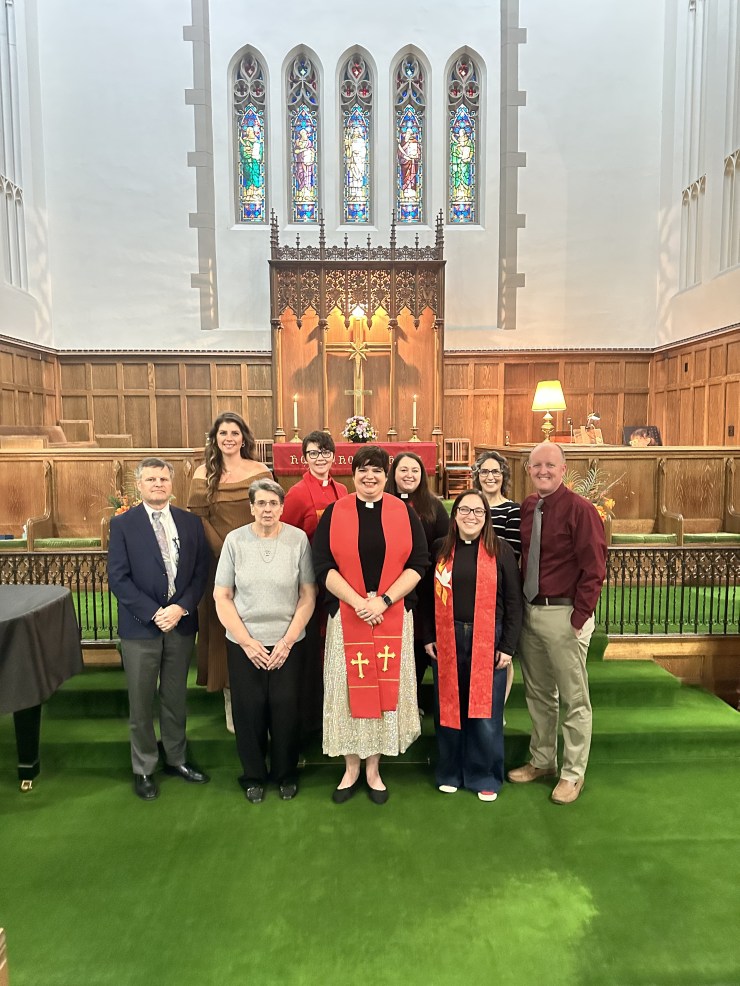
Written for The Rev. Dr. Rebecca DePoe on the occasion of her installation at the Presbyterian Church of Coraopolis on Sunday October 26th, Reformation Sunday.
Psalm 130
A Song of Ascents.
1 Out of the depths I cry to you, O Lord.
2 Lord, hear my voice!
Let your ears be attentive
to the voice of my supplications!
3 If you, O Lord, should mark iniquities,
Lord, who could stand?
4 But there is forgiveness with you,
so that you may be revered.
5 I wait for the Lord; my soul waits,
and in his word I hope;
6 my soul waits for the Lord
more than those who watch for the morning,
more than those who watch for the morning.
7 O Israel, hope in the Lord!
For with the Lord there is steadfast love,
and with him is great power to redeem.
8 It is he who will redeem Israel
from all its iniquities.
Before I start the sermon, I’m taking a moment of personal privilege to tell you the story of my baptism. I came home from seminary one day and called my mom to ask what my baptism was like. To my surprise, I wasn’t baptized at Sharon Church in Moon Twp, but at The Presbyterian Church in Coraopolis.
I asked her to tell me what she remembered about the service. She said that I screamed the entire time. The minister was young and nervous, and she didn’t think he said all the right words. What?!? And then she said, don’t worry your baptism still worked.
So, I guess this will be the second sermon I’ve given at the Presbyterian Church of Coraopolis and if I don’t say all the right words, I’m sure it will still work.
Psalm 130 is one of my favorites. I am often awake in the middle of the night or at least a couple of hours before my alarm goes off watching and waiting for morning. Even when I’m not worried about something specific, I seem to always be thinking about what’s next. What’s next in my personal life, what’s next for our church, what’s next for our country, what’s next … there is never an end to that question, because even when we get to a place of resolution, we can always ask, now what? Maybe some of the members of the PNC have lost sleep at some point in the process wondering what’s next for the Presbyterian Church of Coraopolis. And if you’re anything like me, you thought to yourself, when we get our new pastor, I will feel much better. And you did. For a minute. And then you found something else to worry about. So, you’re not sleeping well, again. On top of not sleeping well, you are also beating yourself up for not feeling better now that the new pastor is here.
So, let me share a little wisdom Pastor Rebecca shared with me and our pilgrimage group. You’re not going to sleep well. There will be a point at which you will be tired and cranky. And if you need to use the bathroom, say so, because chances are someone else does too. Okay, that last piece of advice is specific to a long day on pilgrimage, but I want you to hear that your Pastor knows you are human. On a pilgrimage, we have chosen to live together in an unfamiliar place so that we can experience God in a new way. That means we are going to be uncomfortable, and we need to communicate with each other how we are feeling so that we don’t melt down. Pastor Rebecca and Pastor Laura always do a great job of acknowledging that while we are doing life together, it won’t always be easy or perfect, but if we communicate clearly and tell the truth about how we are feeling we will be able to deal with situations before they become unmanageable. The best part of being on a pilgrimage led by your pastor, is that she is intentional about cultivating a community of love and compassion, where we can tell the truth and take care of one another and live more fully into the life to which God is calling us.
Being part of a church is like being on a long-term pilgrimage. We are gathered here because we believe that living our Christian faith together in this place and for this community matters. And like Pastor Rebecca, the Presbyterian Church of Coraopolis knows that people will join this church for a variety of reasons and they will bring their gifts and their weaknesses with them.
I love your mission statement, it reads: To everyone who has faith or needs it, who lives in hope or would gladly do so, whose character is glorified by the love of God or marred by the love of self; to those who pray and those who do not, who mourn and are weary or who rejoice and are strong; to everyone, in the name of Him who was lifted up to draw all people unto Himself, this Church offers a door of entry and place of worship, saying, ‘Welcome Home!’.
That is quite a crew to invite on your church pilgrimage. So, I’m going to repeat Pastor Rebecca’s wisdom, you aren’t always going to sleep well. You will get tired and cranky. You are human. Remember you are called to be honest, compassionate, and steadfast in love for one another; and this pilgrimage will also be beautiful and transformational.
Transformational is one of those words that feels never ending. How do we know when we are transformed? Are we ever done? What’s next?
As much as I identify with the sleeplessness of anxiously watching for the morning, I know that there is another way, a better way, to watch for the morning that Psalm 130 is pointing us to. Keeping watch is more than just watching time tick by; it is looking expectantly for what we know is coming; it is taking hopeful steps towards the future we anticipate.
For the Presbyterian Church of Coraopolis, you are trusting in God’s love and working towards a future where more of your community will experience love in meaningful ways through your mission work and in worship. Your continued support of programs like meals on wheels and the west hills food bank ensures that your neighbors are fed and cared for. The preschool and other children’s programs provide a safe place for children to learn and grow. Your openness to welcoming worshipers who have doubts and are struggling to pray means you are willing to love people as they are and support their spiritual growth. It is slow steady work. And it is work that transforms individual lives and entire communities.
This is the work of a church that is reformed and always reforming.
Being part of the PCUSA means that we are part of a larger church with a long history. Some of that history is joyful and we can celebrate how the presbyterian church works to be inclusive, anti-racist, and sets goals for mission based on the Matthew 25 initiative. And some of our history is… well… not joyful. The church has also been marred by self-love and preserved our power and privilege at the expense of the marginalized and oppressed. I think part of our work as the PCUSA is to acknowledge those instances when we have been less-than what God calls us to be. Then work towards repairing the damages we’ve done, trusting in God’s steadfast love to guide and sustain our work.
To illustrate how I think that work can be done, I want to talk about the pilgrimage to Scotland that Pastor Rebecca and Pastor Laura led last spring.
Along with the wisdom about how we live together, our pilgrimage group engaged in academic rigor before our trip. We read three books, one about John Knox, one about Mary Queen of Scots and the other about Celtic Spirituality. We gathered to prepare for the trip together by discussing the books, drinking tea, and sharing videos of highland cows. During our time in Scotland, we visited Holyrood Palace where Mary Queen of Scots resided for a time, John Knox’s house, and we took a Witches of Edinburgh tour.
Mary Queen of Scots lived from 1542 to1587, John Knox lived from 1514 to 1572. Mary and John met a few times in person but most of their relationship was one-sided with John bashing Mary while reforming the church and the monarchy with his sermons and writings.
In 1558, John Knox wrote “The First Blast of the Trumpet Against the Monstrous Regiment of Women”. He was reforming the church but also playing into the politics of the time and working to get a protestant ruler of Scotland. Mary Queen of Scots was Catholic, so in his zeal, Knox preached against iconography, idolatry, and the leadership of women to undermine Mary’s rule. That backfired on him as Elizabeth I the protestant monarch in England, forbid him to live in England for his stance on women in leadership. But as Knox had hoped, in Scotland Mary spent most of her “reign” on house arrest while her son James the VI of Scotland was raised by a protestant family. James is also known as James I of England and his rule beginning in 1603, marked the first time England and Scotland were united under one monarch, as they are today.
Knox’s words, and those who followed his teachings helped form the protestant church and secure its link to the monarchy, privilege, and power. These early church fathers did some real damage to the church, to women, and to other marginalized people.
While I appreciate the protestant reformation’s legacy of faith that created the church that we are all participating in now, I know that this reformation as led by John Knox was never supposed to include me, or Pastor Rebecca or most people participating in leadership roles in this worship service today. We are here today because the church chose to continue reforming.
In the dark days of Scotland’s history, between 1563 and 1736 (so beginning in Mary and John’s lifetime and continuing more than 200 years after) In these dark days, nearly 4,000 people, mostly women were accused of witchcraft. They were tortured, hanged, drown, burnt, and experienced more painful and terrible deaths than you and I can imagine. This cruelty was condoned by the church and carried out by its members. The church was complicit in the mistreatment of those it is called to serve.
In 2022, the Scottish government apologized for the atrocities and posthumously pardoned all the people accused of witchcraft. Our tour guide emphasized that this pardon is important because it acknowledges that these were not witches, but everyday people singled out for their disability, or uniqueness, or giftedness, and the pardon reminds us not to make this mistake again, but instead show kindness and compassion to everyone. The church of Scotland has not yet made a statement of apology. I hope that they will because that is the work of a church that is reformed and always reforming.
So, we will wait for the church of Scotland to issue an apology like souls who wait for the Lord, we will wait more than those who watch for the morning, more than those who watch for the morning. Church, our hope is in the Lord! For with God there is steadfast love and the power to redeem. It is God who will redeem the church from all its iniquities.
Waiting for the Lord is not anxiously watching time tick by; it is looking expectantly for what we know is coming; it is taking hopeful steps towards the future we anticipate.
So, if we anticipate a church that apologizes for the way it treated people in the past, we can take steps towards accountability and reconciliation in the present. We can reform our ways one little step at a time.
Maybe you have already made the connections to Scotland’s political changes and church reformation with the Christian Nationalist movement that is currently plaguing our country but just in case you haven’t let me say this clearly.
Christian nationalists are modern day witch hunters. Christian nationalists think that they have the divine right to rule our country because of their moral superiority (which we all know really means racial superiority). They have chosen to blame and destroy anyone who would think, worship, or vote differently than they do.
They are already killing women. They are stripping away medical care for pregnant women, the elderly, the disabled, and those experiencing poverty. They have already cut programs that provide food for school children. This week we learned that No SNAP or WIC benefits will be distributed in November and there will be no money issued from LIEHAP which helps people keep the heat on in their homes during the winter months. And they continue to harass, falsely arrest, and torture people with brown skin.
When those with privilege and power distort Christianity by using it as a tool for their own self-promotion and a weapon to keep oppressed people down, we must boldly say, this is not the way of Jesus. When the title ‘Christian’ is aligned with national pride and political power it ceases to be the gospel of Jesus Christ.
Our role in the new reformation is to continually affirm that Christians live the way Jesus Christ taught us to: feeding the hungry, giving water to the thirsty, welcoming the stranger, clothing the naked, caring for the sick, and visiting the imprisoned. As Presbyterians, reformed and still reforming, we need to dismantle any Christian nationalism in our hearts, on our lips, and in our lives. This is the slow steady work of those who place their hope in God’s steadfast love. This is what it means to watch for the morning during our dark night.
My hope, my prayer is that Pastors like Rebecca and churches like the Presbyterian Church of Coraopolis will boldly take on the work of reformation again, and again.
Amen. And Amen.

 Period Pastor Pad