My spirit soared when a Voice spoke to me: “Come, come to the Heart of Love!”
How long I had stood within the house of fear yearning to enter the gates of Love!
The New Jerusalem, the Holy City, is bound firmly together;
All who seek the Heart of Love, those who have faced their fears,
Enter the gates in peace and with great joy, singing songs of thanksgiving.
There, in harmony with the cosmos, the community gathers united in love.
Pray for the peace of the world! May all nations prosper as one!
May peace reign among all peoples, and integrity dwell within every heart!
Then will friends and neighbors, and former enemies as well, cry out,
“Peace be with you!”
For the good of the universe and in gratitude to the Beloved,
Let us serve the Holy One, of all nations with glad hearts.
Nan C. Merrill Psalms for Praying
Reflection:
Justice ushers peace into existence.
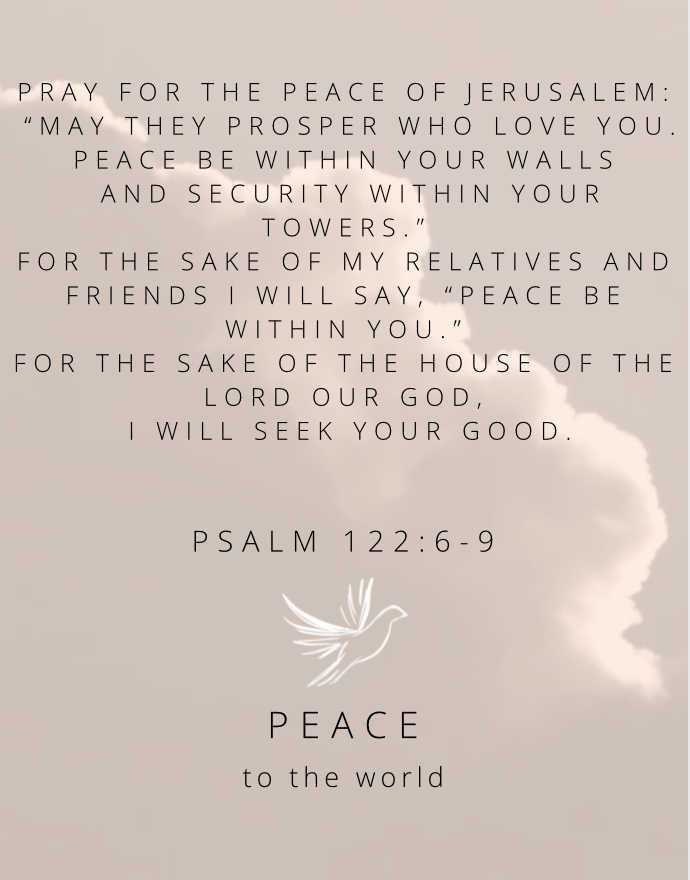
Psalm 122 is a song of praise and a prayer for Jerusalem. It is one of the Songs of Ascents which Hebrew pilgrims would have recited while ascending the uphill road to Jerusalem to attend the annual festivals held at the temple. This psalm describes Jerusalem as a safe place for people to go who are experiencing times of trouble and oppression to find security. The thrones of judgment described in the psalm refer to the monarchy in ancient Israel as the dispenser of justice. The people are on a pilgrimage for justice and they hope to find it in Jerusalem. Peace in Jerusalem meant well-being for all of God’s beloved. Peace means justice has been delivered.
It is hard to imagine Jerusalem as a city of peace. All I have ever known about modern day Jerusalem is horrifying. Walter Brueggemann in “From Whom No Secrets Are Hid” somewhat prophetically says, “when we have peace in Jerusalem, we will have peace in the world”. I hope it is so, and more than that I hope it is soon.
Let us pray for Justice and Peace for the world.
Past reflection links:
Advent 2022 Psalm 122
Check out other psalm reflections in the links below or find more of my writing published in Presbyterian Outlook or listen to my experiments in podcasting on the Period Pastor Podcast. Follow me @periodpastor
I began writing Psalm reflections during Lent of 2020. Shortly after, we decided to close the church building, work from home, and worship via zoom. Many churches use the Revised Common Lectionary (RLC) that rotates scripture on a three-year cycle (A, B, and C). Starting in Advent 2019, the church decided to worship with the texts from Year D, which is still not circulated as are years A, B, and C. Year D was created with the goal of including scriptures that were left out or not used as frequently as others. While we were using Psalms in year D, most other lectionary followers were using Year A. In Advent of 2020 we rejoined those who use the lectionary in year B. Advent of 2021 year C. When we returned to in person worship, we took the psalm reflections out of the order of worship. I continued to write them for the blog. Advent of 2022 year A. I left church work in July of 2023 but continued the practice of writing psalm reflections. Advent of 2023 year B. Advent of 2024 year C. I finished year C early, so I posted Psalm 119 and began work on missed psalms from Year D and others not in the lectionary. Advent of 2025 year A.
I use the Vanderbilt Divinity Library’s resource for lectionary readings and the PCUSA planning calendar to make text selections.
Year A Psalms
1st Sunday in Advent Psalm 122, 2nd Sunday in Advent Psalm 72, 3rd Sunday in Advent Psalm 146, 4th Sunday in Advent Psalm 80, Christmas Psalm 96, Psalm 97, Psalm 98, 1st Sunday after Christmas Psalm 148, New Year Psalm 8, Epiphany Psalm 72, 1st Sunday after Epiphany Psalm 29, 2nd Sunday after Epiphany Psalm 40, 3rd Sunday after Epiphany Psalm 27, 4th Sunday after Epiphany Psalm 15, 5th Sunday after Epiphany Psalm 112, 6th Sunday after Epiphany Psalm 119, Transfiguration Sunday Psalm 2 or Psalm 99.
Ash Wednesday Psalm 51, 1st Sunday in Lent Psalm 32, 2nd Sunday in Lent Psalm 121, 3rdSunday in Lent Psalm 95, 4th Sunday in Lent Psalm 23, 5th Sunday in Lent Psalm 130, 6th Sunday in Lent Psalm 118 or Psalm 31.
Holy Week: Monday Psalm 36, Tuesday Psalm 71, Wednesday Psalm 70, Thursday Psalm 116, Friday Psalm 22, Saturday Psalm 31.
Easter Psalm 118 or Psalm 114, 2nd Sunday of Easter Psalm 16, 3rd Sunday of Easter Psalm 116, 4th Sunday of Easter Psalm 23, 5th Sunday of Easter Psalm 31, 6th Sunday of Easter Psalm 66, Ascension of the Lord Psalm 47 or Psalm 93, 7th Sunday of Easter Psalm 68, Pentecost Psalm 104.
1st Sunday after Pentecost Psalm 8, 2nd Sunday after Pentecost Psalm 33 or Psalm 50, 3rd Sunday after Pentecost Psalm 116 or Psalm 100, 4th Sunday after Pentecost Psalm 86 or Psalm 69, 5th Sunday after Pentecost Psalm 13 or Psalm 89, 6th Sunday after Pentecost Psalm 45 or Psalm 145, 7th Sunday after Pentecost Psalm 119 or Psalm 65, 8th Sunday after Pentecost Psalm 139 or Psalm 86, 9th Sunday after Pentecost Psalm 105 or Psalm 119, 10th Sunday after Pentecost Psalm 17 or Psalm 145, 11th Sunday after Pentecost Psalm 105 or Psalm 85, 12th Sunday after Pentecost Psalm 133 or Psalm 67, 13th Sunday after Pentecost Psalm 124 or Psalm 138, 14th Sunday after Pentecost Psalm 105 or Psalm 26, 15thSunday after Pentecost Psalm 149 or Psalm 119, 16th Sunday after Pentecost Psalm 114 or Psalm 103, 17th Sunday after Pentecost Psalm 105 or Psalm 145, 18th Sunday after Pentecost Psalm 78 or Psalm 25, 19th Sunday after Pentecost Psalm 19 or Psalm 80, 20th Sunday after Pentecost Psalm 106 or Psalm 23, 21st Sunday after Pentecost Psalm 99 or Psalm 96, 22nd Sunday after Pentecost Psalm 90 or Psalm 1, 23rd Sunday after Pentecost Psalm 107 or Psalm 43, 24th Sunday after Pentecost Psalm 78 or Psalm 70, 25th Sunday after Pentecost Psalm 123 or Psalm 90, 26th Sunday after Pentecost Psalm 100 or Psalm 95.
Sources and notes:
“Psalm 122 is the third in the series of Songs of Ascents (see Psalms 120-124). Its first work in Hebrew is the verb for rejoicing. The entire song overflows with joy over Jerusalem–being there, contemplating its significance, and praying for its peace.” Mays p. 392
“In the sequence of these pilgrimage songs, Psalm 122 serves as a song of arrival. Verse 2 locates the company of pilgrims within the gates of the city.” Mays p. 392
“The description conjures up visions of Jerusalem as a safe place, a place to which people could go in times of trouble and oppression and find security. In the ancient Near East city walls provided protection and sanctuary for inhabitants and surrounding peasant families in times of danger from enemies.” W p. 185
The thrones “in verse 5 refer to the role of the monarchy in ancient Israel as dispenser of justice to the people.” W. p 185
“The peace of Jerusalem guaranteed the well-being of the people of God.” W p. 187
Jerusalem is a place of justice. “The thrones fo judgment were the legal institutions, seats of justice, that had been established by the Davidic monarchy in Jerusalem (II Sam. 8:15; 15:2-6); the prophets held the city to be especially responsible for the provision o justice in Israel (Micah 3:9-12; Isa. 1:21-23). Pilgrimage season was likely a time when conflicts and disputes unsettled in the country courts were brought to the royal officials and their successors in the post exilic period. The peace of the community depended on the establishment of justice. Pilgrimage is a journey in search of justice.” Mays p. 393
“… for unless Jerusalem, knows peace, the place of the Presence is set in an environment that ignores and denies the purpose of the LORD (35:27).” Mays p. 394
“Given the contested reality of Jerusalem today among Israelis and Palestinians (not to mention rival Christian groups who quarrel about eh Church of the Holy Sepulcher)–we might rightly conclude that preoccupation with Jerusalem is at the center of our faith; when we have peace in Jerusalem, we will have peace in the world. It is not for nothing that the city has the name Jeru-shalom, the city of shalom. So we may pray, all of us, for the peace of Jerusalem (Ps. 122:6)–when God establishes God’s promise of justice end mercy and compassion in that holy environment.” Brueggeman From Whom No Secrets are Hid p. 84
Alter, Robert. 2007. The Book of Psalms: A Translation with Commentary New York: W. W. Norton & Company
WBC Allen, Leslie C. 1983. Word Biblical Commentary: Psalms 101-150. Vol. 21. Waco, TX: Word Books, Publisher.
Bonhoeffer, Dietrich. 1974. Psalms: The Prayer Book of the Bible. 8th ed. Minneapolis, MN: Augsburg Press.
Bourgeault, C. (2006). Chanting the psalms: A practical guide Audio Book. New Seeds.
Brueggemann, Walter. 2007. Praying the Psalms: Engaging Scripture and the Life of the Spirit. 2nd ed. Eugene, OR: Cascade.
Brueggemann, Walter. 2014. From Whom No Secrets Are Hid: Introducing the Psalms. Edited by Brent A. Strawn. 1st ed. Louisville, KY: Westminster John Knox Press.
Brueggemann, Walter. Davis Hanskins, Editor. 2022. Our Hearts Wait: Worshiping Through Praise and Lament in the Psalms Westminster John Knox Press, Louisville KY.
Brueggemann, Walter. (2002). Spirituality of the psalms. Augsburg Pub. House.
Brueggemann, Walter. (1984). The Message of the Psalms: A Theological Commentary. Minneapolis: Augsburg.
Chilson, Richard, ed. You Shall Not Want: A Spiritual Journey Based on the Psalms. Ave Maria Press, 2009.
Chittister, Joan. (2011). Songs of the heart: reflections on the psalms. John Garratt Publishing.
Cudjoe-Wilkes, G., Wilkes, A. J., & Moss, O. (2022). Psalms for black lives: Reflections for the work of Liberation. Upper Room Books.
WBC Craigie, Peter C. 1983. Psalms 1-50–Word Biblical Commentary. Vol. 19. Waco, TX: Word Books.
Creach, Jerome Frederick Davis. 1998. Psalms: Interpretation Bible Studies. Louisville, KY: Westminster John Knox Press.
DAFLER, J. (2021). PSOBRIETY: A journey of recovery through the psalms. Louisville, KY: WESTMINSTER JOHN KNOX.
W de Claisse-Walford, Nancy L. WISDOM COMMENTARY: Psalms Bks. 4-5. Edited by Barbara E. Reid. Vol. 22. Collegeville, MN: Liturgical, 2020.
Green, Barbara. 1997. Like a Tree Planted: An Exploration of Psalms and Parables Through Metaphor. Collegeville, MN: Liturgical Press.
W Hopkins, Denise Dombkowski. WISDOM COMMENTARY: Psalms Bks. 2-3. Edited by Barbara E. Reid. Vol. 21. Collegeville, MN: Liturgical, 2016.
NIB Keck, Leander E. 2015. The New Interpreters Bible Commentary. Vol. 3. Nashville, TN: Abingdon Press.
Lewis, C. S. (2017). Reflections on the Psalms. Harper One, an imprint of Harper Collins Publishers.
Mays, James Luther. 1994. Psalms. Louisville, KY: John Knox Press.
McCann, J. C. (1993). A theological introduction to the book of Psalms: The Psalms as Torah. Nashville, TN: Abingdon Press.
McCann, J. C., & Howell, J. C. 2001. Preaching the Psalms. Nashville, TN: Abingdon Press.
Merrill, N. C. (2020). Psalms for praying an invitation to wholeness (10th Anniversary Edition ed.). London, England: Bloomsbury Publishing.
Miller, Patrick D. 1986. Interpreting the Psalms. Philadelphia, PA: Fortress Press.
Morgan, Michael. 2010. The Psalter for Christian Worship Revised Edition. Westminster John Knox Press.
Schlimm, Matthew Richard. 2018. 70 Hebrew Words Every Christian Should Know. Nashville, TN: Abington Press.
Spong, M. (Ed.). (2020). The words of her mouth: Psalms for the struggle. Cleveland, OH: The Pilgrim Press.
WBC Tate, Marvin E. 1990. Word Biblical Commentary: Psalms 51-100. Edited by David Allan. Hubbard and Glenn W. Barker. Vol. 20. Waco, TX: Word.
Weems, Ann. 1995. Psalm of Lament. Westminster John Knox Pres
OTL Weiser, Artur. 1998. Old Testament Library: Psalms. Translated by Herbert Hartwell. 3rd ed. New York, NY: Manchester University Press.

 Period Pastor Pad