O come, let us sing to the Most High Creator of the Cosmos;
let us make a joyful song to the Beloved!
Let us come to the Radiant One with thanksgiving,
with gratitude let us offer our psalms of praise!
For the Beloved is Infinite, the Breathing of all.
The depths of the earth belong to Love; the height of the mountains, as well.
The sea and all that is in it, the dry land and air above were created by Love.
O come, let us bow down and give thanks,
let us be humble before the Blessed One!
For the Beloved is Supreme, and we,
blessed to be invited to friendship as companions along the Way!
O that today we would harken to the Beloved’s voice!
Harden not your hearts, as in days of old, that you be not separated from Love.
Be not like those who hear the Spirit’s Voice and heed it not,
thinking to be above the Teacher.
For life is but a breath in the Eternal Dance,
a gift to be reverenced with trust, an opportunity to grown in spirit and truth,
That in passing into new Life, you enter into the new Jerusalem.
Nan C. Merrill, Psalms for Praying
Reflection:
Psalm 95 is one of the enthronement psalms that asks the faithful to worship, give thanks, bow down, and wait for a word from the throne of God. It was written during exile and recalls the wilderness experience after the escape from Egypt. Specifically, verses 8-10 recall the people being worried about accessing water, which led them to argue and complain about Moses and God. Moses cried out to God, and God provided water from a rock (Exodus 17:1-7). The psalmist warns us not to be like those who hardened their hearts and did not trust God.
This psalm would have been important to those who are outside of the promised land in ancient times and is still important to those who are in exile or wilderness journeys today. The word the psalmist is hoping we hear is to trust that God is with us, loves us, and will provide a way for us. God will do this even when we are full of doubt and fear.
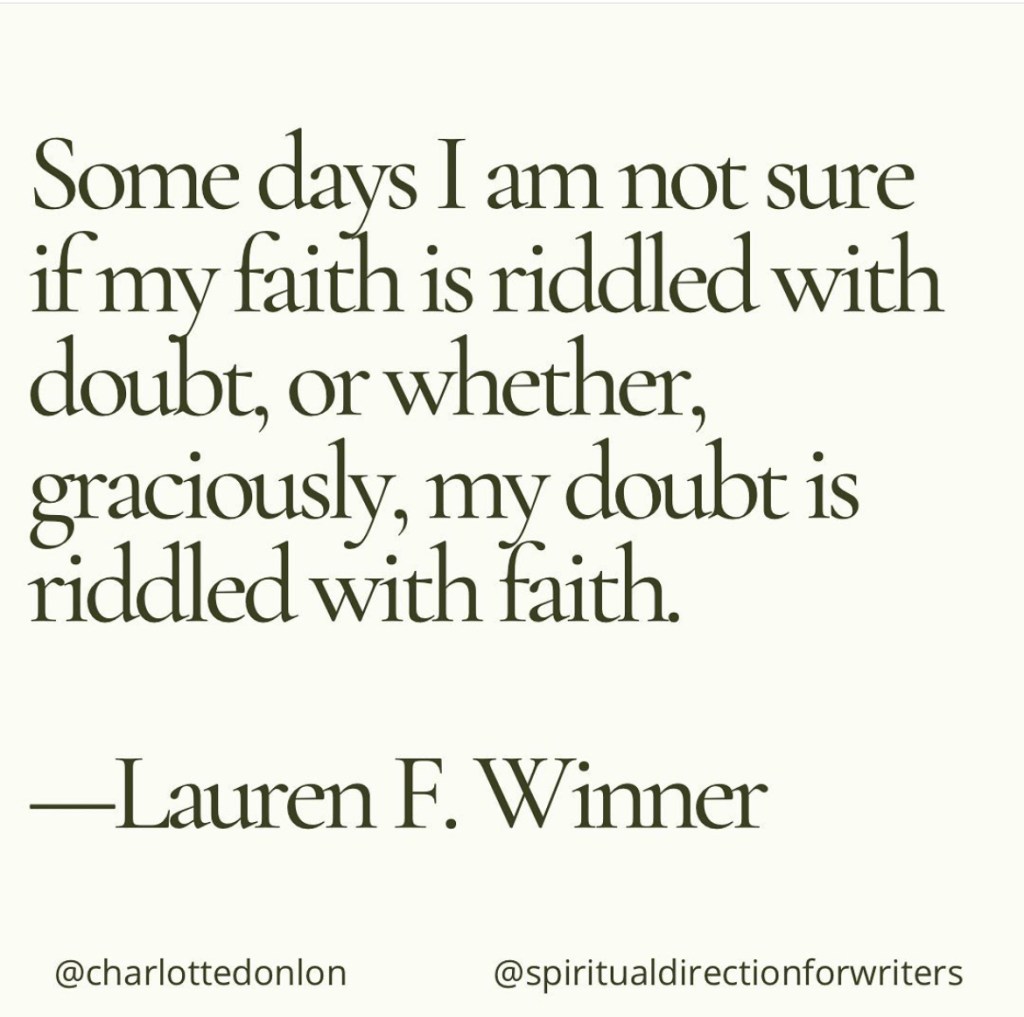
Sometimes I think of faith and doubt as conversation partners. I am one person at the table with Faith, Doubt, and God. When I talk to Doubt, the conversation is full of worry and fear. It reveals what I am concerned about and as I question doubt, it reveals a wounded part of me, a part that needs to be healed. On my best days, I can treat those wounds with love. When I talk to Faith, the conversation is full of hope, hope that all things will be well. This inspires me to work towards justice, mercy, peace, and new life. But Faith is often exhausted and doesn’t know where to start. God is a loving presence throughout the conversation. After Doubt and Faith have run out of things to say, we listen for God’s voice. Sometimes we get an idea or new clarity on our situation that seems divinely inspired. Sometimes we just feel like we’ve been hugged. I always leave the conversation with a sense of being deeply loved.
May all of the faithful listen to God’s voice so that we are not separated from Love.
Check out other psalm reflections in the links below or find more of my writing published in Presbyterian Outlook or listen to my experiments in podcasting on the Period Pastor Podcast. Follow me @periodpastor
Past reflection links:
Psalm 95 Year A (2022-2023)
I began writing Psalm reflections during Lent of 2020. Shortly after, we decided to close the church building, work from home, and worship via zoom. Many churches use the Revised Common Lectionary (RLC) that rotates scripture on a three-year cycle (A, B, and C). Starting in Advent 2019, the church decided to worship with the texts from Year D, which is still not circulated as are years A, B, and C. Year D was created with the goal of including scriptures that were left out or not used as frequently as others. While we were using Psalms in year D, most other lectionary followers were using Year A. In Advent of 2020 we rejoined those who use the lectionary in year B. Advent of 2021 year C. When we returned to in person worship, we took the psalm reflections out of the order of worship. I continued to write them for the blog. Advent of 2022 year A. I left church work in July of 2023 but continued the practice of writing psalm reflections. Advent of 2023 year B. Advent of 2024 year C. I finished year C early, so I began work on psalms I missed: Psalm 119, Year D and others not in the lectionary. By the end of 2025, I have written a reflection for each psalm.
Advent of 2025 year A.
I use the Vanderbilt Divinity Library’s resource for lectionary readings and the PCUSA planning calendar to make text selections.
Year A Psalms
1st Sunday in Advent Psalm 122, 2nd Sunday in Advent Psalm 72, 3rd Sunday in Advent Psalm 146, 4th Sunday in Advent Psalm 80, Christmas Psalm 96, Psalm 97, Psalm 98, 1st Sunday after Christmas Psalm 148, 2nd Sunday after Christmas Psalm 147, 1st Sunday after Epiphany Psalm 29, 2nd Sunday after Epiphany Psalm 40, 3rd Sunday after Epiphany Psalm 27, 4th Sunday after Epiphany Psalm 15, 5th Sunday after Epiphany Psalm 112, Transfiguration Sunday Psalm 2 or Psalm 99.
1st Sunday in Lent Psalm 32, 2nd Sunday in Lent Psalm 121, 3rdSunday in Lent Psalm 95, 4th Sunday in Lent Psalm 23, 5th Sunday in Lent Psalm 130, 6th Sunday in Lent Psalm 118 or Psalm 31.Holy Week: Monday Psalm 36, Tuesday Psalm 71, Wednesday Psalm 70, Thursday Psalm 116, Friday Psalm 22, Saturday Psalm 31.
Easter Psalm 118 or Psalm 114, 2nd Sunday of Easter Psalm 16, 3rd Sunday of Easter Psalm 116, 4th Sunday of Easter Psalm 23, 5th Sunday of Easter Psalm 31, 6th Sunday of Easter Psalm 66, Ascension of the Lord Psalm 47 or Psalm 93, 7th Sunday of Easter Psalm 68, Pentecost Psalm 104.
1st Sunday after Pentecost Psalm 8, 2nd Sunday after Pentecost Psalm 33 or Psalm 50, 3rd Sunday after Pentecost Psalm 116 or Psalm 100, 4th Sunday after Pentecost Psalm 86 or Psalm 69, 5th Sunday after Pentecost Psalm 13 or Psalm 89, 6th Sunday after Pentecost Psalm 45 or Psalm 145, 7th Sunday after Pentecost Psalm 119 or Psalm 65, 8th Sunday after Pentecost Psalm 139 or Psalm 86, 9th Sunday after Pentecost Psalm 105 or Psalm 119, 10th Sunday after Pentecost Psalm 17 or Psalm 145, 11th Sunday after Pentecost Psalm 105 or Psalm 85, 12th Sunday after Pentecost Psalm 133 or Psalm 67, 13th Sunday after Pentecost Psalm 124 or Psalm 138, 14th Sunday after Pentecost Psalm 105 or Psalm 26, 15thSunday after Pentecost Psalm 149 or Psalm 119, 16th Sunday after Pentecost Psalm 114 or Psalm 103, 17th Sunday after Pentecost Psalm 105 or Psalm 145, 18th Sunday after Pentecost Psalm 78 or Psalm 25, 19th Sunday after Pentecost Psalm 19 or Psalm 80, 20th Sunday after Pentecost Psalm 106 or Psalm 23, 21st Sunday after Pentecost Psalm 99 or Psalm 96, 22nd Sunday after Pentecost Psalm 90 or Psalm 1, 23rd Sunday after Pentecost Psalm 107 or Psalm 43, 24th Sunday after Pentecost Psalm 78 or Psalm 70, 25th Sunday after Pentecost Psalm 123 or Psalm 90, 26th Sunday after Pentecost Psalm 100 or Psalm 95.
Sources and notes:
“The liturgical sequence represents the movement of subjects into the presence of their sovereign, there to bow in submission awaiting a royal declaration from the throne. So the psalm is another that depicts and interprets the reign of the LORD. The theology is clear: The LORD is “the great king” because he is maker and ruler of the universe and maker and shepherd of his people; therefore his people should heed his voice. In its literary structure and in other features, Psalm 95 is similar to Psalms 50 and 81″ Mays p. 305
“The conduct of Israel at Massah-Meribah (Exod. 17:1-7; see Num. 20:1-13) is cited as a waring that such failure is a real possibility for people of the LORD.” Mays p. 306
“Putting God to the test is a self-centered demand for signs and wonders for me and us in the present, as if the signs and wonders of God’s creation and salvation were not enough reason to trust him, and him alone.” Mays p. 307
“The story of Mariah and Massah, related in Exodus 17, is about provision of water. It occurs not long after God delivered the people from the Egyptian army at the reed Sea (Exod 14-15). The people camped at Rephidim but there was no water to drink. They complained against Moses, saying, “Why did you bring us out of Egypt, to kill us and our children and livestock with thirst?” (Exod 17:3). God instructs Moses to strike the rock at Horeb with his staff, and water comes gushing out (Exod 17:6). The God who tamed the chaotic waters at creation (Gen 1:2) and provided water to the thirsty Israelites in the wilderness continues to provide the essential elements of life to God’s people. The words of Psalm 95:8-11 would have been powerful to the Israelites in exile in Babylon and to members of the postexilic community’ they remain powerful words today to women and men living in various “wildernesses” and exiles”. W p. 28
“The enthronement psalms are the heart of book 4, which, according to the storyline of the Psalter , is sent in the exilic period of the life of ancient Israel but calls on the people to recall the exodus and wilderness wanderings fo their ancestors. The Babylonian exile and the wilderness wanderings were “bookends,” both times when the people of YHWH were outside the land of promise, waiting to return to that land. These were undoubtedly times of great insecurity and questioning for the people.” W p.41
Alter, Robert. 2007. The Book of Psalms: A Translation with Commentary New York: W. W. Norton & Company
WBC Allen, Leslie C. 1983. Word Biblical Commentary: Psalms 101-150. Vol. 21. Waco, TX: Word Books, Publisher.
Bonhoeffer, Dietrich. 1974. Psalms: The Prayer Book of the Bible. 8th ed. Minneapolis, MN: Augsburg Press.
Bourgeault, C. (2006). Chanting the psalms: A practical guide Audio Book. New Seeds.
Brueggemann, Walter. 2007. Praying the Psalms: Engaging Scripture and the Life of the Spirit. 2nd ed. Eugene, OR: Cascade.
Brueggemann, Walter. 2014. From Whom No Secrets Are Hid: Introducing the Psalms. Edited by Brent A. Strawn. 1st ed. Louisville, KY: Westminster John Knox Press.
Brueggemann, Walter. Davis Hanskins, Editor. 2022. Our Hearts Wait: Worshiping Through Praise and Lament in the Psalms Westminster John Knox Press, Louisville KY.
Brueggemann, Walter. (2002). Spirituality of the psalms. Augsburg Pub. House.
Brueggemann, Walter. (1984). The Message of the Psalms: A Theological Commentary. Minneapolis: Augsburg.
Chilson, Richard, ed. You Shall Not Want: A Spiritual Journey Based on the Psalms. Ave Maria Press, 2009.
Chittister, Joan. (2011). Songs of the heart: reflections on the psalms. John Garratt Publishing.
Cudjoe-Wilkes and Wilkes Cudjoe-Wilkes, G., Wilkes, A. J., & Moss, O. (2022). Psalms for black lives: Reflections for the work of Liberation. Upper Room Books.
WBC Craigie, Peter C. 1983. Psalms 1-50–Word Biblical Commentary. Vol. 19. Waco, TX: Word Books.
Creach, Jerome Frederick Davis. 1998. Psalms: Interpretation Bible Studies. Louisville, KY: Westminster John Knox Press.
DAFLER, J. (2021). PSOBRIETY: A journey of recovery through the psalms. Louisville, KY: WESTMINSTER JOHN KNOX.
W de Claisse-Walford, Nancy L. WISDOM COMMENTARY: Psalms Bks. 4-5. Edited by Barbara E. Reid. Vol. 22. Collegeville, MN: Liturgical, 2020.
Green, Barbara. 1997. Like a Tree Planted: An Exploration of Psalms and Parables Through Metaphor. Collegeville, MN: Liturgical Press.
W Hopkins, Denise Dombkowski. WISDOM COMMENTARY: Psalms Bks. 2-3. Edited by Barbara E. Reid. Vol. 21. Collegeville, MN: Liturgical, 2016.
NIB Keck, Leander E. 2015. The New Interpreters Bible Commentary. Vol. 3. Nashville, TN: Abingdon Press.
Lewis, C. S. (2017). Reflections on the Psalms. Harper One, an imprint of Harper Collins Publishers.
Mays, James Luther. 1994. Psalms. Louisville, KY: John Knox Press.
McCann, J. C. (1993). A theological introduction to the book of Psalms: The Psalms as Torah. Nashville, TN: Abingdon Press.
McCann, J. C., & Howell, J. C. 2001. Preaching the Psalms. Nashville, TN: Abingdon Press.
Merrill, N. C. (2020). Psalms for praying an invitation to wholeness (10th Anniversary Edition ed.). London, England: Bloomsbury Publishing.
Miller, Patrick D. 1986. Interpreting the Psalms. Philadelphia, PA: Fortress Press.
Morgan, Michael. 2010. The Psalter for Christian Worship Revised Edition. Westminster John Knox Press.
Schlimm, Matthew Richard. 2018. 70 Hebrew Words Every Christian Should Know. Nashville, TN: Abington Press.
Spong, M. (Ed.). (2020). The words of her mouth: Psalms for the struggle. Cleveland, OH: The Pilgrim Press.
WBC Tate, Marvin E. 1990. Word Biblical Commentary: Psalms 51-100. Edited by David Allan. Hubbard and Glenn W. Barker. Vol. 20. Waco, TX: Word.
Weems, Ann. 1995. Psalm of Lament. Westminster John Knox Pres
OTL Weiser, Artur. 1998. Old Testament Library: Psalms. Translated by Herbert Hartwell. 3rd ed. New York, NY: Manchester University Press.

 Period Pastor Pad