Written for The Presbyterian Church of Coraopolis this sermon can be viewed on their youtube channel.
Living Water in the Wilderness
John 4:5–42 | Psalm 95 | Exodus 17
Life has a way of reminding us that we are thirsty.
Not the kind of thirst you fix with a glass of water. The deeper kind.
The kind that shows up when something in life feels unfinished…
when we are worried…
when we are searching for meaning or direction.
Sometimes we try to ignore that thirst. Sometimes we try to distract ourselves from it.
But every once in a while, we sit quietly—maybe at the kitchen table with a cup of tea, maybe in the car after a long day—and we notice something inside us still searching.
Still longing. Still thirsty. Because the truth is, we are all thirsty.
And the good news of this story is simple:
Where there is thirst, God is already preparing living water.
And that is where today’s Gospel begins.
Jesus is traveling and chooses a road many people would avoid. He goes through Samaria.
For generations, Jews and Samaritans had lived with deep religious and cultural hostility. Many travelers would have gone around Samaria entirely.
But Jesus goes straight through it. He stops beside Jacob’s well.
And if the first readers of John’s Gospel were paying attention, they might notice something familiar about this setting.
Because in scripture, wells are often places where life-changing encounters happen.
Abraham’s servant meets Rebekah at a well.
Jacob meets Rachel at a well.
Moses meets Zipporah at a well.
These encounters led to marriages.
So, when Jesus meets a woman at a well, readers might begin to wonder what kind of encounter this will be. Something important is about to happen.
If we imagine an ancient well in the Middle East, it likely had a large stone slab covering its opening. Jesus sits on that stone.
It seems like a small detail. But in John’s Gospel, details often carry meaning.
In Jewish tradition, the temple in Jerusalem was imagined as resting on a stone that sealed the deep waters of creation—the waters God hovered over in the beginning.
That stone marked the place where heaven and earth met.
A place where life flowed from God into the world.
Later prophets imagined water flowing from the temple itself—streams bringing life wherever they went.
So when John shows us Jesus sitting on the stone covering Jacob’s well, something symbolic begins to emerge.
Jesus is becoming a new meeting place between God and the world.
And from him will flow living water.
At first, the conversation between Jesus and the woman is awkward. She isn’t sure what to make of him.
Jews and Samaritans did not share things easily. History, politics, and religion had built walls between them.
But Jesus shifts the conversation. He begins talking about living water.
Water that doesn’t just quench thirst for a moment, but becomes a spring of life within a person.
Almost like hearing the sound of water moving somewhere beneath the surface.
The woman wonders what he means. Can he really provide water that never runs out?
And Jesus says yes. The water he gives leads to eternal life.
Because whether we realize it or not, we are all thirsty.
The conversation between Jesus and the woman moves through symbols—water, thirst, relationships, and worship. It’s important to say something clearly here.
Jesus is not passing moral judgment on the woman for her relationships. In the culture she lived in, marriage was often the only way for a woman to survive economically and socially.
Her relationships tell us more about the realities of her world than about her character.
Some interpreters understand her six relationships as symbols of incomplete worship. In the Gospel of John, the number six sometimes represents something unfinished—something that has not yet reached fulfillment.
Here, too, something new is happening.
Jesus becomes the one who fulfills what was incomplete.
The one who brings living water. The one who makes new life possible.
So when the woman begins asking about worship—about where true worship should happen—it isn’t really a change of topic.
They have already been speaking the language of worship all along.
She asks whether worship belongs on Mount Gerizim or in Jerusalem.
Jesus answers in a surprising way. We expect him to say Jerusalem, but he says, a time is coming when worship will no longer depend on a particular mountain or temple.
True worship will be in spirit and in truth. God’s presence will not be confined to one place.
It will be encountered wherever people seek God.
Eventually the woman begins to understand who Jesus is.
And when she does, she runs back to her town and tells people, “Come and see.”
In that moment, the woman who came to the well thirsty becomes the first person in John’s Gospel to carry the good news back to her community.
She doesn’t argue. She doesn’t try to prove anything.
She simply invites others to encounter Jesus for themselves.
And that isn’t the first time God’s people have been thirsty.
Long before this conversation at a well in Samaria, another group of people wandered through the wilderness wondering if God had abandoned them.
They were tired. They were afraid. They were cranky. They were thirsty.
In Exodus, they complain to Moses. And yet God brings water from a rock. Water in a dry wilderness.
Imagine that miracle and the sound of water moving where no water has been or should be.
Psalm 95 remembers that moment and warns us not to harden our hearts like those who doubted in the wilderness.
But if we’re honest, we understand them, those with doubts. Life sometimes feels like a wilderness.
And in those moments, we are still thirsty.
But scripture keeps reminding us of something important:
Where there is thirst, God is already preparing living water.
One of the things I’ve learned about faith is that it often lives right alongside doubt.
Sometimes I imagine faith and doubt sitting at the same table. Doubt names our fears and shows us where we need help.
Faith holds onto hope. And faith is exhausted because hope is hard to hold. And God sits there with us through the whole conversation.
A quiet, loving presence.
And somehow, when the conversation ends, we leave knowing that we are not alone.
In the gospel story, the Samaritan woman does not solve every question.
She simply says, “Come and see.”
Come thirsty. Come with your questions. Come with your hopes and doubts.
And if you listen closely, you might hear it— the quiet sound of living water moving.
[Pause for about 10 seconds]
Even in the wilderness of life, this promise remains:
Where there is thirst, God is already preparing living water.
Amen.
Charge & Blessing: Go into the world remembering this promise: where there is thirst, God is already preparing living water. Go thirsty for justice, mercy, and love. And may the living water of Christ refresh your heart and flow through your life, bringing hope to you and to all those you meet along the way. Amen.
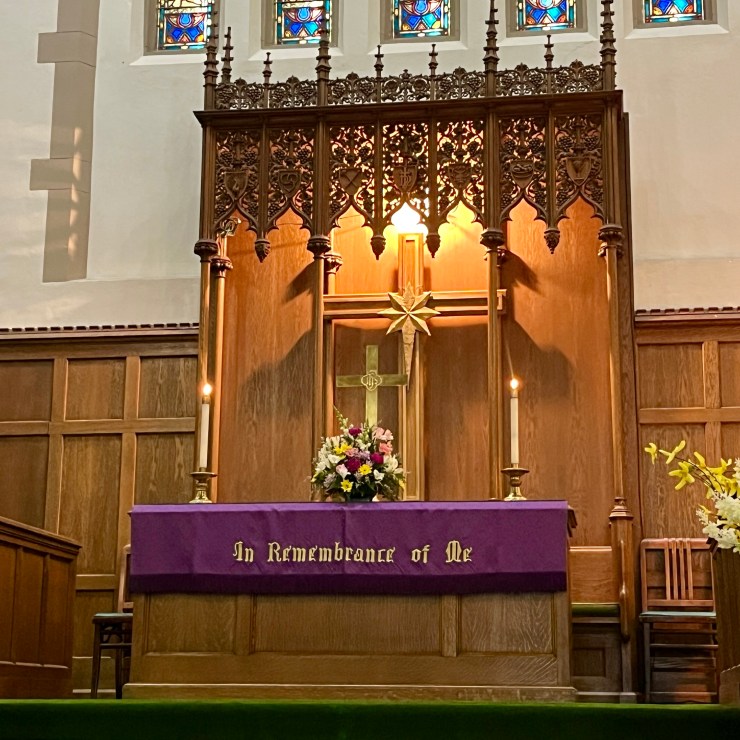
This is the second sermon where I’ve put my scripture selection, research, personal story, etc, into chatgpt and asked it to structure the sermon for me. I was able to edit and adapt it quickly, saving me tons of editing time. I also prompted it to create a 5 minute version of the sermon for the church’s Saturday night service. I wouldn’t have been able to edit down so quickly on my own. It was a life saver for doing pulpit supply after not preaching in so long (other than the period sermon). I usually write in paragraphs, but chatgpt formatted it into these shorter lines which was easier to read from the pulpit. (I did loose my place and go off script a little but not nearly as much as I do when I have longer paragraphs). I’m still a little unsure about using AI tools, but I know that it is a technology that I will have to learn how to navigate so this was a good chance to practice and see how it felt.
I want to explain that saving time is a big deal for me with sermon writing for a few reasons. One is that I have managed to fill my own schedule with other contacted work, volunteer time, etc… it’s amazing how fast my time has filled up even when the work is not full time. Even if I had all of the time in the world, I want my time to have a reasonable value when I’m doing paid work. Pulpit supply in my presbytery is generally $100 per sermon plus milage. Taking 8 to 10 hours to write and rehearse a sermon felt more manageable when I was employed full time by a church, but $100 for that much work doesn’t feel the same. Many people choose to do pulpit supply in retirement and reuse sermons they have already given. Or people in seminary that are still learning how to write sermons will do pulpit supply mostly for the practice and not the income. I’m in a weird place because I served as an associate pastor and only preached occasionally, so my repertoire is rather small, which means when I agree to pulpit supply it’s likely that I’m preaching on something I’ve never preached before.
I didn’t like the Chatgpt suggestions as much this week, so it required a little more editing on my part but it was still not as much as writing without AI and without an editor. Chat suggested adding things about the wedding in Cana and made some parallels I wasn’t familiar with, so I asked it where it drew that material from, and lets just say it came from sources I wouldn’t use so I deleted that section. This really made me feel uneasy about using AI. I talked to my husband who has been learning how to use AI for work tasks and what I probably need to do is create a master prompt so that I can tell chat what I do and do not want it to pull from as far as source material. I told it to pull from the draft I provided and period pastor but clearly it also pulled other sources. I think Chat was giving a more devotional or contemplative feel than sermon. Probably because most of my period pastor writing is psalm reflections that have that feel to them. Chat wanted me to have a “hook” for the sermon and gave me a few options, I went with “where there is thirst, God is already preparing living water” and then chat suggested using more water imagery throughout, I went with those suggestions but after preaching it, I’m not sure how necessary those were and honestly it felt a little repetitive or maybe just a little too much water imagery for me.
I’ve been attending events cosponsored by the Christian Associates of Southwest Pennsylvania and the Holocaust Center of Pittsburgh on the topic of “Reckoning with Antisemitism as Christians”. Through these events, I’ve gained new perspectives on preaching and teaching scripture (especially scriptures that Christians read during the season of Lent). These programs have also brought a deeper awareness of how easily my words (or my lack of explanation) might contribute to antisemitism in Christian congregations.
There were two areas of this sermon I considered when thinking about antisemitism. One was the gospels’ account of Jews and Samaritans rocky relationship and the other area was in using an Old Testament text of people who didn’t understand what God was doing, or weren’t able to trust in God.
I’m not sure I did a fantastic job pointing out that the disagreements between Jews and Samaritans isn’t something we need to choose a side on but I hope I didn’t unintentionally reinforce stereotypes either. In the text, Jesus is the one breaking down the dividing walls between those groups in this passage and says that neither group is able to contain God in their own box. I’m hoping that is enough to allow people to open their hearts and minds about our neighbors who worship differently. God is so much bigger than anything we can describe and certainly no religion has the exact correct way of understanding God or maintaining pleasing worship. We are all doing our best, but none of us get it right. And it really isn’t about getting it right or perfect, the point is to be in relationship with God and with neighbor. These relationships should be based on love and compassion.
Hopefully, my use of Old Testament texts came across as people have had doubt and been cranky at God for as long as we have recorded our relationship with the divine. My intention wasn’t to say the new testament people or even us today, are doing much better than ancient people when it comes to trusting in the divine. Doubt is always part of the faith story.

 Period Pastor Pad