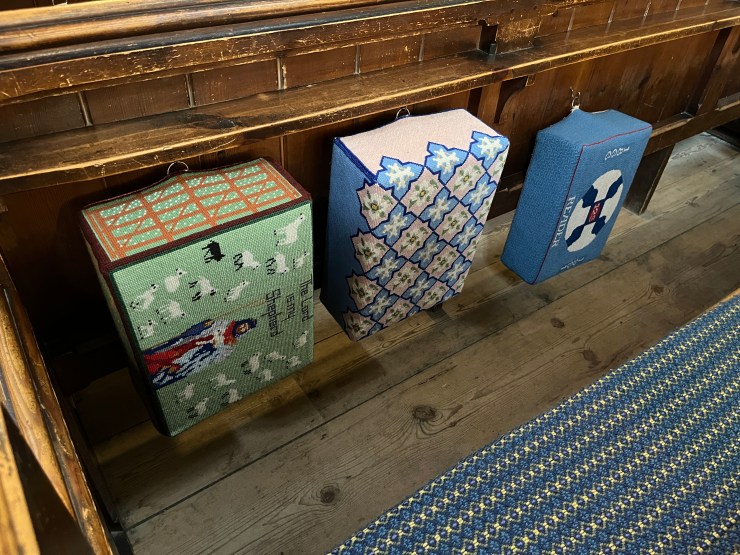
O My Beloved, You are my shepherd, I shall not want;
You bring me to green pastures for rest and
lead me beside still waters renewing my spirit;
You restore my soul.
You lead me in the path of goodness to follow Love’s way.
Even though I walk through the valley of the shadow of death,
I am not afraid;
You are ever with me;
your rod and your staff they guide me,
they give me strength and comfort.
You prepare a table before me in the presence of all my fears;
you bless me with oil, my cup overflows.
Surely goodness and mercy will follow me all the days of my life;
and I shall dwell in the heart of the Beloved forever. Amen.
Nan Merrill Psalms for Praying
Reflection:
Psalm 23 is one of the most familiar psalms, which can make it difficult to offer new insight when so much reflection already exists. Each of us carries our own feelings and experiences connected to these words.
For me, this psalm is a reminder that God is always present with us. Yet that presence does not mean we will be spared dark valleys, fear, or hardship; those are part of life. What continues to surprise me is that the abundance of an overflowing cup can be found even in those dark times. My worries and fears are no match for God’s love. Surely, I will dwell in God’s heart forever.
Psalm 23 is not only for assurance in difficult moments or for reading at funerals; it is a psalm for every stage of the faith journey. It speaks to times of celebration—baptisms, weddings, graduations, new beginnings—and any moment when we rejoice together. It is the psalm my mother taught us at the dining room table, one verse at a time, until we had it memorized. Perhaps someone in your life guided you to learn it as well. It is engraved on my heart, alongside the Lord’s Prayer and the communion liturgy from my home church. Like those prayers, Psalm 23 accompanies the ordinary movements of faith, affirming that we belong to God and to one another. We are not alone.
Take a moment to think of the person or persons who helped shape your faith, and lift those memories to God with gratitude.
Check out other psalm reflections in the links below or find more of my writing published in Presbyterian Outlook or listen to my experiments in podcasting on the Period Pastor Podcast. Follow me @periodpastor
Past reflection links:
Psalm 23 Year B (2023-2024)
Psalm 23 Year B (2020-2021)
I began writing Psalm reflections during Lent of 2020. Shortly after, we decided to close the church building, work from home, and worship via zoom. Many churches use the Revised Common Lectionary (RLC) that rotates scripture on a three-year cycle (A, B, and C). Starting in Advent 2019, the church decided to worship with the texts from Year D, which is still not circulated as are years A, B, and C. Year D was created with the goal of including scriptures that were left out or not used as frequently as others. While we were using Psalms in year D, most other lectionary followers were using Year A. In Advent of 2020 we rejoined those who use the lectionary in year B. Advent of 2021 year C. When we returned to in person worship, we took the psalm reflections out of the order of worship. I continued to write them for the blog. Advent of 2022 year A. I left church work in July of 2023 but continued the practice of writing psalm reflections. Advent of 2023 year B. Advent of 2024 year C. I finished year C early, so I began work on psalms I missed: Psalm 119, Year D and others not in the lectionary. By the end of 2025, I have written a reflection for each psalm.
Advent of 2025 year A.
I use the Vanderbilt Divinity Library’s resource for lectionary readings and the PCUSA planning calendar to make text selections.
Year A Psalms
1st Sunday in Advent Psalm 122, 2nd Sunday in Advent Psalm 72, 3rd Sunday in Advent Psalm 146, 4th Sunday in Advent Psalm 80, Christmas Psalm 96, Psalm 97, Psalm 98, 1st Sunday after Christmas Psalm 148, 2nd Sunday after Christmas Psalm 147, 1st Sunday after Epiphany Psalm 29, 2nd Sunday after Epiphany Psalm 40, 3rd Sunday after Epiphany Psalm 27, 4th Sunday after Epiphany Psalm 15, 5th Sunday after Epiphany Psalm 112, Transfiguration Sunday Psalm 2 or Psalm 99.
1st Sunday in Lent Psalm 32, 2nd Sunday in Lent Psalm 121, 3rdSunday in Lent Psalm 95, 4th Sunday in Lent Psalm 23, 5th Sunday in Lent Psalm 130, 6th Sunday in Lent Psalm 118 or Psalm 31.
Holy Week: Monday Psalm 36, Tuesday Psalm 71, Wednesday Psalm 70, Thursday Psalm 116, Friday Psalm 22, Saturday Psalm 31.
Easter Psalm 118 or Psalm 114, 2nd Sunday of Easter Psalm 16, 3rd Sunday of Easter Psalm 116, 4th Sunday of Easter Psalm 23, 5th Sunday of Easter Psalm 31, 6th Sunday of Easter Psalm 66, Ascension of the Lord Psalm 47 or Psalm 93, 7th Sunday of Easter Psalm 68, Pentecost Psalm 104.
1st Sunday after Pentecost Psalm 8, 2nd Sunday after Pentecost Psalm 33 or Psalm 50, 3rd Sunday after Pentecost Psalm 116 or Psalm 100, 4th Sunday after Pentecost Psalm 86 or Psalm 69, 5th Sunday after Pentecost Psalm 13 or Psalm 89, 6th Sunday after Pentecost Psalm 45 or Psalm 145, 7th Sunday after Pentecost Psalm 119 or Psalm 65, 8th Sunday after Pentecost Psalm 139 or Psalm 86, 9th Sunday after Pentecost Psalm 105 or Psalm 119, 10th Sunday after Pentecost Psalm 17 or Psalm 145, 11th Sunday after Pentecost Psalm 105 or Psalm 85, 12th Sunday after Pentecost Psalm 133 or Psalm 67, 13th Sunday after Pentecost Psalm 124 or Psalm 138, 14th Sunday after Pentecost Psalm 105 or Psalm 26, 15thSunday after Pentecost Psalm 149 or Psalm 119, 16th Sunday after Pentecost Psalm 114 or Psalm 103, 17th Sunday after Pentecost Psalm 105 or Psalm 145, 18th Sunday after Pentecost Psalm 78 or Psalm 25, 19th Sunday after Pentecost Psalm 19 or Psalm 80, 20th Sunday after Pentecost Psalm 106 or Psalm 23, 21st Sunday after Pentecost Psalm 99 or Psalm 96, 22nd Sunday after Pentecost Psalm 90 or Psalm 1, 23rd Sunday after Pentecost Psalm 107 or Psalm 43, 24th Sunday after Pentecost Psalm 78 or Psalm 70, 25th Sunday after Pentecost Psalm 123 or Psalm 90, 26th Sunday after Pentecost Psalm 100 or Psalm 95.
Sources and notes:
“Behind the confession of faith in psalm 23 are trials that required the psalmist to seek the shepherd’s staff and tent for protection and shelter. All that we have of the psalmist’s experience, however, is the beautiful poetic expression of confidence in the aftermath of threat and danger. That is, surely the psalmist experienced an unspecified threat, survived, and then composed this poem.” Creach p. 34
“In Psalm 23:3, life and restoration are given “for his name’s sake,” an indication that God’s offer of safe space for sheep (Israel) seres to maintain God’s name or reputation. As frequently in the Psalms, God is to act on behalf of the needy in Israel in order to vindicate God’s fidelity to God’s creation. In this way, the well-being of the sheep attests to the fidelity of the shepherd.” Brueggemann From Whom No Secrets are Hid p. 104
“The darkest valley is suddenly charged with divine provision. these two images of valley and enemies bespeak jeopardy. But, the psalmist asserts, there are sufficient resources even in such contexts: a well-laid table and a full cup of well-being. The attentive generosity of God with staff, table, and cup overrides the threatening circumstance.” Brueggemann From Whom No Secrets are Hid pp. 104-105
“There is no reason to think that Israel at the end of Psalm 22 would have promptly recited Psalm 23. Regardless, Psalm 23 provides a full culmination and resolve to Psalm 22. There is a good reason to take the two Psalms tighter. When we take Psalm 23 by itself as the church is won’t to do, it may claim far too quickly that “all is well”. Psalm 22 knows better than that. Psalm 22 knows that the darkness must be fully and deeply engaged The reality of much of life is one of divine abandonment, of being in the valley without the protective staff, of being before enemies without a good table or a full cup. The miracle of it all is that Israel and, after Jesus, the church have found the stamina and the grounding to confess that, in the abandonment, God can yet be trusted. While Psalm 22:1 is a rhetorical shock when we stop and pay attention to it, perhaps the trust voice in Psalm 23 is anticipated even there, because the very one who abandons continues to be “my God”. In the courage of faith that borders on hutzpah, the church dares to confess that “my God” who abandons is still and in any case “the Good Shepherd”. This may lead to reliance on the “goodness and mercy” of God that is given in the risen one who appears at the end of Psalm 22 in praise and in devotion to the well-being of the community.” Brueggemann From Whom No Secrets are Hid p. 105
“It is God’s companionship that transforms every situation. It does not mean there are no deathly valleys, no enemies. But they are not capable of hurt, and so the powerful loyalty and solidarity of Yahweh comfort, precisely in situations of threat. As the assertion of “comfort” is Leslie-ending (cf. Isa. 40:1-2), so here it is wilderness-ending. The end of forlornness is access to the temple, where life is ordered anew. Yet it is not the place but the vitality of the relationship which transforms. The temple comes only as a consolidation of the relationship. For one whose life has been transformed by such solidarity, a life of worshipful praise is a crown for time to come, a safe place in which to live for now. Psalm 23 knows that evil is present in the world, but is not feared. Confidence in God is the source of new orientation.” Brueggemann The Message of the Psalms p. 156
“The psalm’s confession is based on the salvation history of the people and expresses the individual’s participation in God’s ongoing salvific activity. The trust expressed is not just a matter of mood. Strength must be found, a way must be walked, harm and evil threatened. Enemies persist. That is the environment of trust.” Mays p. 118
“The psalm is written consistently from the perspective of the sheep; that is, its expression of trust and confidence presupposes an awareness of helplessness and need on the part of the one who trusts. In a distinctive fashion, the psalmist has set forth the fundamentals of the covenant relationship, not in terms of Lord and servant, but in the more intimate language of shepherd and sheep.” WBC p. 209
“In effect, to make Psalm 23 our words is to affirm that we do not need to worry about our lives (or our deaths). God will provide, and God’s provision is grounded in the reality of God’s reign. The proper response to the simple good news of Psalm 23 and Jesus Christ is to trust God. But this is precisely the rub. In a secular society, we are encouraged to trust first ourselves and to work first to secure our own lives and futures.” NIB pp. 366-367
“Psalm 23, like the Lord’s Supper, becomes finally an invitation to live under God’s rule and in solidarity with all God’s children. Thus to make Psalm 23 our own is a profoundly radical affirmation of faith that transforms our lives and our world. To be sure, Psalm 23 is to be heard in the midst of death and dying, but it is also to be heard amid the ordinary daily activities of living. And it gives these daily activities an extraordinary significance, for it invites us to share daily bread with all of God’s people.” NIB pp. 367-368
Jesus the Good Shepherd “In short, in NT terms, Jesus is shepherd, host, Emmanuel. When Psalm 23 is heard in the context of Psalm 22 and of Jesus Christ, its profoundly radical implications are even clearer: God is with us, but God is not ours to own; the God who shepherds us to life also gives life to the world; the table at which we are hosted is one to which the whole world is invited.” NIB p. 368
“There are some kinds of pain that cannot be taken away in life. Loss. Hurt. Rejection. Disability. But those who enter into the pain of another know what it is to talk about the love of a God who does not change the circumstances that form us but walks through them with us every step of the way.” Chittister p. 49
Alter, Robert. 2007. The Book of Psalms: A Translation with Commentary New York: W. W. Norton & Company
WBC Allen, Leslie C. 1983. Word Biblical Commentary: Psalms 101-150. Vol. 21. Waco, TX: Word Books, Publisher.
Bonhoeffer, Dietrich. 1974. Psalms: The Prayer Book of the Bible. 8th ed. Minneapolis, MN: Augsburg Press.
Bourgeault, C. (2006). Chanting the psalms: A practical guide Audio Book. New Seeds.
Brueggemann, Walter. 2007. Praying the Psalms: Engaging Scripture and the Life of the Spirit. 2nd ed. Eugene, OR: Cascade.
Brueggemann, Walter. 2014. From Whom No Secrets Are Hid: Introducing the Psalms. Edited by Brent A. Strawn. 1st ed. Louisville, KY: Westminster John Knox Press.
Brueggemann, Walter. Davis Hanskins, Editor. 2022. Our Hearts Wait: Worshiping Through Praise and Lament in the Psalms Westminster John Knox Press, Louisville KY.
Brueggemann, Walter. (2002). Spirituality of the psalms. Augsburg Pub. House.
Brueggemann, Walter. (1984). The Message of the Psalms: A Theological Commentary. Minneapolis: Augsburg.
Chilson, Richard, ed. You Shall Not Want: A Spiritual Journey Based on the Psalms. Ave Maria Press, 2009.
Chittister, Joan. (2011). Songs of the heart: reflections on the psalms. John Garratt Publishing.
Cudjoe-Wilkes and Wilkes Cudjoe-Wilkes, G., Wilkes, A. J., & Moss, O. (2022). Psalms for black lives: Reflections for the work of Liberation. Upper Room Books.
WBC Craigie, Peter C. 1983. Psalms 1-50–Word Biblical Commentary. Vol. 19. Waco, TX: Word Books.
Creach, Jerome Frederick Davis. 1998. Psalms: Interpretation Bible Studies. Louisville, KY: Westminster John Knox Press.
DAFLER, J. (2021). PSOBRIETY: A journey of recovery through the psalms. Louisville, KY: WESTMINSTER JOHN KNOX.
W de Claisse-Walford, Nancy L. WISDOM COMMENTARY: Psalms Bks. 4-5. Edited by Barbara E. Reid. Vol. 22. Collegeville, MN: Liturgical, 2020.
Green, Barbara. 1997. Like a Tree Planted: An Exploration of Psalms and Parables Through Metaphor. Collegeville, MN: Liturgical Press.
W Hopkins, Denise Dombkowski. WISDOM COMMENTARY: Psalms Bks. 2-3. Edited by Barbara E. Reid. Vol. 21. Collegeville, MN: Liturgical, 2016.
NIB Keck, Leander E. 2015. The New Interpreters Bible Commentary. Vol. 3. Nashville, TN: Abingdon Press.
Lewis, C. S. (2017). Reflections on the Psalms. Harper One, an imprint of Harper Collins Publishers.
Mays, James Luther. 1994. Psalms. Louisville, KY: John Knox Press.
McCann, J. C. (1993). A theological introduction to the book of Psalms: The Psalms as Torah. Nashville, TN: Abingdon Press.
McCann, J. C., & Howell, J. C. 2001. Preaching the Psalms. Nashville, TN: Abingdon Press.
Merrill, N. C. (2020). Psalms for praying an invitation to wholeness (10th Anniversary Edition ed.). London, England: Bloomsbury Publishing.
Miller, Patrick D. 1986. Interpreting the Psalms. Philadelphia, PA: Fortress Press.
Morgan, Michael. 2010. The Psalter for Christian Worship Revised Edition. Westminster John Knox Press.
Schlimm, Matthew Richard. 2018. 70 Hebrew Words Every Christian Should Know. Nashville, TN: Abington Press.
Spong, M. (Ed.). (2020). The words of her mouth: Psalms for the struggle. Cleveland, OH: The Pilgrim Press.
WBC Tate, Marvin E. 1990. Word Biblical Commentary: Psalms 51-100. Edited by David Allan. Hubbard and Glenn W. Barker. Vol. 20. Waco, TX: Word.
Weems, Ann. 1995. Psalm of Lament. Westminster John Knox Pres
OTL Weiser, Artur. 1998. Old Testament Library: Psalms. Translated by Herbert Hartwell. 3rd ed. New York, NY: Manchester University Press.

 Period Pastor Pad