Written for The Presbyterian Church of Coraopolis this sermon can be viewed on their youtube channel. This week the recording was made at the Saturday service 30@6.
John 9:1–41 | Psalm 23
Sometimes the hardest thing to change is not our circumstances.
It’s the way we see the world.
We get used to things being a certain way.
We get used to the stories we tell about why things are the way they are.
We get used to the explanations that help us feel like life makes sense.
And then something happens that challenges the way we see.
That’s what happens in today’s Gospel.
In John’s Gospel, Jesus heals a man who has been blind since birth.
But the writer of the Gospel doesn’t call this a miracle.
He calls it a sign.
A sign is a story that points beyond itself.
It points toward a deeper truth about who Jesus is.
This sign isn’t just about restoring sight.
It’s about changing how people see the world, how they understand God, and how they treat one another.
Interestingly, the actual healing takes up only a few moments in the story.
Most of the chapter focuses on what happens afterward.
How people react.
How they argue.
How they struggle to understand what has happened.
And how the man himself comes to recognize who Jesus really is.
At the beginning of the story, people are trying to answer a familiar question.
Someone asks Jesus, “Who sinned, this man or his parents, that he was born blind?”
It’s a question people have asked for centuries.
If someone suffers, someone must be responsible.
If something goes wrong, someone must have done something wrong.
But Jesus refuses that way of thinking.
He says the man’s blindness was not caused by sin.
In that moment, Jesus dismantles a powerful assumption.
Suffering is not a punishment.
This man’s blindness is not anyone’s fault.
After the healing, the man’s neighbors see him and become confused.
They start asking each other,
“Is this the same man who used to sit and beg?”
Some say yes.
Others say no.
I sometimes think it’s a little like when children see their teachers at the grocery store.
They stare and whisper to each other:
“Is that her?
That can’t be her.
She lives at the school.”
The neighbors cannot quite recognize the man anymore.
Because they have never really seen him before.
They have only known him for what he lacked.
He was blind.
He begged for money.
He lived on the margins of society.
And because of his status, he was excluded from parts of the community’s worship life.
But when Jesus restores his sight, something else changes too.
His place in society begins to shift.
The man tells his neighbors what happened.
He explains how Jesus healed him.
And in doing so, he is essentially inviting them to go and find Jesus.
In a way, he sounds a lot like the woman at the well in last week’s Gospel reading—telling people what he has experienced and inviting them to discover Jesus for themselves.
But the neighbors aren’t curious.
They’re suspicious.
Instead of asking what this healing might mean, they begin asking whether someone has broken a rule.
So they bring the man to the Pharisees.
The Pharisees were religious leaders who helped people interpret the law and understand how to live faithfully.
They listen to the story and begin debating.
If Jesus healed this man, perhaps he is a prophet.
But the healing happened on the Sabbath.
And if Jesus worked on the Sabbath, maybe he’s a sinner.
They argue back and forth.
If he’s a sinner, how could he perform such a healing?
But if he performed such a healing, how could he be a sinner?
Unable to decide, they ask the man what he thinks.
And he says something simple.
He says Jesus is a prophet.
Someone sent by God.
Apparently that answer isn’t good enough.
So they call the man’s parents.
Maybe the parents can clarify things.
But his parents realize they are in a dangerous situation.
If they blame sin, they condemn themselves or their son.
If they deny the blindness, they deny the healing everyone knows has happened.
And if they support Jesus too strongly, they risk being expelled from the community.
So they say carefully,
“He is our son.
We know he was born blind.
But how he now sees, we do not know.
Ask him.
He is an adult.”
So the man is summoned again.
Once again he is questioned.
Once again they accuse Jesus of being a sinner.
And the man responds with one of the most honest statements in scripture.
“I don’t know whether he is a sinner.
All I know is this:
I was blind.
And now I see.”
And then, almost playfully, he asks them a question.
“Do you want to hear the story again?
Do you also want to become his disciples?”
That question makes them furious.
And they drive him out.
The man who had been excluded because he was blind is now excluded again.
This time because he believes Jesus is from God.
The healing that should have restored him to society ends up pushing him out once more.
Just for different reasons.
And if we’re honest, we’re not so different from the people in this story.
We still want explanations when something goes wrong.
We still want to know who is responsible.
We still struggle when something challenges the way we understand the world.
At the beginning of the story, people are trying to figure out why the man was born blind.
Did his parents sin?
Did he sin?
Is God punishing someone?
But sometimes painful things happen without a clear explanation.
And when we spend all our time looking for someone to blame, we forget something more important.
Offering help.
Creating space.
Showing compassion.
I wish we could be more like Jesus.
Offering compassion instead of blame.
Even after the man is healed, people resist seeing him differently.
It’s almost as if keeping him in the role of beggar makes them feel more secure about their own lives.
If he is suffering, maybe they can reassure themselves that they must be doing something right.
We still do that today.
We compare our lives to the struggles of others and convince ourselves that we must deserve the good things we have.
But that way of thinking prevents us from recognizing the humanity of our neighbors.
I wish we could be more like Jesus.
Offering compassion instead of oppression.
The story also shows how easy it is to get caught up in doing things the “proper” way.
Instead of celebrating that a man who had never seen can now see, people argue about whether the healing happened on the wrong day.
Rules matter.
Traditions matter.
But when they become more important than people, something has gone wrong.
Throughout history, systems of power have often disguised cruelty as order.
Injustice can hide behind words like tradition, respectability, or law and order.
When maintaining the status quo becomes more important than human dignity, people suffer.
I wish we could be more like Jesus.
Offering compassion instead of cruelty.
Jesus shows us something different.
God’s compassion often appears in unexpected places.
God refuses to stay inside the boxes we build to contain our ideas about the divine.
And God transforms us—not through power, not through coercion, but through love.
And it is love that remains with us.
Not perfection.
Not certainty.
Not an easy life.
Love.
Psalm 23 reminds us of this promise.
We will walk through dark valleys.
We will experience fear.
We will encounter hardship.
But we will not walk alone.
God’s promise is not that life will be easy.
God’s promise is presence.
And when we allow that love to shape us, something changes.
We begin to see differently.
We begin to live differently.
We begin to show up for one another.
In moments of joy.
In moments of struggle.
In light.
And in shadow.
Maybe the question this story leaves us with is simple.
When God opens our eyes…
what will we choose to see?
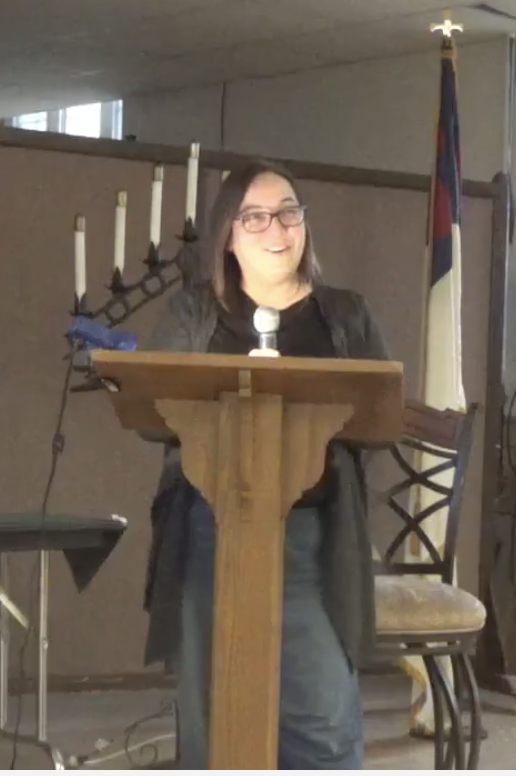
I’ve been experimenting with using Chatgpt to edit sermons and help me speed up my writing process. I was hopeful that I had enough writing examples on this blog that Chat could imitate my voice and my beliefs. It sort of works, but it’s not perfect. I didn’t really like the sermon from last week as I was preaching it… and that’s the worst feeling. It was fine, but it didn’t feel right. I think I lost too much of my own voice by taking too many of chat’s suggestions. Perhaps I was experiencing too much self-doubt and trusted AI instead of my instincts.
This week, I decided to prompt the chat a little differently, so I asked it to edit for grammar and flow and then to make suggestions. I didn’t use all of the suggestions this time. One of the suggestions was the very thing I was trying to avoid, to use sight/blindness, darkness/light as a metaphor (only used one at the end). These metaphors tend to fall down the slippery slope of equating goodness/godliness with being able bodied and light (and whiteness) and darkness (or blackness) with bad. Jesus is clear that this man’s blindness was not caused by sin, so I didn’t want to muddy that message by using sightedness as a metaphor for understanding God. I was also careful in my word choices to describe the people in the story as simply people and not Jews. I didn’t want to accidentally reinforce antisemitic stereotypes either.
I did notice that AI softened my language about white christian nationalism, racism, and antisemitism. It made me wonder if Chatgpt has a political bend. And I wondered how wise it is for a guest preacher to say something that would cause the congregation to divide politically over a sermon. Ugh.
Even after using AI to help edit I spent between 10 and 15 hours on this sermon. I’m not great at paying attention to the clock as I’m working but I spent a full Friday on writing and editing after short spirts of researching and note taking earlier in the week. I only managed to rehearse it twice through before preaching on Saturday. It’s hard to describe how my process works, but some texts come together quickly and others are a real challenge. This was one would be in the challenging category.
If I was doing this purely for the paycheck, pulpit supply is not worth it. But, this sermon set is mostly to help out a dear friend while she is recovering from surgery and it is priceless to be able to help and alleviate worry for her. I also love visiting her with a stack of cards from her congregation. They have also sent me with soup in previous weeks. Often, when our friends are having a hard time we feel helpless, but this time I am able to do things that are actually helpful and that feels amazing. And, I’m getting to learn to use AI tools so this sermon series is also a learning opportunity. Having a Saturday night short version, and Sunday morning longer version of a sermon is a unique context so I’m learning a lot about preaching (and editing) by having to provide sermons for each based on the same text. In previous weeks, I’ve had AI shorten the Sunday sermon. This week…. I didn’t like the shortened version, so I cut the scripture readings except for the gospel, shortened the pastoral prayer, and tried to deliver the sermon quickly (but clearly). I went 6 minutes over on Saturday night for the 30 minute worship service. Luckily, people were gracious about the overtime, especially since the Saturday night service is intentionally meant to be quick and informal.
Below is the prompt I started with. Chat makes suggestions and I respond or edit what chat suggests. I didn’t capture the entire process, but the intro and the conclusion of the sermon came through that interaction.
Edit the following for grammar and flow. Make suggestions for how to style this like a period pastor sermon.
John 9:1-41 Psalm 23
Jesus heals a blind man, and the writer of the gospel calls this a sign not a miracle. A sign is a story that points beyond itself, it points to a deeper truth about who Jesus is. Jesus is going to change how we see the world, how we relate to God, and how we treat our neighbor.
The actual healing is a brief part of this story. Most of the story is about what happens after, how the people respond, and how the man becomes a follower of Jesus, and Jesus’ identity as being sent from God.
There is a lot of discussion about who’s fault it is that this man is blind. His? His parents? Jesus answers these questions by saying that the blindness was not caused by sin. Jesus dismantles the assumption that suffering is a punishment. This man’s blindness is not anyone’s fault.
The man’s neighbors don’t recognize him after he is healed. I’m not exactly sure what this is about but I think it’s like when kids see their schoolteachers at the grocery store. Is that her? Couldn’t be. She lives at the school.
For this man’s neighbors, they have never seen him as someone like them. They only know him for what he lacks, physical sight. He is separated from them because he does not work but must rely on begging and he is not allowed in some of the worship spaces because of his social status. So, when Jesus restores his sight, he also changes this man’s status in society. When he explains how he was healed he is inviting his neighbors to go find Jesus in a similar way to how the woman at the well from last week’s story evangelizes her neighbors. But instead, the neighbors are more concerned about if Jesus and this man broke a law.
They take the man to the Pharisees, who are religious leaders that help people interpret the religious laws and how to live according to God’s word. They hear the story of healing and debate about whether (or not) Jesus is from God. Only a great prophet would be able to heal this man, but a great prophet would also be following God’s word to the letter and Jesus performed this healing on the sabbath thus breaking the command to rest from work on the Sabbath. But if Jesus was a sabbath breaker and sinner, he would not be able to heal this man, so he must be from God. So, they are stuck without a clear decision, so they ask the man what who was healed and he tells them that he believes that Jesus is a prophet, someone sent by God.
It isn’t clear if it’s the Pharisees or the neighbors who are unsatisfied with this answer, but an undefined “they” ask to talk to the man’s parents. Maybe the parents can clear up the matter. But his parents are afraid to get caught in a trap. They don’t want to say that it is their sin that made their son blind in the first place. Nor do they want to say he wasn’t born blind and deny the miracle. Maybe they already knew that the Pharisees couldn’t agree on if Jesus was a sinner or a prophet. They were in a no-win situation. So, they said, ask our son, he is an adult and can speak for himself.
Again, the man is summoned. They ask the same questions over again. They accuse Jesus of being a sinner. The man will neither confirm nor deny but says what he does know is that he was blind but now he sees. Then he asks them if they want him to repeat his story so that they might also become Jesus’ disciples. Their response is anger and they drive him out. The man who was excluded for his blindness and status of beggar, is now excluded for believing that Jesus is from God. The healing that should have restored him to being a full member of society has marginalized him again, but for new reasons.
I don’t think we are so different from the people in the story. We look to blame someone for the suffering we see. We have a hard time figuring things out when something doesn’t fit our preconceived notions. We don’t know what to do with transformation, when our reality shifts for better or worse.
At the beginning of the story, people were trying to figure out why the man had been born blind. Did his parents sin? Did he sin? Is God punishing someone? Is there purpose for this suffering? We compare our reality to a made-up idea of perfection and goodness. But real life isn’t perfect, sometimes bad things happen without a reason. We get caught up in trying to figure out who’s fault it is instead of offering help, or accommodations, or working to dismantle a system that keeps people poor and sick with no way out. I wish we could be more like Jesus, offering compassion instead of blame.
After the man is healed, people don’t seem to believe him or want him to move out of his position of beggar and have a different life. It’s as if keeping him down is making them feel better about themselves. They can point to him and think, I didn’t do anything so bad as to cause God to make me blind, so I must be good. We use other people’s hardship to feel better about ourselves. We see ourselves as deserving of a good life but feel that others who don’t have it as good as we do must be less deserving. This line of thinking prevents us from seeing the humanity and goodness of our neighbors. I wish we could be more like Jesus, offering compassion instead of oppression.
I also think this story shows us how easy it is to get caught up in doing things the proper way or following the rules. Instead of rejoicing that this man could see, the people in the story thought that he and Jesus must have broken rules. Somehow the way in which the miracle occurred discounted it. This idea of perfectionism, rule following, polite society norms are ways in which white Christian nationalism, racism, antisemitism and all sorts of discrimination are left unchecked because we value status quo (as set by wealthy white men) over human life, liberty, and happiness. We disguise our cruelty as law and order. I wish we could be more like Jesus, offering compassion instead of cruelty.
Jesus shows us that God’s compassion can show up in unexpected ways; that God is bigger than the boxes we build to hold our concept of the mysterious divine. God is with us, transforming us into more compassionate people. God does this, not with power, or law, or coercion, but with love.
It is love that is with us always. Not perfection, not good health, not easy life. God’s love accompanies us throughout life’s ups and downs. The 23rd Psalm reminds us God’s presence with us. We will not be spared dark valleys, fear, or hardship; those are part of life. God’s promise is to be with us no matter what. And when we can be our best selves, modeling Jesus’ compassion, we can show up for our neighbors, in good times and in bad.

 Period Pastor Pad