Easter – Sunday Isaiah 65: 17-25 and John 20:1-18: An unexpected ending is now a beginning
This sermon was written for The Coraopolis Presbyterian Church a recording can be found on their youtube channel.
Friends, we are truly glad you’re here today.
Whether you come every week or find your way here at Christmas and Easter, your presence matters. There is something sacred about choosing—amid busy lives and many demands—to step into a place of worship and be among others who are seeking God. That choice is meaningful, and we honor it.
These seasons remind us that God meets us in powerful and unexpected ways—in a manger, at an empty tomb, and in moments just like this one. And wherever you find yourself on your journey of faith—full of belief, full of questions, or somewhere in between—you are welcome here.
Today, you are not guests. You are part of this community, part of this story, and part of what God is doing in the world.
I found that to be true because I’m here as a guest preacher. I’ve felt like part of this community. And part of what God is doing in the world.
So, on behalf of my community, we’re grateful you came.
In both Christmas and Easter, we celebrate God doing something remarkable through the life of Jesus. In both seasons, we remember God entering the world in a new way and transforming it and we look forward to when God will enter the world and transform it again.
In the Advent/Christmas and Easter seasons, we read from Isaiah because Isaiah lives in the tension between promise, fulfillment, and future hope. Isaiah speaks into a world that feels broken and announces: God is not finished.
Based on this vision from Isaiah, Glenn L. Rudolph wrote the song, “The Dream Isaiah Saw” and I want to share some of the lyrics with you:
Lions and oxen will sleep in the hay
Leopards will join with the lambs as they play
Wolves will be pastured with cows in the glade
Blood will not darken the earth that God made
Peace will pervade more than forest and field
God will transfigure the Violence concealed
Deep in the heart and in systems of gain
Ripe for the judgement the Lord will ordain
Nature reordered to match God′s intent
Nations obeying the call to repent
All of creation completely restored
Filled with the knowledge and love of the Lord
Little child whose bed is straw
Take new lodgings in my heart
Bring the dream Isaiah saw
Life redeemed from fang and claw
Bring the dream Isaiah saw
Justice purifying law
Bring the dream Isaiah saw
Knowledge, wisdom, worship, awe
For Easter, we might change the chorus to:
Risen Lord, who left tomb’s cold maw
Change my life, dwell in my heart
Bring the dream Isaiah saw
Life redeemed from fang and claw
Bring the dream Isaiah saw
Justice purifying law
Bring the dream Isaiah saw
Knowledge, wisdom, worship, awe
God enters the world to transform it into a new creation. We will have new ways of relating to God and one another. All manifestations of evil will be gone: no sorrow and no pain. The animals will not hurt or destroy each other either. I cannot imagine a lion and an ox eating straw together, nor can I image that a wolf and a lamb as playmates. These visions seem as unlikely as resurrection. As unlikely as seeing Lazarus walk out of a tomb. As unlikely as Jesus standing in the garden beside his grief-stricken friend.
The new creation God proclaims is so different from the world as we know it. And yet, God’s new reality for all creation, generating a good life where peace reigns, can be seen breaking through even in the most unlikely places.
Isaiah’s vision of this transformed redeemed world can inspire us to work towards new life, a resurrected life.
In John’s telling of the resurrection, Mary comes to the garden alone, not to anoint the body, not to do anything, but simply to cry near Jesus’ grave.
Mary comes to the tomb—not with hope, but with grief.
She has been a witness to all that has happened to Jesus in the last week, so when she finds the tomb empty, she assumes calamity, another humiliating thing has happened to him. His body has been taken. She imagines an anonymous “they” who have stolen the body. This is suffering upon suffering. She turns away from the tomb and runs to tell the other disciples. Maybe she is hoping they will help her locate Jesus’ body. Maybe they will know what to do next. Maybe she simply doesn’t want to be alone in this moment.
They run back. Peter and the beloved disciple race back. And John makes a big deal about the beloved disciple arriving first but stopping outside the tomb. Peter, arriving second, rushes into the tomb. He sees the empty tomb first, and then the linen wrappings and cloth laying there, but we don’t know how he reacts to the sight. The beloved disciple sees and he believes. John doesn’t tell us what he believes but that he believes but does not understand. So, they turn and go home. They do nothing with the information that the tomb is empty. They just go home.
They go home. But Mary stays.
Mary stays and weeps outside of the tomb. Eventually, she looks in and sees two angels where the body was, one where Jesus’s head would have been and the other at his feet. This image is a vague reminder of the arc of the covenant with the angels on each end of it. Perhaps we are to think of Mary as entering the tomb as if she is entering the holy of holies, God’s dwelling place on earth.
Mary’s grief has brought her into the heart of God.
When the angels ask her why she is weeping, she repeats what she said to the disciples, “they have taken away my Lord, and I do not know where they have laid him.”
In most biblical scenes, angelic appearances provoke fear, awe, or even fainting. It’s as if Mary’s sorrow narrows her world so completely that even heaven breaking in doesn’t register as remarkable.
Mary cannot see past her grief. She cannot see past the reality she knows.
Jesus has died and on top of it, someone has taken him.
She assumes that “they” have done something, and not that God is doing something.
And after all the horrible things she has witnessed in the last week, who could blame her for assuming the worst.
She then turns to see a gardener. And has the same conversation all over again. He asks, “Why are you weeping? Who are you looking for?”, And Mary says, “Sir, if you have carried him away, tell me where you have laid him, and I will take him away.” She is sure that someone moved the body and her only hope is that this gardener might be able to tell her where to go next.
Because after all, the disciples, who she called for help, have gone home. She is consumed by sorrow. In her grief, all she can think about is what has happened, and what they have done. She cannot see that she is standing on holy ground in front of the living God.
Then he calls her name. God calls her name. Mary.
The gardener is the creator of the world; the good shepherd who calls the sheep by name; Her favorite Rabbi, and when he calls her name, she recognizes him.
I like to think she recognizes the love in his voice. Jesus.
He tells her not to hold onto him.
Maybe what he means is not to hold onto the past reality but to live in this new life.
The story is still unfolding. This is not the end.
He calls her by name to announce to the disciples—and by extension all who would believe, even us, —an unimaginable future. This good news is only the beginning of an ongoing revelation of what resurrection might mean, resurrection is a commissioning.
Resurrection is sending Mary (and all believers) into the world to say that death is not the last word. Death seemed final, but it wasn’t. Resurrection felt like a conclusion too; but it isn’t, it is the on-going work of the reign of God that is continuing to unfold in our lives.
Mary is sent. She becomes the first witness of resurrection. The first preacher of Easter.
She goes to tell the others: An unexpected ending is now a beginning—a new revelation in the on-going work God has been doing in creation.
Isaiah’s vision and Easter morning meet here: A world being remade. A creation being restored. A future breaking into the present.
And we are part of it. We are sent—like Mary—to live resurrection lives.
Because resurrection is not just something we believe. It is something we live.
Like Mary, the disciples, and all believers, we are invited to participate in this earth changing mission.
We are called to work for the end of war and all forms of cruelty.
We are charged to demand justice and healing, helping the poor and oppressed.
We are sent to share the wisdom we have received from God about how this world could be with our neighbors.
We do all these things in the way Jesus would do them.
And I hope that when we do, our neighbors will hear his love in our voice.
Amen.
Benediction:
Go now as people of the resurrection.
Do not remain at the tomb,
do not cling to what has been,
but step into the new life God is unfolding even now.
Go as those who have heard your name spoken in love.
Go as those sent, like Mary, to share good news:
That death is not the last word.
That hope is alive.
That God is still at work in this world.
So seek peace where there is violence.
Bring justice where there is brokenness.
Offer love where there is grief.
And as you go,
may the risen Christ walk beside you,
may the Spirit give you courage,
and may God’s new creation take root in you and grow through you—until all things are made new.
Amen.
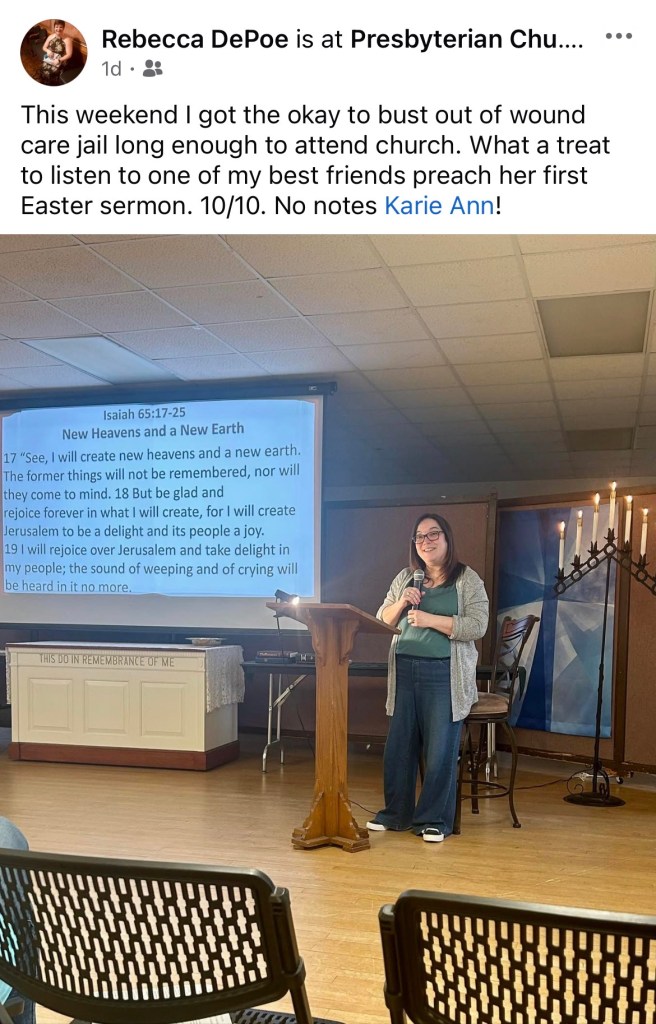
So thrilled that Rebecca’s healing is progressing well enough for her to attend services. Insurance will only cover her wound dressing changes if she is home bound. She found out that homebound patients are allowed to attend worship services but leading them would constitute “working”. Her people were thrilled to see her. I love seeing her, and I was a little nervous to preach my first Easter sermon in front of her. But that was silly. I have such a wonderful and supportive friend (check out her facebook post above). As an associate pastor, I’ve never had the opportunity to preach on Easter (or Christmas), so this weekend felt like a milestone in ministry.
I worked really hard on the Sunday morning sermon… I didn’t keep track of hours but let’s just say this was a full time job kind of week. I entered my “final” draft into chatgpt to generate the Saturday night service, pastoral prayer, and benediction.
I did select things out of the Saturday night sermon chat edits to edit my Sunday morning to be a little tighter. Then more editing on the Sunday morning sermon. I did put a couple of the paragraphs from the Sunday morning sermon into chat to get some suggestions. This editing certainly took longer but I think was well worth the effort for Easter.
Below is the Saturday night sermon and pastoral prayer.
Easter – Saturday
Isaiah 65:17–25 & John 20:1–18
“An unexpected ending is now a beginning”
Friends, we are truly glad you’re here today.
Whether you come every week or find your way here at Christmas and Easter, your presence matters. There is something sacred about choosing—amid busy lives and many demands—to step into a place of worship and be among others who are seeking God.
And wherever you find yourself on your journey of faith—full of belief, full of questions, or somewhere in between—you are welcome here.
Today, you are not guests.
You are part of this community.
Part of this story.
Part of what God is doing in the world.
I found that to be true because I’m here as a guest preacher. I’ve felt like part of this community. And part of what God is doing in the world.
So, on behalf of my community, we’re grateful you came.
In both Christmas and Easter, we celebrate God doing something remarkable through Jesus.
At Christmas, God enters the world.
At Easter, God transforms it.
Both seasons remind us: God is not finished.
That’s why we hear from Isaiah—because Isaiah speaks into a broken world and dares to proclaim hope:
A new creation.
A restored world.
A future where peace reigns.
We hear it in the vision:
- The wolf and the lamb together
- The lion eating straw like the ox
- No more hurt, no more destruction
It’s almost unimaginable.
And honestly—it sounds just as unlikely as resurrection.
Isaiah gives us a vision of what God intends.
Easter shows us that God has already begun.
Then we turn to John’s Gospel.
Mary comes to the tomb—not with hope, but with grief.
She has seen everything.
The suffering.
The death.
And now, one more loss:
“The body is gone.”
She assumes the worst—because what else could she assume?
She runs to the disciples.
They run back.
They look.
They leave.
They go home.
But Mary stays.
She stays in her grief.
She stays at the tomb.
She stays in the place where everything ended.
And it is there—in that place—that God meets her.
She sees angels but barely reacts.
She is too consumed by sorrow.
Then she sees a man she thinks is the gardener.
“Where have you taken him?”
She is still looking backward.
Still trying to make sense of loss.
She cannot yet see what God is doing.
Then everything changes with one word:
Her name.
“Mary.”
And suddenly she knows.
The gardener is the risen Christ.
The one she thought was gone is alive.
Not just restored—but transformed.
I like to imagine she recognizes him not just by sound—but by love.
And then Jesus says something surprising:
“Do not hold on to me.”
In other words:
Don’t cling to what was.
Don’t try to go back.
Because this—
This is not the end.
This is the beginning.
Mary is sent.
She becomes the first witness of resurrection.
The first preacher of Easter.
She goes to tell the others:
Death is not the last word.
And that is the good news for us, too.
Resurrection is not just something that happened to Jesus.
It is something that is still happening.
It is God’s ongoing work in the world.
Isaiah’s vision and Easter morning meet here:
A world being remade.
A creation being restored.
A future breaking into the present.
And we are part of it.
We are sent—like Mary—to live resurrection lives:
- To work for peace where there is violence
- To seek justice where there is oppression
- To bring healing where there is pain
- To love as Christ loves
Not just in words—but in action.
Because resurrection is not just something we believe.
It is something we live.
An unexpected ending…
is now a beginning.
And as we go into the world, may others hear—
in our voices, in our actions, in our lives—
the love of the risen Christ.
Risen and loving God,
We come to you this day carrying many things.
Some of us arrive with joy—
with hearts lifted by the beauty of Easter morning,
by songs of resurrection,
by the hope that something new is possible.
And some of us come like Mary—
weeping, searching, unsure of what to do next.
Holding grief, disappointment, or quiet exhaustion.
Wondering where you are in the midst of it all.
And so we thank you, God,
that you meet us in every place—
in joy and in sorrow,
in certainty and in doubt,
in life’s fullness and in its emptiness.
You meet us, and you call us by name.
God of new creation,
you spoke through the prophet Isaiah of a world remade—
a world without hurt or destruction,
a world filled with peace, justice, and deep belonging.
We long for that world.
We long for an end to violence and war.
We long for healing where there is pain—
in bodies, in relationships, in communities.
We long for justice where there is oppression,
for dignity where there is neglect,
for hope where despair has taken root.
We lift before you those who are suffering this day—
those who are sick or recovering,
those who are grieving losses both recent and long carried,
those who feel alone or forgotten.
Draw near to them, O God.
Hold them in your mercy.
Speak their names with love.
Risen Christ,
you stood in the garden and turned grief into joy,
confusion into calling,
and endings into beginnings.
Do that work in us.
Where we are stuck in the past, lead us forward.
Where we are afraid, give us courage.
Where we cannot yet see new life, open our eyes.
Teach us to recognize you—
not only in moments of wonder,
but in ordinary encounters,
in voices of compassion,
in acts of love.
Sending God,
you did not let Mary remain at the tomb,
but sent her to proclaim good news.
Send us, too.
Into our homes, our workplaces, our neighborhoods—
into every place where your love is needed.
Make us people of resurrection:
people who choose hope,
who work for peace,
who seek justice,
who embody your compassion in a hurting world.
Let others hear your love in our voices,
and see your grace in our lives.
We trust that the story is not over.
That even now, you are making all things new.
And so we pray together in the hope and promise of resurrection,
through Jesus Christ our Lord… who taught us when we pray together to say….

 Period Pastor Pad