Blessed are You, O Radiant One, You, who are hidden within our hearts,
even as we are hidden within your Heart!
You invite us to participate in the Divine Unfoldment,
As we Awaken from our long sleep and give birth to creativity.
Open us that we might recognize the divine in every person,
and become sensitive to all we meet along the path.
For You are the Breathing Life of all, the infinite and eternal within our hearts.
Evoke the Child in our souls, that purity and grace might flourish!
Inflame us with compassion
so we nurture ourselves and others with healing and forgiveness!
Empower us with wisdom and knowledge,
that we might bring for the Divine Plan!
And let us recognize the Truth that clear vision might unfold.
Let us sing a new song to You, O Beloved;
with drums and flutes let us express our joy!
You who are Divine Love, receive our devotion, that we may walk in beauty.
May our heart’s ears heed well the Divine Word written on every heart,
that integrity and justice may dwell within us.
Let each one be receptive to the Spirit that inspires,
allowing our will to respond with action;
And may all judgments and denials be released,
that our souls are freed to serve the Light with joy!
Thus will we recognize oneness with The Divine Spark
dwelling within our hearts, fanning it to illuminate the way.
Gratitude and inner peace will abide in every tranquil soul,
blessing the universe that lovingly cares for us.
Nan C. Merrill Psalms for Praying
Reflection:
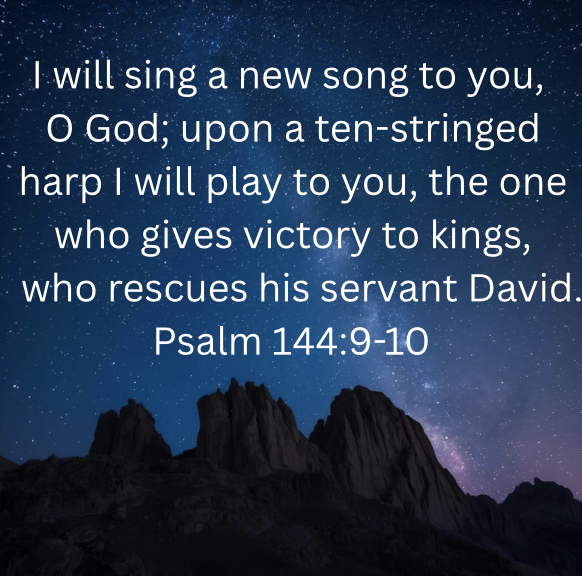
When life is tough, we need a new song, or we think we do. But we find comfort in old words, stories, and songs, so we reuse this material to comfort and to renew hope. That’s exactly what the person who wrote Psalm 144 did, they borrowed material from older psalms. Psalm 144 borrowed language and imagery from Psalm 18 (which is a copy with edits/errors of 2 Samuel 22, for more on this see my reflection on Psalm 18). It seems that when the people of God are afraid or are in the midst of a war with their neighbors, the words images of Psalm 8, 18, 33 and others are the ones that psalmist recites in Psalm 144. The old is made new. The promise of rescue is made new. God’s strength and love are remembered with hope.
Check out other psalm reflections in the links below or find more of my writing published in Presbyterian Outlook or listen to my experiments in podcasting on the Period Pastor Podcast. Follow me @periodpastor
I began writing Psalm reflections during Lent of 2020. Shortly after, we decided to close the church building, work from home, and worship via zoom. Many churches use the Revised Common Lectionary (RLC) that rotates scripture on a three-year cycle (A, B, and C). Starting in Advent 2019, the church decided to worship with the texts from Year D, which is still not circulated as are years A, B, and C. Year D was created with the goal of including scriptures that were left out or not used as frequently as others. While we were using Psalms in year D, most other lectionary followers were using Year A. In Advent of 2020 we rejoined those who use the lectionary in year B. Advent of 2021 year C. When we returned to in person worship, we took the psalm reflections out of the order of worship. I continued to write them for the blog. Advent of 2022 year A. I left church work in July of 2023 but continued the practice of writing psalm reflections. Advent of 2023 year B. Advent of 2024 year C. I finished year C early, so I posted Psalm 119 and began work on missed psalms from Year D and others not in the lectionary. Advent of 2025 year A.
I use the Vanderbilt Divinity Library’s resource for lectionary readings and the PCUSA planning calendar to make text selections.
Year D Psalms that I haven’t come across in the other lectionary years, yet:
18, 144, 44, 110, 73, 75, 76, 28, 12, 61, 11, 88, 108, 64, 60, 10, 120
These are the psalms I haven’t found in any lectionary, yet:
5, 53, 64, 81, 131, 134, 135
Sources and notes:
“Psalm 144 appears to be designed for use by a king. It has often been identified as one of the royal songs composed for use in ceremonies involving a Davidic king. But its combination of different kinds of material and its relation to other psalms point to different conclusions concerning its composition and character.” Mays p. 435
“The psalm is divided into two parts by style and subject. The first part (vv. 1-11) is composed in first person singular style, and its concern is rescue from the power of aliens. The second part (vv. 12-15) uses first person plurals, and its subject is the blessings of people whose God is the LORD.” Mays p. 435
“Psalm 144 bears an obvious resemblance to Psalm 18, the long psalm of thanksgiving for deliverance composed for use by Davidic kings. Verses 1-7 are woven of material that also appears in Psalm 8. The correspondences of Psalm 144 to Psalm 118 are: 144:1 to 18:1, 34; 144:2 to 18:2, 47; 144:5 to 18:9; 144:6 to 18:14; and 144:7 to 18:16, 44, 45. “His servant David” in 144:10 may reflect the superscription of Psalm 18. Lines from Psalm 33 also appear in Psalm 144: 144:9 is like 33:2b, 3a; and 144:15b is like 33:12a. The composer of Psalm 144 was obviously drawing on Psalms 18 and 33 to compose one for his now time and situation.” Mays p. 436
“A likely setting for the psalm is the time of Nehemiah. The one other place where “aliens” appears is in Psalm 18:44, 45. these verses tell of a David whom the LORD empowered against foreigners. the composer of Psalm 144 must have found in these verses a promise for his own time. So he composed a psalm of praise and prayer to the God “who gives salvation to kings and rescues his servant David ” (v. 10) as a context for petitions for deliverance from the aliens of his time. By re-praying Psalm 18 in a new version, he applied to the LORD to do for his people what the LORD had done for his servant David.” Mays p. 436
“This psalm, then, is an illustration of the practice of using psalms to compose hymns and prayers, combining earlier material into new compositions for new needs. In the process, the formal limits of the tradition types are transcended, and the employed material is put to different purposes. Revising the material of psalms for new hymns and prayers is a practice that continues to this day. By it the power and beauty of psalmic material continuously make a canonical contribution to worship. This psalm is also evidence of the influence of the use of psalms attributed to David as the praise and prayer of the people. By the time of its composition, using David’s prayers as their prayers was already a tradition among the fearers of the LORD. The tradition made it possible to compose a psalm for the community in the form of a psalm of David. Psalm 144 is a prayer in which the community prays as David.” Mays p. 437
“Psalm 144 is a masterful example of appropriating traditional phrases, images, and ideas to ever-new situations in life. Whether the psalmist borrowed from book 1 of the Psalter in general, from Psalms 8, 18, and 32 in particular, or from a stock of traditions shared by a faith community, the resulting son his a witness to the power of what James Sanders calls “the old, tired, and true.”” W p. 294
“Book 5 of the Psalter tells the story of ancient Israel as it returned from exile in Babylon and attempted to find a way to be God’s people in a radically changed world. Old words, words that rang true in the past, are attributed to David and paint a picture of new hope for a struggling community.” W p. 294
Alter, Robert. 2007. The Book of Psalms: A Translation with Commentary New York: W. W. Norton & Company
WBC Allen, Leslie C. 1983. Word Biblical Commentary: Psalms 101-150. Vol. 21. Waco, TX: Word Books, Publisher.
Bonhoeffer, Dietrich. 1974. Psalms: The Prayer Book of the Bible. 8th ed. Minneapolis, MN: Augsburg Press.
Bourgeault, C. (2006). Chanting the psalms: A practical guide Audio Book. New Seeds.
Brueggemann, Walter. 2007. Praying the Psalms: Engaging Scripture and the Life of the Spirit. 2nd ed. Eugene, OR: Cascade.
Brueggemann, Walter. 2014. From Whom No Secrets Are Hid: Introducing the Psalms. Edited by Brent A. Strawn. 1st ed. Louisville, KY: Westminster John Knox Press.
Brueggemann, Walter. Davis Hanskins, Editor. 2022. Our Hearts Wait: Worshiping Through Praise and Lament in the Psalms Westminster John Knox Press, Louisville KY.
Brueggemann, Walter. (2002). Spirituality of the psalms. Augsburg Pub. House.
Brueggemann, Walter. (1984). The Message of the Psalms: A Theological Commentary. Minneapolis: Augsburg.
Chilson, Richard, ed. You Shall Not Want: A Spiritual Journey Based on the Psalms. Ave Maria Press, 2009.
Chittister, Joan. (2011). Songs of the heart: reflections on the psalms. John Garratt Publishing.
Cudjoe-Wilkes, G., Wilkes, A. J., & Moss, O. (2022). Psalms for black lives: Reflections for the work of Liberation. Upper Room Books.
WBC Craigie, Peter C. 1983. Psalms 1-50–Word Biblical Commentary. Vol. 19. Waco, TX: Word Books.
Creach, Jerome Frederick Davis. 1998. Psalms: Interpretation Bible Studies. Louisville, KY: Westminster John Knox Press.
DAFLER, J. (2021). PSOBRIETY: A journey of recovery through the psalms. Louisville, KY: WESTMINSTER JOHN KNOX.
W de Claisse-Walford, Nancy L. WISDOM COMMENTARY: Psalms Bks. 4-5. Edited by Barbara E. Reid. Vol. 22. Collegeville, MN: Liturgical, 2020.
Green, Barbara. 1997. Like a Tree Planted: An Exploration of Psalms and Parables Through Metaphor. Collegeville, MN: Liturgical Press.
W Hopkins, Denise Dombkowski. WISDOM COMMENTARY: Psalms Bks. 2-3. Edited by Barbara E. Reid. Vol. 21. Collegeville, MN: Liturgical, 2016.
NIB Keck, Leander E. 2015. The New Interpreters Bible Commentary. Vol. 3. Nashville, TN: Abingdon Press.
Lewis, C. S. (2017). Reflections on the Psalms. Harper One, an imprint of Harper Collins Publishers.
Mays, James Luther. 1994. Psalms. Louisville, KY: John Knox Press.
McCann, J. C. (1993). A theological introduction to the book of Psalms: The Psalms as Torah. Nashville, TN: Abingdon Press.
McCann, J. C., & Howell, J. C. 2001. Preaching the Psalms. Nashville, TN: Abingdon Press.
Merrill, N. C. (2020). Psalms for praying an invitation to wholeness (10th Anniversary Edition ed.). London, England: Bloomsbury Publishing.
Miller, Patrick D. 1986. Interpreting the Psalms. Philadelphia, PA: Fortress Press.
Morgan, Michael. 2010. The Psalter for Christian Worship Revised Edition. Westminster John Knox Press.
Schlimm, Matthew Richard. 2018. 70 Hebrew Words Every Christian Should Know. Nashville, TN: Abington Press.
Spong, M. (Ed.). (2020). The words of her mouth: Psalms for the struggle. Cleveland, OH: The Pilgrim Press.
WBC Tate, Marvin E. 1990. Word Biblical Commentary: Psalms 51-100. Edited by David Allan. Hubbard and Glenn W. Barker. Vol. 20. Waco, TX: Word.
Weems, Ann. 1995. Psalm of Lament. Westminster John Knox Pres
OTL Weiser, Artur. 1998. Old Testament Library: Psalms. Translated by Herbert Hartwell. 3rd ed. New York, NY: Manchester University Press.


