I yearn to know You, O Beloved, to abide in the Peace of Love;
I choose to turn from the ways of the world, where ego separates and divides.
“At the set time which I appoint, I will judge with equity.
When the earth totters with all its inhabitants, it is I who keep steady its axis.”
I say to the powerful, “Lead with justice and mercy.”
And to the greedy, “Share your abundance with those in need.
Let no one see your acts of mercy, or know your works of charity.”
For not from the four directions,
nor from the heights or the depths comes lifting up;
Rather, it is the Most High who fulfills the balance, sifting as a Thresher,
burning as a refining Fire.
For hidden within the heart of each soul, there dwells the Divine Guest,
that knows well our secret thoughts, that weighs us in the balance.
Let us rejoice and be glad! Let us sing praise to the Beloved!
As the unjust and oppressors dwell in the wilderness,
those who live with mercy and truth will soar like the eagle.
Nan C. Merrill Psalms for Praying
Reflection:
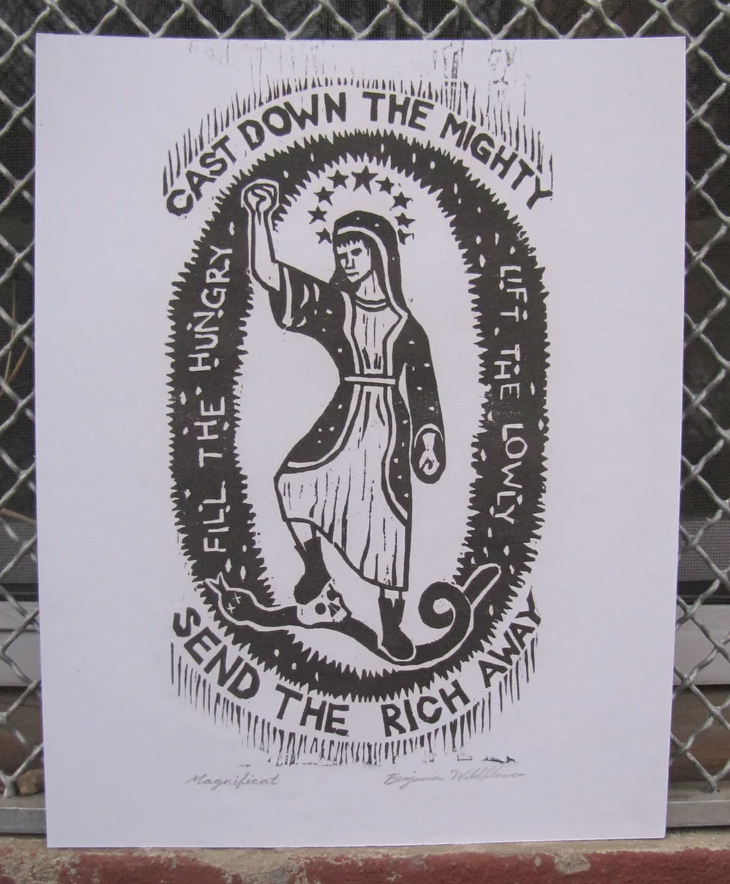
God will judge with justice and mercy. Those who are in power because of their oppression of others will be brought down and those who are oppressed will be lifted up. In Psalm 75 this refers to the oppression of people as well as the mistreatment of all of creation. God will reverse the destructive forces on people and all of creation. These themes can also be found in Hannah’s song (I Sam. 2:3, 6-8, 10). Christians may also notice the similarities in the magnificat too (Luke 1:46-55).
In psalm 75, we give thanks for the justice we know is coming. Thanks be to God, the one who has the power to reverse the wrongs and restore all of creation.
Check out other psalm reflections in the links below or find more of my writing published in Presbyterian Outlook or listen to my experiments in podcasting on the Period Pastor Podcast. Follow me @periodpastor
I began writing Psalm reflections during Lent of 2020. Shortly after, we decided to close the church building, work from home, and worship via zoom. Many churches use the Revised Common Lectionary (RLC) that rotates scripture on a three-year cycle (A, B, and C). Starting in Advent 2019, the church decided to worship with the texts from Year D, which is still not circulated as are years A, B, and C. Year D was created with the goal of including scriptures that were left out or not used as frequently as others. While we were using Psalms in year D, most other lectionary followers were using Year A. In Advent of 2020 we rejoined those who use the lectionary in year B. Advent of 2021 year C. When we returned to in person worship, we took the psalm reflections out of the order of worship. I continued to write them for the blog. Advent of 2022 year A. I left church work in July of 2023 but continued the practice of writing psalm reflections. Advent of 2023 year B. Advent of 2024 year C. I finished year C early, so I posted Psalm 119 and began work on missed psalms from Year D and others not in the lectionary. Advent of 2025 year A.
I use the Vanderbilt Divinity Library’s resource for lectionary readings and the PCUSA planning calendar to make text selections.
Year D Psalms that I haven’t come across in the other lectionary years, yet:
18, 144, 44, 110, 73, 75, 76, 28, 12, 61, 11, 88, 108, 64, 60, 10, 120
These are the psalms I haven’t found in any lectionary, yet:
5, 53, 64, 81, 131, 134, 135
Sources and notes:
“A conviction that runs through all of Scripture that boasting is an offense to the divine majesty, that the arrogance of self-importance and autonomous power stands under the judgement of God. Psalm 75 is a song to praise God who judges the boastful wicked.” Mays p. 248
“In the psalm, God is portrayed as judge of all the earth. The role of judge and the work of judging with equity belong to God’s kingship (9:8; 98:9). God’s rule over chaos by which the world is established and his reign over the inhabitants are closely connected (v. 3; 24:1-2). God’s judgement of societies and nations corresponds to his work to create and maintain the world. The one extends and completes the other.” Mays p. 248
“God rights and rules human affairs by “putting down one and lifting up another” (v. 7). the boastful wicked are brought low and the lowly righteous are exalted (v. 10). This reordering of the human situation is the equity of God’s judgement. This corrective interference in society and history is God’s way of bringing affairs in line with his policy of opposing the arrogant wicked and favoring the lowly righteous. On this conception of God’s royal judgement, see Psalm 113 and Hannah’s Song, which is similar to Psalm 75 at numerous points (I Sam. 2:3, 6-8, 10).” Mays pp. 248-249
“God has a cup whose content is his decreed destiny for those under judgment, and he will pour a draught from it for all the wicked of the earth to drink (Jer. 25:15; 49:12; Exek. 23:32-34; Isa. 51:17; Hab. 2:15-16). When that will happen is a matter of God’s choice, but the divine saying in verse 2 makes it very clear that God will set an appointed time for this judgement.” Mays p. 249
“The warning of the psalm is directed at the boastful wicked, who life up their horn on high (vv. 4-5, 10). “Horn” is an ideogram for power. The motif of “lifting up” is fixed as the focus of the psalm by its insistent repetition. The motif is the only characterization of the wicked (vv. 4-5). It designates power and prerogative that belgian to God alone (v. 7) and can be derived from no other source (v. 6). When the wicked lift their horn, they presume to preempt the very right and power of God, who will vindicate his reign by limiting up the righteous (v. 10; NRSV, “exalt”).” Mays p. 249
Wisdom commentary sites two links between Hannah’s song and Psalm 75: 1. reversal of unjust and oppressive social conditions and 2. God’s care for keeping creation stable (God keeping the pillars of the earth steady). (pp. 248-249)
“Though ecological concerns are not specifically a gender issue or a feminist concern, they do shape the quality of life for men, women, children, and all creatures on our planet.” W p. 249
Alter, Robert. 2007. The Book of Psalms: A Translation with Commentary New York: W. W. Norton & Company
WBC Allen, Leslie C. 1983. Word Biblical Commentary: Psalms 101-150. Vol. 21. Waco, TX: Word Books, Publisher.
Bonhoeffer, Dietrich. 1974. Psalms: The Prayer Book of the Bible. 8th ed. Minneapolis, MN: Augsburg Press.
Bourgeault, C. (2006). Chanting the psalms: A practical guide Audio Book. New Seeds.
Brueggemann, Walter. 2007. Praying the Psalms: Engaging Scripture and the Life of the Spirit. 2nd ed. Eugene, OR: Cascade.
Brueggemann, Walter. 2014. From Whom No Secrets Are Hid: Introducing the Psalms. Edited by Brent A. Strawn. 1st ed. Louisville, KY: Westminster John Knox Press.
Brueggemann, Walter. Davis Hanskins, Editor. 2022. Our Hearts Wait: Worshiping Through Praise and Lament in the Psalms Westminster John Knox Press, Louisville KY.
Brueggemann, Walter. (2002). Spirituality of the psalms. Augsburg Pub. House.
Brueggemann, Walter. (1984). The Message of the Psalms: A Theological Commentary. Minneapolis: Augsburg.
Chilson, Richard, ed. You Shall Not Want: A Spiritual Journey Based on the Psalms. Ave Maria Press, 2009.
Chittister, Joan. (2011). Songs of the heart: reflections on the psalms. John Garratt Publishing.
Cudjoe-Wilkes, G., Wilkes, A. J., & Moss, O. (2022). Psalms for black lives: Reflections for the work of Liberation. Upper Room Books.
WBC Craigie, Peter C. 1983. Psalms 1-50–Word Biblical Commentary. Vol. 19. Waco, TX: Word Books.
Creach, Jerome Frederick Davis. 1998. Psalms: Interpretation Bible Studies. Louisville, KY: Westminster John Knox Press.
DAFLER, J. (2021). PSOBRIETY: A journey of recovery through the psalms. Louisville, KY: WESTMINSTER JOHN KNOX.
W de Claisse-Walford, Nancy L. WISDOM COMMENTARY: Psalms Bks. 4-5. Edited by Barbara E. Reid. Vol. 22. Collegeville, MN: Liturgical, 2020.
Green, Barbara. 1997. Like a Tree Planted: An Exploration of Psalms and Parables Through Metaphor. Collegeville, MN: Liturgical Press.
W Hopkins, Denise Dombkowski. WISDOM COMMENTARY: Psalms Bks. 2-3. Edited by Barbara E. Reid. Vol. 21. Collegeville, MN: Liturgical, 2016.
NIB Keck, Leander E. 2015. The New Interpreters Bible Commentary. Vol. 3. Nashville, TN: Abingdon Press.
Lewis, C. S. (2017). Reflections on the Psalms. Harper One, an imprint of Harper Collins Publishers.
Mays, James Luther. 1994. Psalms. Louisville, KY: John Knox Press.
McCann, J. C. (1993). A theological introduction to the book of Psalms: The Psalms as Torah. Nashville, TN: Abingdon Press.
McCann, J. C., & Howell, J. C. 2001. Preaching the Psalms. Nashville, TN: Abingdon Press.
Merrill, N. C. (2020). Psalms for praying an invitation to wholeness (10th Anniversary Edition ed.). London, England: Bloomsbury Publishing.
Miller, Patrick D. 1986. Interpreting the Psalms. Philadelphia, PA: Fortress Press.
Morgan, Michael. 2010. The Psalter for Christian Worship Revised Edition. Westminster John Knox Press.
Schlimm, Matthew Richard. 2018. 70 Hebrew Words Every Christian Should Know. Nashville, TN: Abington Press.
Spong, M. (Ed.). (2020). The words of her mouth: Psalms for the struggle. Cleveland, OH: The Pilgrim Press.
WBC Tate, Marvin E. 1990. Word Biblical Commentary: Psalms 51-100. Edited by David Allan. Hubbard and Glenn W. Barker. Vol. 20. Waco, TX: Word.
Weems, Ann. 1995. Psalm of Lament. Westminster John Knox Pres
OTL Weiser, Artur. 1998. Old Testament Library: Psalms. Translated by Herbert Hartwell. 3rd ed. New York, NY: Manchester University Press.

 Period Pastor Pad