O Beloved, Heart of my heart, I call to You for help by day; I cry out in the night.
Let my prayer come before You, bend your ear to my cry!
For my soul is full of troubles, and my life seems like dust,
I have fallen into a pit of despair; I have no strength and I feel powerless,
Like one from whom You have turned, life the soil people walk upon.
You alone can comfort me in this abyss, in the darkness of fear.
Seperation from You is an agony, hopelessness threatens to overwhelm me.
Through You alone can I pray for my enemies, for those who ignorant my plight.
I am in prison, chained by fear; I am weary of tears.
Every day I call upon You, O Beloved; I will lift my hand in supplication.
Will You raise me from this living death? Will You mend a broken heart?
Let not your steadfast Love pass me by; have mercy on me, O Comforter!
Reach your hand into the darkness of my ego-fears;
by your saving grace, forgive my unholy ways.
O Merciful Beloved, I cry to You; each day my prayer comes before You.
Let not separation keep me from your Heart;
be my strength as I face the darkness inside.
Too long have I let fear control me,
projecting onto others the demons dwelling within.
Let your Love encircle and envelop me; in your mercy raise me up.
let peace become my companion all day long;
by night free me from the bonds of fear.
Let me be reconciled with family and friends; an may I know You,
O Loving Companion Presence, as in days of old. Amen.
Nan C. Merill Psalms for Praying
Reflection:
Psalm 88 is heartbreaking. The experience of unanswered prayer is gut-wrenching. It is an experience that we hide, because we are ashamed that somehow we didn’t believe enough to get an answer, or that we are so sinful God has refused to be present, or some equally unhelpful and unloving theology we have internalized.
I believe in a loving, ever-present God. And yet, I have experienced what I can only describe as God’s absence. And I’ve tried to make this experience my fault. So I’ve confessed sin, done spiritual practices that usually bring me to an awareness of God’s presence, and just kept trying to no avail. It was not for my lack of effort that God didn’t show up. But, I also believe that I cannot earn or deserve God’s love, it’s a gift, so “effort” isn’t a factor. Psalm 88 reminds us that sometimes God doesn’t show up and we won’t know why. We cannot conjure God or control God; God is God and we are not. That’s the best I can come up with… my need to make it make sense, to get some sort of wrap up, is exactly what this psalm says won’t happen…Ugh.
In a strange way, Psalm 88 is helpful in its lack of conclusion. It does not neatly resolve at the end of the lament, as so many other psalms do. It reminds me that some things take a long time and perhaps in my limited life time I will not see the completion.
So, what does one do?
Persist. The desperate believer keeps praying, keeps searching, keeps hounding God. (Check out Brueggemann’s words below in the notes section). Prayers go unanswered. But I refuse to accept that it will always be that way. So, I must persist for the sake of hope and love and what I believe the reign of God to be.
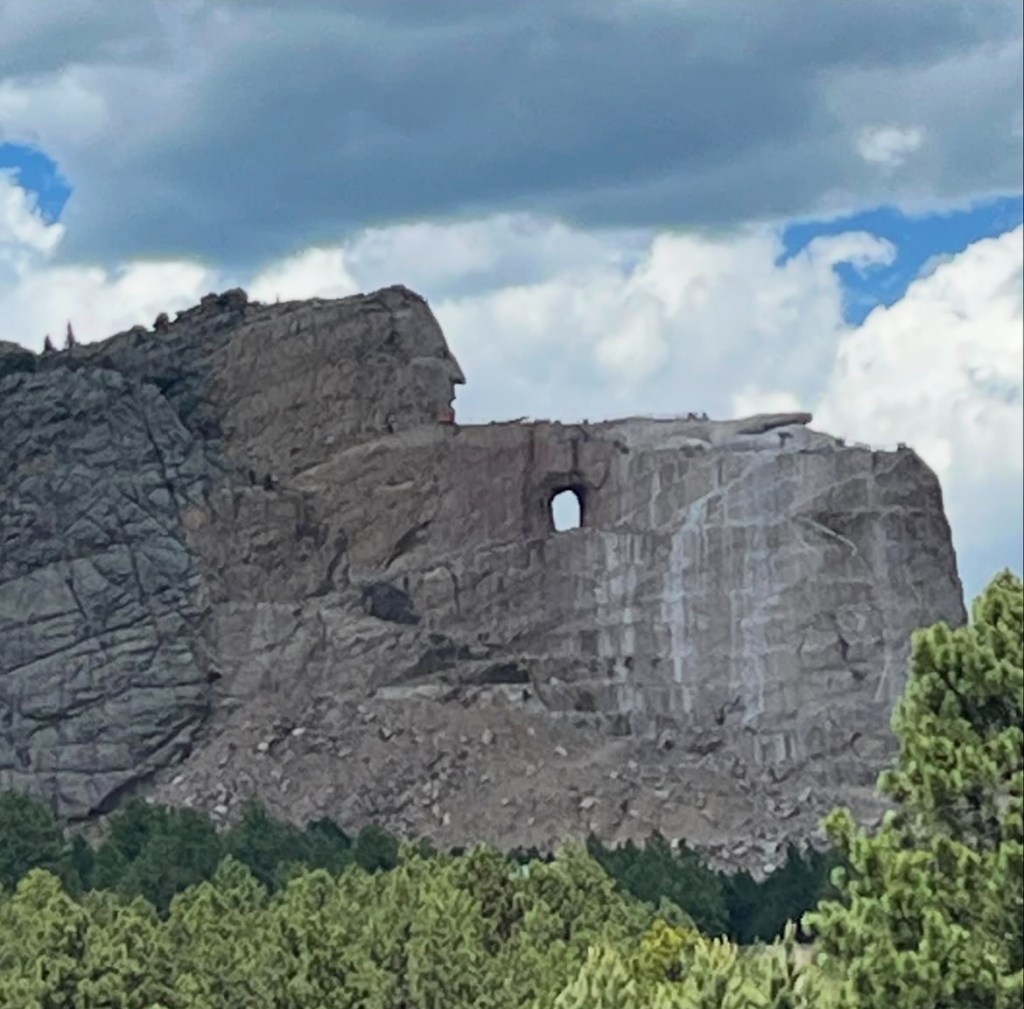

Finding a picture to go with this post was tricky… my husband and I visited the Crazy Horse Memorial in 2024 and after we viewed the monument and museum we were struck by the idea that this will not see the monument completed. Not because we won’t visit again, but because it won’t be done in our lifetime. This is true about many things, but this was the first time we came to a deep understanding of our finiteness.
Check out other psalm reflections in the links below or find more of my writing published in Presbyterian Outlook or listen to my experiments in podcasting on the Period Pastor Podcast. Follow me @periodpastor
I began writing Psalm reflections during Lent of 2020. Shortly after, we decided to close the church building, work from home, and worship via zoom. Many churches use the Revised Common Lectionary (RLC) that rotates scripture on a three-year cycle (A, B, and C). Starting in Advent 2019, the church decided to worship with the texts from Year D, which is still not circulated as are years A, B, and C. Year D was created with the goal of including scriptures that were left out or not used as frequently as others. While we were using Psalms in year D, most other lectionary followers were using Year A. In Advent of 2020 we rejoined those who use the lectionary in year B. Advent of 2021 year C. When we returned to in person worship, we took the psalm reflections out of the order of worship. I continued to write them for the blog. Advent of 2022 year A. I left church work in July of 2023 but continued the practice of writing psalm reflections. Advent of 2023 year B. Advent of 2024 year C. I finished year C early, so I posted Psalm 119 and began work on missed psalms from Year D and others not in the lectionary. Advent of 2025 year A.
I use the Vanderbilt Divinity Library’s resource for lectionary readings and the PCUSA planning calendar to make text selections.
Year D Psalms that I haven’t come across in the other lectionary years, yet:
18, 144, 44, 110, 73, 75, 76, 28, 12, 61, 11, 88, 108, 64, 60, 10, 120
These are the psalms I haven’t found in any lectionary, yet:
5, 53, 64, 81, 131, 134, 135
Sources and notes:
“Psalm 88 is a very unusual prayer for help in first person singular style. There are no confessions of trust and no vows or expressions of praise. Only one petition is made (v. 2). The rest is all lament over the psalmist’s condition, his relation to others, and the silence of God. The psalmist suffers from an affliction of long duration (v. 15). In his affliction he has become abhorrent to friends and neighbors (vv. 8, 18). The LORD has rejected him, and the psalmist understands all his suffering to be the effect of the wrath of the LORD (vv. 6-8, 14, 16, 18). These features of the lament are common to many prayers for help. What is remarkable here is the prominence of death. The lament speaks not only of an affliction that leads to death but o death itself. Death is so near and so real that it becomes the subject of lament.” Mays p. 282
“…Psalm 88 is one of the texts where the view of dying and death assumed by the psalms comes more distinctly into focus.” Mays p. 282
“Death is displacement from the realm of life and the world of the living. The dead have a place. No one knows what lies on the other side of death. In Israel the principal source of imagination about the state of the dead was the grave. the realm of the dead was thought of as an extension of ht grave. Its name was Sheol, the Pit, Abbadon. It was deep and dark and silent. Notice in the psalm how language about the grave and Sheol merges. In Sheol one continued to exist as one of the shades (v. 11) in a way that was the opposite and negation of every characteristic of the living.” Mays p. 282
“Even Job received an “answer”–albeit an unsatisfactory one– to his complaints: God bellows at him in the speeches from the whirlwind (Job 38-41). The supplicant in Psalm 88, however, hears nothing at all from God; the psalm literally begins and ends in darkness.” W p. 355
“The psalm unfolds in three major sections. the two outer sections contain emotionally charged descriptions of the psalmist’s suffering (vv. 1-9a, 13-18). These two sections parallel one another in their structure; each speaker metaphorically of God’s wrath (vv. 7, 16) and of the destructive power of water (vv. 7, 17), and each ends with the psalmist’s experience of being shunned by companions (vv. 8, 18). The word (NRSV: “soul,” literally “being,” “person”) also ties the two together (vv. 3, 14); the whole person is suffering. The outer sections surround a center section of confrontational rhetorical questions hurled at God (vv. 9b- 12).” W p. 356
“The psalm ends abruptly: its very last word is (“darkness” or “dark place”). This word occurs only five times in Tanakh, perhaps indicating how extraordinarily painful and terrifying the psalmist’s experience is.” W p. 357
The psalmist, “she holds God accountable for her suffering” W p. 358
“The middle section of Psalm 88, vv.. 10-12, makes clear what is at stake for both God and the psalmist in a series of rhetorical questions with the obvious answer “no”. ” W p. 359
“Perhaps, however, the psalmist has given up on God intervening at all; her pain is too great. These rhetorical questions suggest that God desires (needs?) our praise and thanks, but if God allows the psalmist to go down to Sheol, giving such praise and thanks will not be possible.” W p. 360
“Psalm 88 is an embarrassment to conventional faith. It is the cry of a believer (who sounds like Job) whose life has gone awry, who desperately seeks contact with Yahweh, but who is unable to evoke a response from God. This is indeed “the dark night of the soul,” when the troubled person must be and must stay in the darkness of abandonment, utterly alone.” Brueggemann, The Message of the Psalms p. 78
“The unanswered plea does not silence the speaker. Perhaps the speaker is in fact speaking to the empty sky, but that does not deter the speaker. The faith of Israel is like that. The failure of God to respond does not lead to atheism or doubt in God or rejection of God. It leads to more intense address. This psalm, like the faith of Israel, is utterly contained in the notion that Yahweh is there and must be addressed. Yahweh must be addressed, even if Yahweh never answers.” Brueggemann, The Message of the Psalms p. 79
End of Psalm, no answer, only darkness. “So what is one to do about that? Wait. That is what Israel has been doing for a very long time. I suspect that practically and dramatically, what one must do is say it over again, and again, until the speech and the speaker have genuinely reached the bottom. One has two options: either to wait in silence, or to speak it again. What one may not do is to rush to an easier psalm, or to give up on Yahweh.” Brueggemann, The Message of the Psalms p. 80
“What is a psalm like that doing in our Bible? Two things suggest themselves. First, life is like that, and these poems intend to speak of all of life, not just the good parts. Here, more than anywhere else, faith faces life as it is. Second, we observe that this psalm is not a psalm of mute depression. It is still speech. It is still addressed. In the bottom of the Pit, Israel still knows it has to do with Yahweh. It cannot be otherwise.” Brueggemann, The Message of the Psalms p. 80
“In this painful, unresolved speech, Israel is simply engaged in being Israel. To be Israel means to address God, even in God’s unresponsive absence.” Brueggemann, The Message of the Psalms p. 81
“Psalm 88 shows us what the cross is about: faithfulness in scenes of complete abandonment.” Brueggemann, The Message of the Psalms p. 81
“Psalm 88 stands as a mark of realism for biblical faith. It has its pastoral use, because there are situations in which easy, cheap talk of resolution must be avoided. Here are words not to be used frequently, but for the limit experiences when words must be honest and not claim too much.” Brueggemann, The Message of the Psalms p. 81
“Ancient Israel knew about talking – or rather praying – to a wall, experiencing the absence and silence of God. And after ancient Israel, countless Jews and Christians, mystics among them, have known about divine absence and divine silence. Our best script for praying to a wall is Psalm 88. It is an exceptional lament in the book of Psalms because it voices not hint of resolution as the laments typically do. (The only other such exception is Psalm 39.) Psalm 88 is thus a model for unanswered prayer. The fact that Psalm 88 is included in the book of Psalms makes clear that ancient Israel knew all about unanswered prayer and had no reason to deny it. In the most difficult of circumstances, the common assumption that God answers even before we pray (as in Isa. 65:24) turns out to be, for many, nothing more than a wishful self-deception.” Brueggemann, From Whom No Secrets are Hid p. 113
“The resolution to unanswered prayer is to pray more, more intensely and more insistently.” Brueggemann, From Whom No Secrets are Hid p. 114
“… such prayer is nonetheless what the faithful do, speaking out in the midst of darkness, silence, and absence, refusing that the abyss should prevail.” Brueggemann, From Whom No Secrets are Hid p. 114
“So we might ask ourselves, who gives up on God in God’s silence? The answer in the Psalter is that it is not the desperate who give up. They are the ones who keep praying even more extremely; the ones who age up rather are the well-off…” Brueggemann, From Whom No Secrets are Hid p. 117
“Psalm 88 is thus the voice of the “scum of the earth” who yet refuse to accept current power arrangements as the final order of the day.” Brueggemann, From Whom No Secrets are Hid p. 119
Alter, Robert. 2007. The Book of Psalms: A Translation with Commentary New York: W. W. Norton & Company
WBC Allen, Leslie C. 1983. Word Biblical Commentary: Psalms 101-150. Vol. 21. Waco, TX: Word Books, Publisher.
Bonhoeffer, Dietrich. 1974. Psalms: The Prayer Book of the Bible. 8th ed. Minneapolis, MN: Augsburg Press.
Bourgeault, C. (2006). Chanting the psalms: A practical guide Audio Book. New Seeds.
Brueggemann, Walter. 2007. Praying the Psalms: Engaging Scripture and the Life of the Spirit. 2nd ed. Eugene, OR: Cascade.
Brueggemann, Walter. 2014. From Whom No Secrets Are Hid: Introducing the Psalms. Edited by Brent A. Strawn. 1st ed. Louisville, KY: Westminster John Knox Press.
Brueggemann, Walter. Davis Hanskins, Editor. 2022. Our Hearts Wait: Worshiping Through Praise and Lament in the Psalms Westminster John Knox Press, Louisville KY.
Brueggemann, Walter. (2002). Spirituality of the psalms. Augsburg Pub. House.
Brueggemann, Walter. (1984). The Message of the Psalms: A Theological Commentary. Minneapolis: Augsburg.
Chilson, Richard, ed. You Shall Not Want: A Spiritual Journey Based on the Psalms. Ave Maria Press, 2009.
Chittister, Joan. (2011). Songs of the heart: reflections on the psalms. John Garratt Publishing.
Cudjoe-Wilkes, G., Wilkes, A. J., & Moss, O. (2022). Psalms for black lives: Reflections for the work of Liberation. Upper Room Books.
WBC Craigie, Peter C. 1983. Psalms 1-50–Word Biblical Commentary. Vol. 19. Waco, TX: Word Books.
Creach, Jerome Frederick Davis. 1998. Psalms: Interpretation Bible Studies. Louisville, KY: Westminster John Knox Press.
DAFLER, J. (2021). PSOBRIETY: A journey of recovery through the psalms. Louisville, KY: WESTMINSTER JOHN KNOX.
W de Claisse-Walford, Nancy L. WISDOM COMMENTARY: Psalms Bks. 4-5. Edited by Barbara E. Reid. Vol. 22. Collegeville, MN: Liturgical, 2020.
Green, Barbara. 1997. Like a Tree Planted: An Exploration of Psalms and Parables Through Metaphor. Collegeville, MN: Liturgical Press.
W Hopkins, Denise Dombkowski. WISDOM COMMENTARY: Psalms Bks. 2-3. Edited by Barbara E. Reid. Vol. 21. Collegeville, MN: Liturgical, 2016.
NIB Keck, Leander E. 2015. The New Interpreters Bible Commentary. Vol. 3. Nashville, TN: Abingdon Press.
Lewis, C. S. (2017). Reflections on the Psalms. Harper One, an imprint of Harper Collins Publishers.
Mays, James Luther. 1994. Psalms. Louisville, KY: John Knox Press.
McCann, J. C. (1993). A theological introduction to the book of Psalms: The Psalms as Torah. Nashville, TN: Abingdon Press.
McCann, J. C., & Howell, J. C. 2001. Preaching the Psalms. Nashville, TN: Abingdon Press.
Merrill, N. C. (2020). Psalms for praying an invitation to wholeness (10th Anniversary Edition ed.). London, England: Bloomsbury Publishing.
Miller, Patrick D. 1986. Interpreting the Psalms. Philadelphia, PA: Fortress Press.
Morgan, Michael. 2010. The Psalter for Christian Worship Revised Edition. Westminster John Knox Press.
Schlimm, Matthew Richard. 2018. 70 Hebrew Words Every Christian Should Know. Nashville, TN: Abington Press.
Spong, M. (Ed.). (2020). The words of her mouth: Psalms for the struggle. Cleveland, OH: The Pilgrim Press.
WBC Tate, Marvin E. 1990. Word Biblical Commentary: Psalms 51-100. Edited by David Allan. Hubbard and Glenn W. Barker. Vol. 20. Waco, TX: Word.
Weems, Ann. 1995. Psalm of Lament. Westminster John Knox Pres
OTL Weiser, Artur. 1998. Old Testament Library: Psalms. Translated by Herbert Hartwell. 3rd ed. New York, NY: Manchester University Press.

 Period Pastor Pad