Why do You seem so far from me, O Silent One?
Where do You hide when fears beset me?
I boast and strike outs against those weaker than myself,
even knowing I shall be caught in a snare of my own making.
When I feel insecure, I look for pleasure,
greed grips my heart and I banish You from my life.
In my pride, I seek You not, I come to believe, “I am the Creator of my world.”
I even prosper at times: your Love seems too great for me, out of my reach;
as for my fears, I preteen they do not exist.
I think in my heart, “I do not need You; adversity will come only to others.”
My eyes watch carefully for another’s weakness,
I wait in secret like a spider in its web;
I wait that I might seize those who are weaker than myself,
draw others into my web, that I might use the to feel powerful.
Like me, the fearful are crushed, we fall by our own illusions.
Then we think in our hearts, “I do not deserve Love;
my Beloved has forgotten me, I am alone with my fears forever.”
Awaken, O Love! O You who created me, return to my side;
forget me not in my weakness.
Why do I turn my back to You, and say in my hear,
“You will not take notice of me?”
You do see me. Yes, You know my anguish and fears;
You make yourself known to me when I commit myself into your hands.
You are ever my strength and comforter.
Help me to break the webs I have woven,
To seek out and forgive my illusions until You find not one.
For You are my Beloved forever;
All that is separate from You will disappear through Love.
O my Beloved, You hear my heart; strengthen me and answer my soul’s Cry!
May I live with integrity, as a loving presence in the world.
May my will be one with your Will!
Nan C. Merrill Psalms for Praying
Reflection:
As people with open hearts, who hear Love’s voice, we are called to remember God’s loving ways and to act accordingly. Psalms 9 and 10 (originally one psalm) is a prayer; a remembrance of God’s Love, especially God’s love for the oppressed; and the nations that cruelly act against God’s ways. It is prayer that God will once again deliver us from oppression and self inflicted cruelty. We are one; both cruel, and hurt; both oppressors and oppressed.
The congregation of psalm 10 identifies with the oppressed, separating themselves from the nations (oppressors). In today’s world, it seems that the people of God are more like the nations that this psalm speaks against. Even when we are not being overtly cruel, we are dividing ourselves into us and them instead of recognizing our unity. We complain about the “other”. Our nationalism is killing us, hurting all of us, especially the poor, oppressed, and vulnerable.
Instead of behaving as individual nations and warring people, my hope is that we could remember our oneness and our beloved-ness. That remembrance calls us to see that our ways are not God’s ways. This prayer is to ask God to act on behalf of the oppressed, and it is a prayer to remind us that we have that power too. We need to let go of cruelty and hate. Love is the way. Love is the divine plan. Love is what lasts forever. And when we connect with love, we all flourish.
Check out other psalm reflections in the links below or find more of my writing published in Presbyterian Outlook or listen to my experiments in podcasting on the Period Pastor Podcast. Follow me @periodpastor
I began writing Psalm reflections during Lent of 2020. Shortly after, we decided to close the church building, work from home, and worship via zoom. Many churches use the Revised Common Lectionary (RLC) that rotates scripture on a three-year cycle (A, B, and C). Starting in Advent 2019, the church decided to worship with the texts from Year D, which is still not circulated as are years A, B, and C. Year D was created with the goal of including scriptures that were left out or not used as frequently as others. While we were using Psalms in year D, most other lectionary followers were using Year A. In Advent of 2020 we rejoined those who use the lectionary in year B. Advent of 2021 year C. When we returned to in person worship, we took the psalm reflections out of the order of worship. I continued to write them for the blog. Advent of 2022 year A. I left church work in July of 2023 but continued the practice of writing psalm reflections. Advent of 2023 year B. Advent of 2024 year C. I finished year C early, so I posted Psalm 119 and began work on missed psalms from Year D and others not in the lectionary. Advent of 2025 year A.
I use the Vanderbilt Divinity Library’s resource for lectionary readings and the PCUSA planning calendar to make text selections.
Year D Psalms that I haven’t come across in the other lectionary years, yet:
18, 144, 44, 110, 73, 75, 76, 28, 12, 61, 11, 88, 108, 64, 60, 10, 120
These are the psalms I haven’t found in any lectionary, yet:
5, 53, 64, 81, 131, 134, 135
Sources and notes:
“Psalms 9 and 10 are together a song of the people of God who live in faith in the reign of God in the midst of the afflictions of history. Though the song is divided into two parts in Hebrew manuscripts and in most English versions, it appears as one psalm in the Septuagint and in translations dependent on it.” Mays p. 70
“The situation reflected in the composition is that of the postexilic congregation of the faithful whose life is beset and threatened by conditions and incidents caused by the succession of peoples who held power over them.” Mays p. 71
“One might think of Psalm 10 as an individual prayer for help against the wicked, a kind of counterpart to the thanks and prayer in Psalm 9 about the nations. But in 10:16 the personification of the problem of Psalm 9 is restated: The issue is still the contradiction between the everlasting reign of the LORD and the conduct of the nations.” Mays p. 72
“The whole, then, is a prayer. It begins with thanksgiving for the history and salvation in which the LORD has disclosed his reign by his judgement of the nations. It laments the present situation in which nations act with impunity and call the kingship of God into question. It asks for the intervention of the LORD to judge the nations and deliver the lowly. The portrayal of the congregation and the nations in terms of the prayer and thanksgiving of the individual interprets both in a highly theological way and create prayer that is designed for the new situation of the congregation. The composition undoubtedly reflects the practice in its time of using the individual genres of psalms for corporate purposes.” Mays p. 72
“The LORD appears in the psalm as the king enthroned in Zion, whose realm includes all nations and whose rule will last forever (9:4, 7-8, 11, 19; 10: 16).” Mays p. 72
“The prayer builds up a white comprehensive vision of the LORD as the one who has the power and responsibility to set things right in the human world.” Mays p. 73
Congregation = lowly, oppressed, needy, innocent, helpless, orphan etc. “Persons o this kinship are the ones who ave a claim on the king’s justice. The congregation casts itself in this role as a confession about its own helpless dependence and as the bias of its appeal. They do not pray as the elect; they claim no special rights. In the midst of history and life, they know themselves as the “poor.” And the prayer is formulated primarily as an appeal for God to act in judgment on behalf of all who belong to this category.” Mays p. 73
“The nations/peoples are cast as the wicked and play the role given the enemy in the individual prayers for help. …. Like humans, nations pass away and are forgotten (9:5-6). This is what they do not know, so they strut in the earth as if they won the permanence that belongs alone to the reign of the LORD (10:5-6 and 10:16). Israel had learned from the prophets and from the exile that all of this was true of them as a nation. When the LORD made himself known in judgment, they came to know themselves and to recognize the wickedness of the nations that forget God.” Mays p. 74
“They want the nations to discover that their schemes and strategies and prices are self-destructive (10:2 and 9: 15-16). They wan to live in a land and world which arrogant nationalism has vanished (9:17; 10:16). They want to live in a world determined by the justice of God’s reign.” Mays pp. 74-75
“This psalm [psalm 9] and the next one [psalm 10] are a string testimony to the scrambling in textual transmission that, unfortunately, a good many of the psalms have suffered. the septuagint presents Psalms 9 and 10 as a single psalm, and there is formal evidence for the fact that it was originally one poem.” Alter p. 25
“Something along the following lines seems to have happened to our psalm: At some early moment in the long history of its transmission, a single authoritative copy was damaged (by decay, moisture, fire, or whatever). Lines of verse may have been patched into the text from other sources in an attempt to fill in lacunae. Quite a few phrases or lines were simply transcribed in their mangled form or perhaps poorly reconstructed. When the chapter divisions of the Bible were introduced in the late Middle Ages, the editors, struggling with this imperfect text no longer realized that it was an acrostic and broke it into two separate psalms. The result of this whole process, alas, is that we are left with a rather imperfect notion of what some of the text means.” Alter p. 25
“The counter-world of the Psalms contradicts our closely held world of self-sufficiency by mediating to us a world confident in God’s preferential option for hose who call on him in their ultimate dependence. Psalm 10 amounts almost to a socio-gram of a field analysis of social power. The psalm knows of the self-sufficient who acknowledge no limit or accountability. They are arrogant in their use of other people for their own self-enhancement. They have dismissed God as a bad idea: [vv. 3-4, 6, 11] also see v. 9 they prey on the poor].” Brueggemann, From Whom No Secrets are Hid pp. 18-19
“The two always go together: Get rid of God, and you can get rid of the neighbor as well. The psalm celebrates the voice of the vulnerable who, by their prayers, not only assert trust and dependence on God but also establish a working alliance with God who is recruited into the cause of the vulnerable. Thus self-sufficiency is countered by gold, trusting dependence on God, which issues in bold imperatives: [vv. 12,15]” Brueggemann, From Whom No Secrets are Hid p. 19
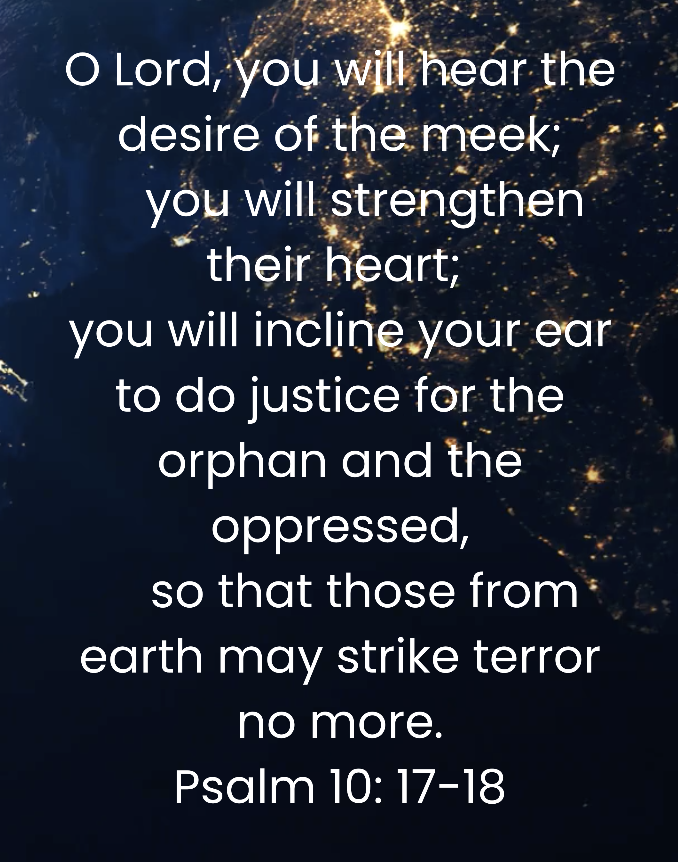
“Thus the unequal ground between the self-sufficient and their helpless victims is corrected by the entry of YHWH on the side of the vulnerable. In this portrayal of gold reliance on YHWH–and in contrast to the default claim of the settled–rather than reliance on the self, the confident conclusion is hat tGod is committed to the cause of those who cannot help themselves: [vv. 17-18]. Brueggemann, From Whom No Secrets are Hid pp. 19-20
“The terrorists, those who “strike terror,” are the self-sufficient who believe they are permitted to do whatever they are able to do. But the counter-reliance on the God of justice means that such self-suffieency cannot and will not prevail in the end.” Brueggemann, From Whom No Secrets are Hid p. 20
Alter, Robert. 2007. The Book of Psalms: A Translation with Commentary New York: W. W. Norton & Company
WBC Allen, Leslie C. 1983. Word Biblical Commentary: Psalms 101-150. Vol. 21. Waco, TX: Word Books, Publisher.
Bonhoeffer, Dietrich. 1974. Psalms: The Prayer Book of the Bible. 8th ed. Minneapolis, MN: Augsburg Press.
Bourgeault, C. (2006). Chanting the psalms: A practical guide Audio Book. New Seeds.
Brueggemann, Walter. 2007. Praying the Psalms: Engaging Scripture and the Life of the Spirit. 2nd ed. Eugene, OR: Cascade.
Brueggemann, Walter. 2014. From Whom No Secrets Are Hid: Introducing the Psalms. Edited by Brent A. Strawn. 1st ed. Louisville, KY: Westminster John Knox Press.
Brueggemann, Walter. Davis Hanskins, Editor. 2022. Our Hearts Wait: Worshiping Through Praise and Lament in the Psalms Westminster John Knox Press, Louisville KY.
Brueggemann, Walter. (2002). Spirituality of the psalms. Augsburg Pub. House.
Brueggemann, Walter. (1984). The Message of the Psalms: A Theological Commentary. Minneapolis: Augsburg.
Chilson, Richard, ed. You Shall Not Want: A Spiritual Journey Based on the Psalms. Ave Maria Press, 2009.
Chittister, Joan. (2011). Songs of the heart: reflections on the psalms. John Garratt Publishing.
Cudjoe-Wilkes, G., Wilkes, A. J., & Moss, O. (2022). Psalms for black lives: Reflections for the work of Liberation. Upper Room Books.
WBC Craigie, Peter C. 1983. Psalms 1-50–Word Biblical Commentary. Vol. 19. Waco, TX: Word Books.
Creach, Jerome Frederick Davis. 1998. Psalms: Interpretation Bible Studies. Louisville, KY: Westminster John Knox Press.
DAFLER, J. (2021). PSOBRIETY: A journey of recovery through the psalms. Louisville, KY: WESTMINSTER JOHN KNOX.
W de Claisse-Walford, Nancy L. WISDOM COMMENTARY: Psalms Bks. 4-5. Edited by Barbara E. Reid. Vol. 22. Collegeville, MN: Liturgical, 2020.
Green, Barbara. 1997. Like a Tree Planted: An Exploration of Psalms and Parables Through Metaphor. Collegeville, MN: Liturgical Press.
W Hopkins, Denise Dombkowski. WISDOM COMMENTARY: Psalms Bks. 2-3. Edited by Barbara E. Reid. Vol. 21. Collegeville, MN: Liturgical, 2016.
NIB Keck, Leander E. 2015. The New Interpreters Bible Commentary. Vol. 3. Nashville, TN: Abingdon Press.
Lewis, C. S. (2017). Reflections on the Psalms. Harper One, an imprint of Harper Collins Publishers.
Mays, James Luther. 1994. Psalms. Louisville, KY: John Knox Press.
McCann, J. C. (1993). A theological introduction to the book of Psalms: The Psalms as Torah. Nashville, TN: Abingdon Press.
McCann, J. C., & Howell, J. C. 2001. Preaching the Psalms. Nashville, TN: Abingdon Press.
Merrill, N. C. (2020). Psalms for praying an invitation to wholeness (10th Anniversary Edition ed.). London, England: Bloomsbury Publishing.
Miller, Patrick D. 1986. Interpreting the Psalms. Philadelphia, PA: Fortress Press.
Morgan, Michael. 2010. The Psalter for Christian Worship Revised Edition. Westminster John Knox Press.
Schlimm, Matthew Richard. 2018. 70 Hebrew Words Every Christian Should Know. Nashville, TN: Abington Press.
Spong, M. (Ed.). (2020). The words of her mouth: Psalms for the struggle. Cleveland, OH: The Pilgrim Press.
WBC Tate, Marvin E. 1990. Word Biblical Commentary: Psalms 51-100. Edited by David Allan. Hubbard and Glenn W. Barker. Vol. 20. Waco, TX: Word.
Weems, Ann. 1995. Psalm of Lament. Westminster John Knox Pres
OTL Weiser, Artur. 1998. Old Testament Library: Psalms. Translated by Herbert Hartwell. 3rd ed. New York, NY: Manchester University Press.

 Period Pastor Pad