Come, bask in the Light of Love, all you who would serve the Divine Plan!
Lift up your hands to the Holy One, singing songs of praise!
Bow down and receive blessings from the Giver of Life!
All praise be to You, whose Love created heaven and earth!
Nan C. Merrill Psalms for Praying
Reflection:
Psalm 134 is the final psalm in the group of psalms known as the songs of ascent (Psalms 120-134). These psalms were used by Pilgrims going to Jerusalem to worship God in the temple. This psalm can be thought of as a final blessing as the pilgrims are leaving Jerusalem to return home. I’ve not been to Jerusalem, but I’ve been on a few pilgrimages to holy places. The “final” blessing is never really the end, but always feels like a new beginning. A blessing for the way back home. A blessing for the completion of a journey that will inspire ordinary life anew.
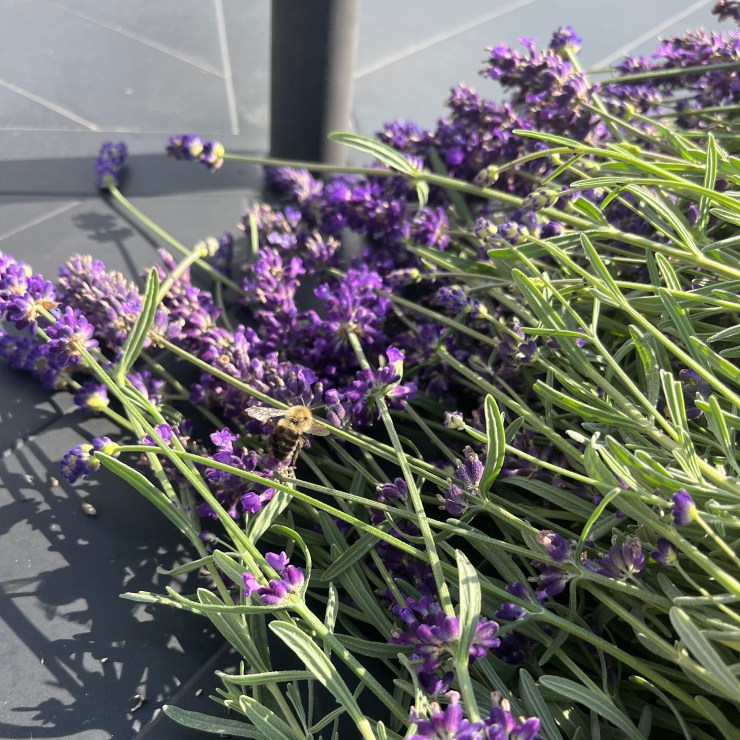
Late last summer I thought I had seen the last of the bees collecting pollen so it felt like the right time to harvest the last of the lavender, but then a last minute bee landed on my patio table. One last goodbye; one last bee getting a final lavender blessing. But the pollen collected will sustain the bee, just as the last blessing of a pilgrimage will sustain the pilgrim on the way home. A final blessing is also the beginning blessing for a new season.
Check out other psalm reflections in the links below or find more of my writing published in Presbyterian Outlook or listen to my experiments in podcasting on the Period Pastor Podcast. Follow me @periodpastor
I began writing Psalm reflections during Lent of 2020. Shortly after, we decided to close the church building, work from home, and worship via zoom. Many churches use the Revised Common Lectionary (RLC) that rotates scripture on a three-year cycle (A, B, and C). Starting in Advent 2019, the church decided to worship with the texts from Year D, which is still not circulated as are years A, B, and C. Year D was created with the goal of including scriptures that were left out or not used as frequently as others. While we were using Psalms in year D, most other lectionary followers were using Year A. In Advent of 2020 we rejoined those who use the lectionary in year B. Advent of 2021 year C. When we returned to in person worship, we took the psalm reflections out of the order of worship. I continued to write them for the blog. Advent of 2022 year A. I left church work in July of 2023 but continued the practice of writing psalm reflections. Advent of 2023 year B. Advent of 2024 year C. I finished year C early, so I posted Psalm 119 and began work on missed psalms from Year D and others not in the lectionary. Advent of 2025 year A.
I use the Vanderbilt Divinity Library’s resource for lectionary readings and the PCUSA planning calendar to make text selections.
Year D Psalms that I haven’t come across in the other lectionary years, yet:
18, 144, 44, 110, 73, 75, 76, 28, 12, 61, 11, 88, 108, 64, 60, 10, 120
These are the psalms I haven’t found in any lectionary, yet:
Sources and notes:
“Psalm 134 is the fifteenth and final unit in the collection of songs of ascents (see Psalms 120-134). It coordinates as if in reciprocal relation the blessing of the LORD by the congregation and the LORD’s blessing upon the people.” Mays p. 414
“Psalm 134 is the shortest of a collection of brief psalms. Its theme, bless, appears in three of its four poetic lines.” Mays p. 414
“The psalm now stands in a literary rather than liturgical location. In that context it serves well as a conclusion of the songs of ascents. It sums up the major concerns of the collection and states the purpose of pilgrimage to Zion: to praise the LORD and receive blessing from the LORD (122:4 and 133:3). Mays p. 415
“Psalm 134, the last of the Songs of Ascents, may be read or heard as departing words of blessing for the pilgrims who have come to Jerusalem as they ready themselves to return to their homes in the surrounding countryside. A worship leader calls on the people to offer a final word of blessing to YHWH, whose dwelling places is in Jerusalem.” W p. 228
“The words of Psalm 134 call on the people to bless YHWH and then for YHWH to bless them in a reciprocal relationship. The psalm singers’ pilgrimage to Jerusalem is at its end; they have carried out acts of worship, have spoken, and have heard words from God, and thus they ready themselves to return to their lives away from Jerusalem. Psalm 134 is the final doxology or, perhaps better, invocation, calling the people to bless God and God to bless the people.” W p. 229
“Worship in the sanctuary of God is a wonderfully moving experience, a time of withdrawal and renewal, but we cannot remain in the sanctuary; we must return to the world.” W p. 229
Alter, Robert. 2007. The Book of Psalms: A Translation with Commentary New York: W. W. Norton & Company
WBC Allen, Leslie C. 1983. Word Biblical Commentary: Psalms 101-150. Vol. 21. Waco, TX: Word Books, Publisher.
Bonhoeffer, Dietrich. 1974. Psalms: The Prayer Book of the Bible. 8th ed. Minneapolis, MN: Augsburg Press.
Bourgeault, C. (2006). Chanting the psalms: A practical guide Audio Book. New Seeds.
Brueggemann, Walter. 2007. Praying the Psalms: Engaging Scripture and the Life of the Spirit. 2nd ed. Eugene, OR: Cascade.
Brueggemann, Walter. 2014. From Whom No Secrets Are Hid: Introducing the Psalms. Edited by Brent A. Strawn. 1st ed. Louisville, KY: Westminster John Knox Press.
Brueggemann, Walter. Davis Hanskins, Editor. 2022. Our Hearts Wait: Worshiping Through Praise and Lament in the Psalms Westminster John Knox Press, Louisville KY.
Brueggemann, Walter. (2002). Spirituality of the psalms. Augsburg Pub. House.
Brueggemann, Walter. (1984). The Message of the Psalms: A Theological Commentary. Minneapolis: Augsburg.
Chilson, Richard, ed. You Shall Not Want: A Spiritual Journey Based on the Psalms. Ave Maria Press, 2009.
Chittister, Joan. (2011). Songs of the heart: reflections on the psalms. John Garratt Publishing.
Cudjoe-Wilkes, G., Wilkes, A. J., & Moss, O. (2022). Psalms for black lives: Reflections for the work of Liberation. Upper Room Books.
WBC Craigie, Peter C. 1983. Psalms 1-50–Word Biblical Commentary. Vol. 19. Waco, TX: Word Books.
Creach, Jerome Frederick Davis. 1998. Psalms: Interpretation Bible Studies. Louisville, KY: Westminster John Knox Press.
DAFLER, J. (2021). PSOBRIETY: A journey of recovery through the psalms. Louisville, KY: WESTMINSTER JOHN KNOX.
W de Claisse-Walford, Nancy L. WISDOM COMMENTARY: Psalms Bks. 4-5. Edited by Barbara E. Reid. Vol. 22. Collegeville, MN: Liturgical, 2020.
Green, Barbara. 1997. Like a Tree Planted: An Exploration of Psalms and Parables Through Metaphor. Collegeville, MN: Liturgical Press.
W Hopkins, Denise Dombkowski. WISDOM COMMENTARY: Psalms Bks. 2-3. Edited by Barbara E. Reid. Vol. 21. Collegeville, MN: Liturgical, 2016.
NIB Keck, Leander E. 2015. The New Interpreters Bible Commentary. Vol. 3. Nashville, TN: Abingdon Press.
Lewis, C. S. (2017). Reflections on the Psalms. Harper One, an imprint of Harper Collins Publishers.
Mays, James Luther. 1994. Psalms. Louisville, KY: John Knox Press.
McCann, J. C. (1993). A theological introduction to the book of Psalms: The Psalms as Torah. Nashville, TN: Abingdon Press.
McCann, J. C., & Howell, J. C. 2001. Preaching the Psalms. Nashville, TN: Abingdon Press.
Merrill, N. C. (2020). Psalms for praying an invitation to wholeness (10th Anniversary Edition ed.). London, England: Bloomsbury Publishing.
Miller, Patrick D. 1986. Interpreting the Psalms. Philadelphia, PA: Fortress Press.
Morgan, Michael. 2010. The Psalter for Christian Worship Revised Edition. Westminster John Knox Press.
Schlimm, Matthew Richard. 2018. 70 Hebrew Words Every Christian Should Know. Nashville, TN: Abington Press.
Spong, M. (Ed.). (2020). The words of her mouth: Psalms for the struggle. Cleveland, OH: The Pilgrim Press.
WBC Tate, Marvin E. 1990. Word Biblical Commentary: Psalms 51-100. Edited by David Allan. Hubbard and Glenn W. Barker. Vol. 20. Waco, TX: Word.
Weems, Ann. 1995. Psalm of Lament. Westminster John Knox Pres
OTL Weiser, Artur. 1998. Old Testament Library: Psalms. Translated by Herbert Hartwell. 3rd ed. New York, NY: Manchester University Press.

 Period Pastor Pad