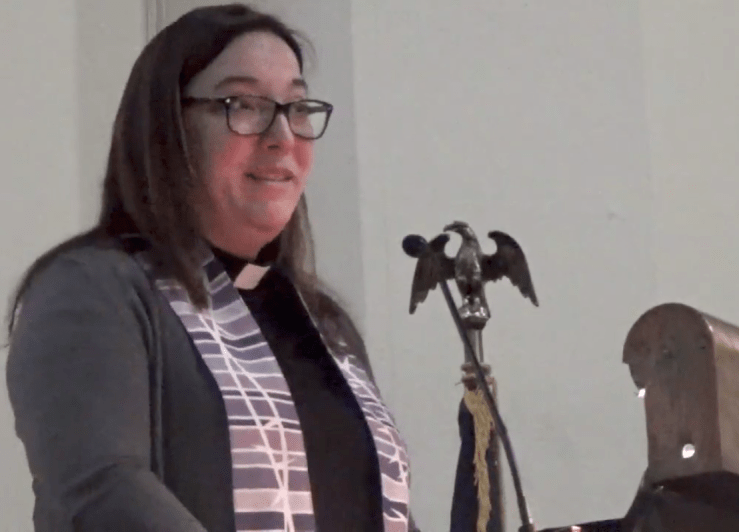
Written for The Presbyterian Church of Coraopolis this sermon can be viewed on their website and youtube channel.
March 1, 2026 2nd Sunday in Lent (Year A) Matthew 17:1–9; Genesis 12:1–4a; Psalm 121
“I lift up my eyes to the hills—from where will my help come?”
That’s a beautiful line. But it’s also a very honest question.
Because sometimes the hills—the mountains—feel like the only place where things make sense.
Where life feels clear.
Where God feels close.
Where we can finally breathe.
There was a time in my life when I felt that kind of clarity.
I was teaching music at OLSH High School. And I loved it!
I loved my students.
I loved their parents.
I loved my colleagues.
I loved the Felician Sisters.
I loved the rhythm of the school year—the bell schedule, the concerts, the sense of movement.
There is something comforting about a bell schedule.
You know when things start.
You know when they end.
You know when lunch is.
And while I was teaching, I was also discerning a call to ordained ministry.
I worked in a few churches in non-ordained roles, just to get a sense of what that life might be like.
And then the time came. The moment when I had to decide. To leave teaching…and step into a pastoral role.
And I was nervous. Because I wasn’t leaving something I disliked. I was leaving something I loved.
But I knew—deep down—God was calling me. Not to something clearer.
Not to something safer. Just… to something different. Something I couldn’t fully see yet. So I went.
And here’s the part no one really prepares you for.
The first few months were… lonely.
I went from teaching and making music with hundreds of students
to working with a smaller congregation and a church staff.
The building was quiet. Very quiet.
I remember sitting at my desk drinking coffee while it was still hot. Which had never happened before. And I liked that part.
But I also remember crying at that desk. Because I missed my students. I missed the noise. The energy. The chaos.
And I remember wondering: Did I make a mistake? Had God really called me… to this?
Nothing dramatic happened to fix it. No moment of clarity. No voice from heaven. Just… small things. Conversations. Relationships. Finding colleagues—like Pastor Rebecca. Figuring out how to build my own rhythm instead of following a bell schedule. It was slow.
And if I’m honest, I never felt as certain as I did the day I said yes.
But that moment—that clarity—stayed with me. And I kept going. Not because I understood everything. But because I trusted the One who called me.
And that’s why this Gospel story feels so familiar.
Jesus takes Peter, James, and John up a mountain.
And suddenly—everything is clear. Jesus is shining. Moses and Elijah are there. And a voice from heaven says: “This is my Son, the Beloved… listen to him.” It is unmistakable.
And Peter says exactly what we would say: “Lord, it is good for us to be here.”
Of course it is. Who wouldn’t want to stay in a moment like that?
Peter wants to build something. Three dwellings. Three tents. A way to hold onto the moment.
Because when something feels that clear— we want to keep it.
We want to stay.
But the moment doesn’t stay.
Even as Peter is speaking, a cloud overshadows them.
The voice speaks.
The disciples fall to the ground in fear.
And when they look up— It’s over. No Moses. No Elijah. No shining light.
Just Jesus. And then he leads them down the mountain.
And this is where Lent meets us:
The mountain shows us God’s glory—but we cannot stay there. Like Abram, we are called to walk forward without certainty. And like the psalmist, we go longing for God’s presence—trusting that the light we glimpsed on the mountain is already at work within us.
We cannot stay there. As much as we want to.
Because this is how God works.
Abram hears God say: “Go.” Leave your country. Leave your people. Leave what you know. Go to the land I will show you.
Not have shown you. “I will show you.”
Which means you won’t see it yet. You’ll have to walk.
And Abram goes. Without a plan. Without clarity. With only a promise.
And the disciples go down the mountain. Back to the crowds. Back to confusion. Back toward Jerusalem… and the cross.
And we go, too. Not because everything is clear. But because we have been called.
Which brings us back to that psalm.
“I lift up my eyes to the hills—from where will my help come?”
It sounds like the answer should be: From the hills. From the mountain. From that moment when everything made sense.
But the psalm says: “My help comes from the Lord, who made heaven and earth.”
Not the place. Not the feeling. God.
And then it says something even more important: “The Lord is your keeper… The Lord will keep your going out and your coming in.”
Your going out. Your coming in.
Which is really just another way of saying: Everywhere. All of it.
The mountain. And the road.
The clarity. And the confusion.
The moment when everything makes sense— and the long stretch when it doesn’t.
God is not waiting for us on the mountain. God goes with us.
So maybe the mountain isn’t where we’re meant to live.
Maybe it’s where we see clearly— just long enough to keep going.
Just long enough to remember: who Jesus is. And who we are. And why we’re on this journey at all.
Because faith doesn’t happen on the mountain. Faith happens on the road. When the moment fades. When the feeling is gone. When we are just… walking.
So this Lent, the question isn’t: How do we stay on the mountain?
The question is: Will we go? Will we trust, like Abram? Will we follow, like the disciples? Will we keep walking— even when we don’t see the whole path?
Because we don’t go alone. The Lord is our keeper. The Lord goes with our going out and our coming in.
The Lord is with us— in the quiet office, in the uncertain step, in the ordinary day.
So yes— “I lift up my eyes to the hills.” We remember those moments. We need those moments.
But we don’t live there. We live here. On the road.
And on that road, we walk with this trust: That the light we glimpsed on the mountain is already at work within us—even now. Even here. Even when we can’t see it.
Prayer: God of the mountain and the journey, you meet us in moments of clarity and call us forward into what we cannot yet see. When we want to stay where it feels safe, give us courage to go. Keep us in our going out and our coming in, and help us trust that your light is with us always. Amen.
Charge & Blessing: Go now into your week—not with everything figured out, but trusting the One who calls you. And may the God who was with you on the mountain go with you on the road, keeping you, guiding you, and holding you in love. Amen.
This is the first sermon where I’ve put my scripture selection, research, personal story, into chatgpt and asked it to structure the sermon for me. It allowed me to choose between options of which scripture to lead with, where to put the personal story, etc. I was able to edit and adapt it quickly, saving me tons of editing time. I also prompted it to create a 5 minute version of the sermon for the church’s Saturday night service. I wouldn’t have been able to edit down so quickly on my own. It was a life saver this first week doing pulpit supply after not preaching in so long (other than the period sermon). I was able to choose from several short prayers and blessings based on the sermon. Some I didn’t like at all, and others were good, and the final one I selected sounded like something I would say. I was surprised by how well the AI could imitate my voice and it felt very natural to read it out loud. I usually write in paragraphs, but chatgpt formatted it into these shorter lines which was easier to read from the pulpit. (I did loose my place and go off script a little but not nearly as much as I do when I have longer paragraphs). I’m still a little unsure about using AI tools, but I know that it is a technology that I will have to learn how to navigate so this was a good chance to practice and see how it felt.
I’ve been attending events cosponsored by the Christian Associates of Southwest Pennsylvania and the Holocaust Center of Pittsburgh on the topic of “Reckoning with Antisemitism as Christians”. Through these events, I’ve gained new perspectives on preaching and teaching scripture (especially scriptures that Christians read during the season of Lent). These programs have also brought a deeper awareness of how easily my words (or my lack of explanation) might contribute to antisemitism in Christian congregations.
The issue that may come up with the Matthew text (especially if we included Matthew 17:1-13) is that Jesus is fulfilling the old testament prophesies and that Jewish people were not able to understand him as the Messiah. What’s important to remember is the disciples (and Jesus) were Jewish. And it isn’t that Jewish people were unable to fulfill the law on their own or that they could not recognize Jesus, but that no people were capable of this. And no one is capable of doing what Jesus’ life and ministry did even now. Criticizing the Jewish people of Jesus’ time and applying that to how we treat modern Jewish people, is how this passage might be used to further antisemitic ideals. Also in my notes from the event about this passage were that it’s core message is that God is with us even when life is difficult, when there is no clear way forward, when we need to rely on trust and hope and each other. The core message is not about what Jesus is fulfilling or worse, replacing, it is about God with us (everywhere and always). In my sermon I leaned into this core message but was not able to find a way to bring up antisemitic concerns and address them. But, given the opportunity to do a bible study or if a parishioner would have follow up questions about this sermon, I feel like I am reasonably able to identify when a conversation around it heads into antisemitism and to steer away from that in a loving and theologically appropriate way.


