This was written for Coraopolis Presbyterian Church and you can listen to it on their YouTube channel.
Sermon: “Held Fast in a Fearful World”
Our scripture this morning picks up exactly where we left off on Easter. John 20:19-31
Later—
after the tomb was found empty,
after Jesus appeared to Mary Magdalene,
after she proclaimed the good news of God’s transforming work in the world through the resurrection—
after all of that…Jesus’ closest followers are still hiding. They are hiding out of fear.
John’s Gospel tells us they are hiding out of fear “of the Jews.”
But that doesn’t quite make sense, because Jesus and his followers are Jews.
So who are they afraid of?
They are afraid of those with religious authority
who have aligned themselves with political authority to gain power.
They are afraid of a small group
who use their religious beliefs to justify political actions—
actions like crucifying a rabbi who taught that God’s love would transform the world.
The good news that Jesus preached—healing for the sick, food for the hungry, release for the captives, freedom from oppression—these are deeply rooted Jewish teachings.
God’s transforming love is good news for those who are suffering.
And it can be good news for those in power as well—
because they have the opportunity to use their power to show generosity
and to model how God loves those who have the least to give back.
But all too often, those in power do not use it for the good of all people, but for their own gain.
Their motives are often fear—fear of what would happen if they lost power—
or a kind of scarcity mindset that twists their perspective, making care for others seem like weakness.
And so they use their power to terrorize others. That is what the disciples are afraid of.
Even though they share the same religious texts and practices with the people they fear,
they know they could be next.
It is a tragic thing when God’s word is twisted and used like a weapon—when it was meant to teach us how to love one another.
And into that fear filled room, Jesus enters.
Just as he found Mary in her grief earlier that morning, he now enters into his beloved community when they are full of fear.
And he says, “Peace be with you.” Shalom. A word they knew well from their scriptures.
A word we often translate as “peace.” Means much more. Wholeness. Completeness.
Not that everything is perfect now, but that God’s future fulfillment is breaking in—
even here. Even now. Even in the midst of fear and grief.
Then Jesus shows them his hands and his side—the scars from the violence done to him.
He speaks shalom while still bearing wounds.
God’s future wholeness is revealed in his broken body.
God is transforming the world with love even when we are afraid of the terror we see.
And then, to these people who are hiding in a locked room,
Jesus says: “As God has sent me, I send you.”
He does not send the brave and strong. He sends those who are afraid.
Those still carrying grief. Those still wrestling with doubt.
He sends them to continue co-creating God’s new world.
Because God knows that love is stronger than fear, stronger than death.
And the disciples—even in their fear—are called to trust that.
To begin living this resurrection life.
Then Jesus breathes on them.
We are meant to remember how God breathed life into creation.
Here, Jesus breathes new life—Spirit-filled life—into his friends.
And then he speaks words that are difficult to translate.
I’ll spare you the full discussion from the Wisdom Commentary,
but the awkward, word-for-word translation would be something like this:
“If of anyone you forgive the sins, they have been forgiven of them.
If of anyone you hold, they have been held.”
Previously, scholars added the word “sin” into the second half to make it make sense.
But there may be another way to hear it: “Whomever you hold, they are held fast.”
Sandra Schneiders is credited with this understanding, and she explains it this way:
“The community that forgive sins must hold fast those who it has brought into the community of eternal life.”
In other words, when we proclaim God’s love and forgiveness, it is not just something we say to strangers.
It is how we become a community.
A community that holds one another
through all the ups and downs
of co-creating a new world
as the Holy Spirit leads us.
We cannot simply believe the good news.
We must live it—together.
And that makes the next part of the story
even more meaningful.
One of them was missing. Thomas wasn’t there.
We don’t know why. But he missed this moment.
And when the others tell him, he does not believe them.
But they hold onto him. They do not push him out. They do not give up on him.
They hold him fast.
A week later, Thomas is still with them. Still part of the community. Still held.
And when Jesus comes again, he stands among them and says, “Peace be with you.”
And then he turns to Thomas.
And offers him something he hasn’t offered before:
“Put your finger here…see my hands…reach out your hand…”
The text doesn’t say whether Thomas actually touches him.
But it is Thomas who speaks the deepest confession: “My Lord and my God.”
It would be a perfect ending.
But John adds one more word—for us.
“Blessed are those who have not seen and yet have come to believe.”
And then John tells us why he wrote all of this:
So that we might believe that Jesus is the Messiah, the Son of God, and that through believing we may have life in his name.
Not just belief—but life. A life lived in a community that holds one another fast.
And that kind of life—that kind of community—looks something like Mr. Rogers’ neighborhood.
Mr. Rogers was a Presbyterian minister, ordained to share God’s love through children’s television.
It was no accident that his neighborhood was a place where people and puppets held each other close.
King Friday the 13th struggled to be a benevolent ruler, and sometimes his neighbors had to gently redirect him.
Daniel Striped Tiger was afraid of nearly everything— and yet his neighbors were patient, kind, and reassuring whenever he needed it.
And even in Mr. Rogers’ interactions with the adults on the show, there was deep dignity and care.
I’m especially thinking of the moment when he invited Officer Clemmons to soak his tired feet in the pool with him.
At a time when pools in the United States were still segregated,
Mr. Rogers quietly modeled a different kind of world.
In his neighborhood, radical love and acceptance were simply the norm.
For Mr. Rogers, a neighbor is any person you meet on any given day.
But Neighbor is not just proximity—it is a moral vision.
When he said, “I’ve always wanted to have a neighbor just like you,” people felt it.
They felt seen. Valued. Wanted.
In that neighborhood, every person is worthy of dignity and love.
Each person is allowed to show up exactly as they are—with gifts, with fears, with needs.
And together, they create something beautiful.
But sometimes our world is not beautiful.
And I think that ugliness comes when we forget that we are neighbors.
So I’ll leave you with one more piece of wisdom from Mr. Rogers: “If it’s mentionable, it is manageable.”
He said that to children with big feelings—encouraging them to find safe people who would help them carry what they feel.
And I would say the same to you:
Keep gathering. Keep building spaces where you can care for one another and be cared for.
Check in with yourself. Check in with your people. Hold one another fast.
Because together, we are co-creating a beautiful neighborhood.
And I am so glad I have neighbors just like you.
Charge
Go out into the world
not as people who have everything figured out,
but as people who are willing to keep showing up.
Go as those who have heard Christ’s peace
spoken into your fear.
Go as those who are sent—not because you are fearless,
but because God’s love is stronger than fear.
Hold one another fast. Make space for doubt. Practice forgiveness.
Be neighbors—not just in kindness, but in courage, in compassion, in commitment to one another.
Help create communities where people are seen, known, and loved.
Blessing
And now, may the peace of Christ—
the deep, abiding shalom
that holds even in the midst of brokenness—
go with you.
May the Spirit breathe new life into you, again and again.
May you be held fast by the love of God
and by the community around you.
And may you go into this world to love and to serve as neighbors to all.
Amen.
Holy and loving God,
We come before you as we are—
some of us full of faith,
some of us full of questions,
many of us carrying fear we do not always name.
You know the places where we feel locked in,
the doors we have closed to protect ourselves,
the worries that keep us from stepping fully into life.
And still, you come to us.
Still, you stand among us.
Still, you speak your word of peace.
So we pray: breathe your Spirit into us again.
Where we are anxious, give us your calm.
Where we are wounded, bring your healing.
Where we are divided from one another, make us whole.
Teach us to trust that your love is stronger than fear.
Stronger than grief.
Stronger even than death.
Form us into a community that reflects your grace—
a people who forgive as we have been forgiven,
a people who do not let one another go,
a people who hold each other fast
through doubt, through struggle, through change.
We pray for those who feel alone today—
those who are grieving,
those who are overwhelmed,
those who feel unseen or forgotten.
Surround them with your presence,
and draw them into communities of care and belonging.
We pray for your world—
where fear so often shapes decisions,
where power is too often used to harm rather than heal.
Raise up leaders who seek justice and mercy.
Give courage to those who speak truth.
And help all of us to remember
that we belong to one another.
Make us good neighbors, O God—
not only in word, but in action.
Give us the courage to show up for one another,
the patience to listen,
and the compassion to care.
And when we struggle to believe,
when we feel like Thomas,
help us remain—
held by you,
and held by one another.
We ask all of this in the name of the risen Christ,
who comes to us in our fear
and calls us into new life.
Amen.
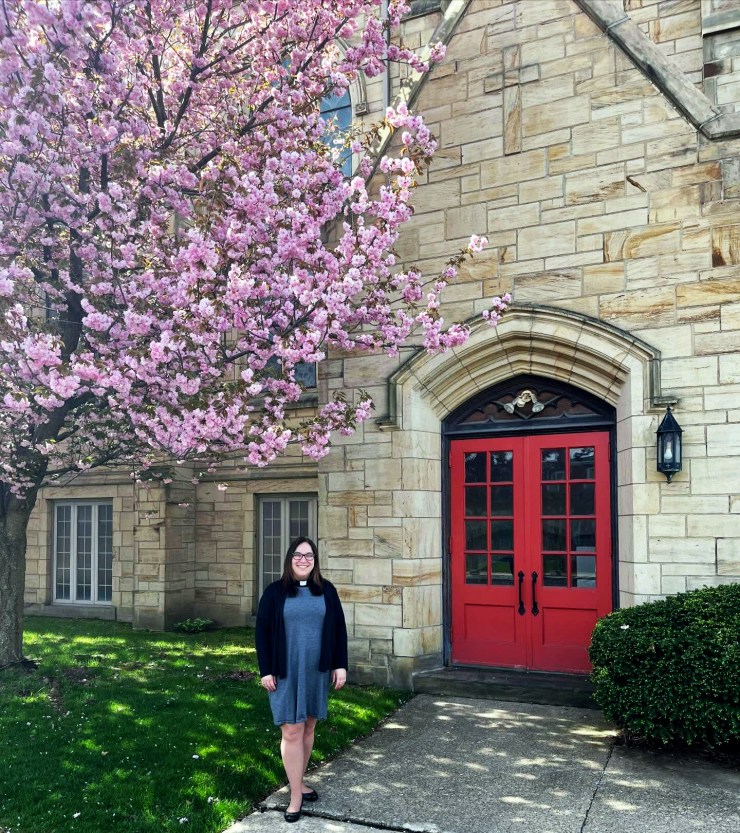
I’ve been attending events cosponsored by the Christian Associates of Southwest Pennsylvania and the Holocaust Center of Pittsburgh on the topic of “Reckoning with Antisemitism as Christians”. Through these events, I’ve gained new perspectives on preaching and teaching scripture (especially scriptures that Christians read during the season of Lent). These programs have also brought a deeper awareness of how easily my words (or my lack of explanation) might contribute to antisemitism in Christian congregations. This might be the sermon I addressed these issues in best. I also took a swing at Christian Nationalism. One couple did tell me they noticed it sounded like today’s politics. I told them I was talking about Jesus (wink) and if they heard something about today’s politics that was the Holy Spirit. But the mention of Mr. Roger’s Neighborhood melted everyone’s hearts so they forgave the political reference.
I’m feeling much more confident using AI for editing. At the beginning it felt like cheating, but really, this is the same as submitting work to an editor who makes suggestions or edits. This tool is helping me become a better writer. I’m seeing patterns in my own work that can be corrected and some that I want to continue to lean into as I continue to preach. I’m grateful to have this tool at a time when I was challenged to preach more frequently than I have before.
This sermon is my last at Coraopolis Presbyterian Church and I’m grateful for their support, prayers, and enthusiasm for my preaching. It was an honor to pray for the Pastor’s recovery with them.


