Mission within a Mission
Period Sermon for Crafton Heights United Presbyterian Church
Worship can be viewed live on the church’s Facebook page. All recordings of the virtual services will be available on YouTube.
This sermon has evolved over the years and so has my work with DfG. Full story One of my favorite things to do is to talk to people about period and God… even better if it’s at the same time.
The Days for Girls mission is simple: creating a more dignified, free, and educated world through access to lasting menstrual health. Our tagline is: Every Girl. Everywhere. Period.
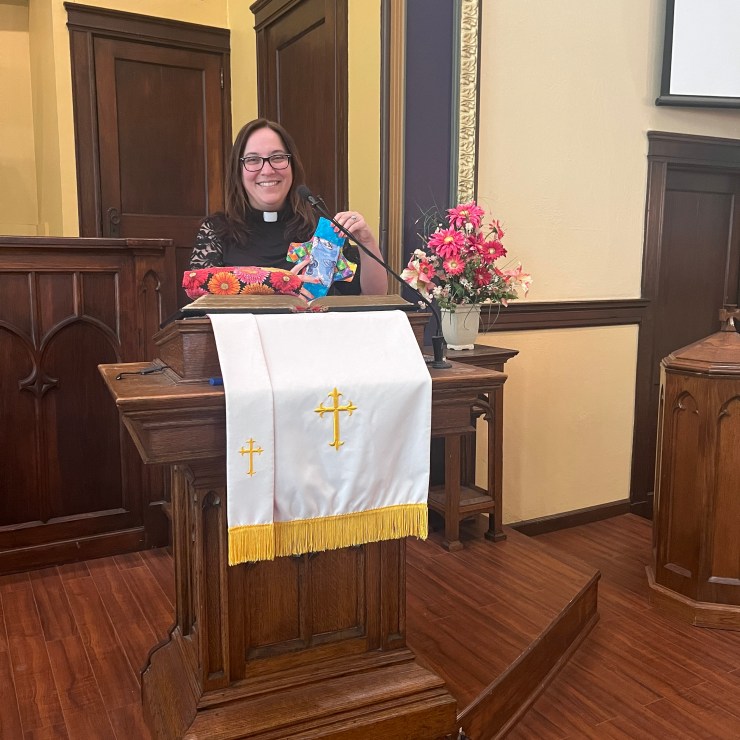
Each standard Days for Girls washable kit includes: two waterproof shields, eight liners, two pairs of underwear, a carry pouch, a 100% cotton washcloth, a small bar of soap, and an ovulation chart with directions—all packaged in a drawstring bag. Those are the things you can see. What you might not notice immediately is that these kits also contain dignity, education, and independence.
Women and girls around the world are vulnerable—especially when they are menstruating and don’t have a way to manage their flow. Periods are a social taboo in many places, each with its own customs to navigate. In some communities, menstruating women and girls are separated from their families and support systems.
But there is hope.
When girls have access to menstrual products, they stay in school longer. When girls finish school, they are less likely to marry young, more likely to delay having children until their bodies are fully developed, and more likely to raise healthier families. Access to washable pads helps break cycles of poverty by giving girls more days in school and women more days at work. Educated women strengthen the health, wellness, and prosperity of entire communities. This is social justice work.
Periods are rarely discussed publicly, which makes period poverty an invisible problem. Yet wherever there is poverty, there is period poverty. Nearly everyone who has experienced menstruation has faced a moment of not having what they needed. Without access to products, people miss school or work—or must leave to obtain supplies.
That’s why it’s important to advocate for free, accessible menstrual products in schools, prisons, and public restrooms. Businesses can also become period positive workplaces by stocking restrooms with supplies, meeting WHO sanitation standards, and formalizing access through workplace policies. Organizations that do this often see increased productivity and reduced absenteeism.
People with periods don’t just work—they live full, engaged lives. Access is needed everywhere: libraries, parks, schools, religious spaces.
Maybe even here, in Crafton Hights United Presbyterian Church. I’ve heard you already started providing menstrual products in the church bathrooms and at the Open Door. Pastor Dave also told me that the high school students have organized a drive for baby and menstrual supplies. You’re doing great work!
By embracing a period-positive perspective, churches can more fully live into their calling as communities of radical hospitality, compassionate advocacy, and holistic care. Period justice is not separate from spiritual work—it is spiritual work. When we affirm the sacredness of the body and lived experience, we embody love of neighbor in its fullest sense. (Period Positive Church)
In the U.S., most organizations provide disposable products. But washable options deserve more attention—they are better for the environment, healthier for our bodies, and more cost-effective over time. Simply put, they are a smart choice.
From personal experience, washable pads are more comfortable, softer, and less prone to odor than disposables. I also use a menstrual cup, which has helped me better understand my body. Sharing these experiences helps break stigma. And when one person speaks openly, others begin to share too. Conversations about periods can open doors to deeper, more meaningful conversations. They create safe spaces.
A Days for Girls workroom is one of those spaces—a place where anyone can come, be welcomed, and feel safe sharing whatever is on their heart. It becomes a sanctuary: a place of love and support, where sorrow, and gratitude are held together in community.
But it took me a long time to recognize that.
I was so focused on making kits and sending them out that I missed what was happening right in front of me.
Read scripture: Luke 8:40–56
When I started this Days for Girls journey, I imagined it would be me, Jesus, and the volunteers—making kits to send to 12-year-old girls who would need them to improve the trajectory of their lives. It felt like a clear path: we make the kits, they go to girls about to get their first period, and those girls don’t have to miss school. They can continue their education, delay marriage, and wait to start families until after they have completed school. And when girls are educated, their communities are lifted out of poverty.
We had great success at our first sewing day—but we also had a lot of half-finished kits. So we held another sewing event, and then another. Eventually, we registered as a Days for Girls Team, and other people began to find us. Students who needed service hours, women from community correction centers and rehab programs, people with special needs, and others who simply wanted to do good in the world.
The sewing room was getting crowded.
The Days for Girls project became so much more than I imagined.
I thought the path was clear. It would be me, and Jesus, and the volunteers—working on kits, raising money, getting on a plane so I could place those kits into the hands of 12-year-old girls, changing their lives forever.
But now there is a crowd of people in the sewing room pressing in on all sides, and suddenly Jesus stops and says, “Who touched me?”
What do you mean, Jesus? With all these people in the sewing room making kits, of course someone touched you. We’re busy here. Keep sewing. Keep ironing. Keep packing. We have to get to that little girl. Remember the plan? Make the kits, fundraise, get on a plane, put the kit in the hand of a 12-year-old girl. We don’t have time to stop.
We have to help vulnerable women. We have to empower little girls. We have to enable them to break the systems that hold them back.
But Jesus stops.
He looks around.
“Who touched me?”
What do you mean, Jesus?
And Jesus says, “Someone touched me. I felt healing happen.”
No, Jesus—you didn’t. We are on the way to healing the world. Remember the little girl.
But Jesus stops again.
“No. Someone was healed just now. Who touched me?”
And in that moment, I begin to see the room through Jesus’ eyes.
The project I thought was leading us to help a 12-year-old girl is really two missions that are deeply connected. The mission is about the girl—but it is also about how we get to her, and who is with us along the way. Centering women, healing, restoring community—this is both the goal and the way to the goal.
Jesus asks, “Who touched me?” to make us look around.
He pauses to center the marginalized woman. He heals her physically, listens to her story, restores her place in the community, praises her faith, and calls her “beloved daughter.” Jesus is a holistic healer. He models what it means to listen to the voices of the oppressed and to honor all people as beloved members of God’s family.
So our Days for Girls mission hasn’t changed—but we have paused and looked around. We’ve realized that those among us—our partners in service—need healing too.
In Luke, we are given two stories of women finding healing through Jesus. One is a young girl who becomes sick and dies while waiting for Jesus, and yet is restored to life despite the doubt and scorn surrounding him. The other is a woman who, through persistence and courage, reaches out for something bigger than herself when all else seems lost—and she is healed along the way.
Jesus’ ministry of healing and reconciliation is not just for those at the destination—it is for all of us along the journey.
And healing, faith, and reconciliation look different for each of us.
The community providing healing is often made up of people who are seeking healing themselves.
So when Jesus asks, “Who touched me?” we might also ask:
Who else has realized they need help?
Who else knows they cannot do this life alone?
Who else is searching for community—and for something greater than themselves?
Ministry is not always what we expect. Sometimes it happens in the interruptions.
What began as a project to empower women “out there” became a community of healing right here in Pittsburgh. It is still about the 12-year-old girl—but it is also about all of us walking together to get there.
Together, we have created a community where people are valued, encouraged, empowered, and—most importantly—loved. A place where, no matter how you arrive, you leave changed—maybe even healed.
My hope and prayer is that you begin to see these layers of ministry as they unfold. Whether through Days for Girls or Open Door Youth Outreach, or in your work with “Hello Neighbor” and “The Women and Girls Foundation” may you connect deeply, share openly, and remember:
Mission is not only about the destination.
It is also about those who travel the way with us.
Charge:
Go now into the world remembering this:
the work of God is not only found at the destination,
but in every moment along the way.
Go ready to notice—
to see the ones who are often unseen,
to hear the voices that are often overlooked,
to pause when the world tells you to keep moving.
Do not be afraid of the interruptions,
for they may be the very places where healing begins.
Go to be a people who create space—
for dignity, for honesty, for belonging.
Go to build communities where all bodies are honored
and all stories are safe to be told.
And as you go, remember: you do not travel alone.
God is with you, and so are those walking beside you.
Blessing:
May the God who sees you and calls you beloved go with you now.
May Christ, who paused for the one in need,
teach you to notice and to care.
May the Holy Spirit guide your steps, soften your heart,
and open your eyes to the sacred all around you.
And may you be swift to love and generous in kindness,
bringing healing not only to the world, but to one another along the way.
Go in peace, to love and to serve. Amen.
Pastoral Prayer
Gracious and loving God,
We come before you as we are—
carrying both what is visible and what is unseen.
You know the quiet burdens we hold,
the needs we hesitate to name,
and the places within us that long for healing.
You are the God who pauses.
The God who notices.
The God who asks, “Who touched me?”—
not out of confusion, but out of compassion.
So today, we ask:
Help us to slow down.
Help us to notice one another.
Help us to see the people right in front of us—
not as interruptions, but as sacred encounters.
We lift up to you all who experience vulnerability—
especially women and girls around the world
who lack access to basic menstrual care,
who face stigma, exclusion, or shame.
May dignity replace shame,
access replace scarcity,
and opportunity replace limitation.
Strengthen those who are working for justice—
those organizing, advocating, and serving.
Bless the work of communities like Crafton Heights United Presbyterian Church,
and all who labor quietly and faithfully
to bring healing into the world.
And God, we remember that we, too, are in need of healing.
For those who feel unseen—
remind them they are known and loved.
For those who feel worn down—
restore their strength.
For those carrying grief, anxiety, or uncertainty—
surround them with your peace.
Create in us communities of radical hospitality—
places where stories can be shared,
where bodies are honored,
where no one feels alone.
Teach us that ministry is not only about the destination,
but about the people we meet along the way.
Open our hearts to be changed by one another.
Give us courage to be honest,
compassion to listen deeply,
and grace to walk together.
And now, as we go forward,
may we be swift to love
and generous in kindness—
gladdening the hearts of those
who travel the way with us.
We pray all of this in your holy name.
Amen.

 Period Pastor Pad