Behold, how good and pleasant it is when brothers and sisters dwell in unity!
It is like vistas seen from atop a mountain one has climbed …
Or like the stillness of a sunset after a long day’s work.
It is like a shimmering rainbow, breaking through a summer rain.
When men and women dwell in harmony, the star of Truth appears!
Nan Merrill Psalms for Praying
Reflection:
Psalm 133 was one of the songs sung during a pilgrimage to Jerusalem. These kindred souls would dwell together; eating, praying, and experiencing wonder in the presence of God. They had a unity of purpose to be in an idealized version of family.
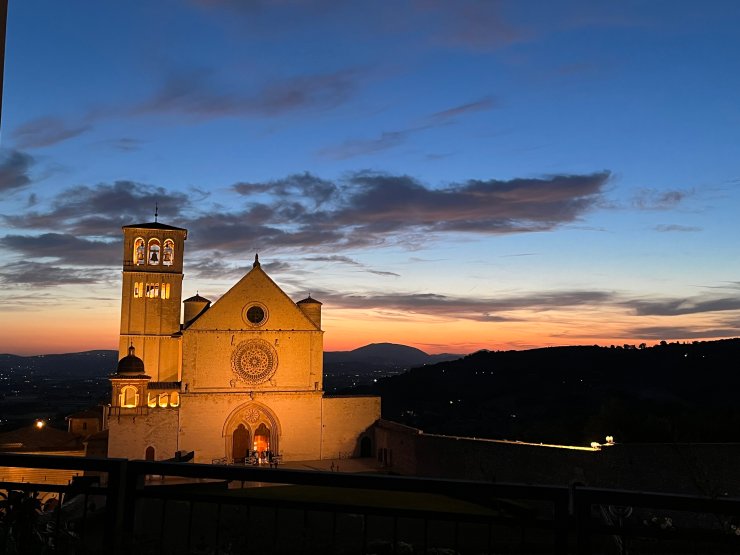
When I think about my pilgrimage experience in Italy, I remember feeling peaceful and joyful in Assisi. As that feeling lingers in my memory, I wonder why Assisi feels that way. Is it because the peaceful nature of St. Francis and St. Clare still dwelled close to their burial places? Or is this city a thin space where God somehow came closer? Or is it the energy and intention that pilgrims carry with them, a unity of purpose and spirit? Maybe it was all of those things.
Since I visited Italy, I have a desire to do more pilgrimages and generally travel more. I went on a pilgrimage to England in 2023 and our group text is still active with each of us sharing new insights into things we studied or enjoyed together. We read a lent devotional together in 2024 and shared thoughts via text. This extension of our pilgrimage feels like a life line that holds me and grounds me with the people of God.
My pilgrimage group visited Japan in 2024 and we visited an onesen, which for us was a new kind of vulnerable. You can read more about that in my Presbyterian Outlook article, Curiosity over Fear. Japan was also the place I was able to process my feelings about leaving pastoral ministry, again, I submitted my thoughts to Presbyterian Outlook, What Japanese Gardens taught me about letting go, and found a community of people who know what it is like to grieve for things that were yet to come, and never will be.
When we visited Scotland 2025, it was like visiting a country that was doing the hard work of owning an unpleasant past, while making changes to correct the damage done. In Scotland, the work of creating a tartan, getting a government apology, and a new monument for those executed as witches, means that the country is committed to treating those who are a little different as fully human and valuable. Scotland is also the first country to require that all bathrooms have period products. The dignity of all people is valued; I hope all of God’s people will do the same.
As I’m writing this reflection, I have just come home from our pilgrimage to Greece which was filled with joy (and olive oil). Today, life feels abundant and blessed in ways I cannot quite describe. Before leaving for Greece, I copied all of the psalms of ascent into my travel journal so I could reflect on them, so it feels fitting that this is the first psalm I’m working on after the trip (although it won’t be published until July and I will be well into the RV travel season) because I’ve only begun processing all of the sites, experiences, and pilgrim community building.
If you follow my instagram you know that my husband and I like to visit National Parks. When I read Nan Merrill’s Psalm 133, it reminded me of the many times we would be standing next to total strangers staring at a beautiful vista and one stranger would say “isn’t this beautiful” and another would answer “yes it is”. Sometimes we exchanged other thoughts and which state we lived in, other parks we visited, and took pictures for each other, but there was something about being in those spaces that made us feel deeply connected to whomever happened to be beside us. I’ve written about our experiences in National Parks for Presbyterian Outlook . We even joined our neighbors in a No Kings protest in Moab during our 2025 summer RV trip. My husband began a blog so we had a space to recount our travels, Our Life in the Rearview.
I think there are special experiences, places, and people that simply feel like home, not like my home, but our home, a place full of love for everyone. Some may call that the gift of God, or the connection of human spirit, or as Nan Merrill says, a star of Truth, but whatever it is, I think those who experience it are the ones who travel with open hearts.
Check out other psalm reflections in the links below or find more of my writing published in Presbyterian Outlook or listen to my experiments in podcasting on the Period Pastor Podcast. Follow me @periodpastor
Past reflection links:
Psalm 133 Year B (2023-2024)
Psalm 133 Year B (2020-2021)
I began writing Psalm reflections during Lent of 2020. Shortly after, we decided to close the church building, work from home, and worship via zoom. Many churches use the Revised Common Lectionary (RLC) that rotates scripture on a three-year cycle (A, B, and C). Starting in Advent 2019, the church decided to worship with the texts from Year D, which is still not circulated as are years A, B, and C. Year D was created with the goal of including scriptures that were left out or not used as frequently as others. While we were using Psalms in year D, most other lectionary followers were using Year A. In Advent of 2020 we rejoined those who use the lectionary in year B. Advent of 2021 year C. When we returned to in person worship, we took the psalm reflections out of the order of worship. I continued to write them for the blog. Advent of 2022 year A. I left church work in July of 2023 but continued the practice of writing psalm reflections. Advent of 2023 year B. Advent of 2024 year C. I finished year C early, so I began work on psalms I missed: Psalm 119, Year D and others not in the lectionary. By the end of 2025, I have written a reflection for each psalm.
Advent of 2025 year A.
I use the Vanderbilt Divinity Library’s resource for lectionary readings and the PCUSA planning calendar to make text selections.
Year A Psalms
1st Sunday in Advent Psalm 122, 2nd Sunday in Advent Psalm 72, 3rd Sunday in Advent Psalm 146, 4th Sunday in Advent Psalm 80, Christmas Psalm 96, Psalm 97, Psalm 98, 1st Sunday after Christmas Psalm 148, 2nd Sunday after Christmas Psalm 147, 1st Sunday after Epiphany Psalm 29, 2nd Sunday after Epiphany Psalm 40, 3rd Sunday after Epiphany Psalm 27, 4th Sunday after Epiphany Psalm 15, 5th Sunday after Epiphany Psalm 112, Transfiguration Sunday Psalm 2 or Psalm 99.
1st Sunday in Lent Psalm 32, 2nd Sunday in Lent Psalm 121, 3rdSunday in Lent Psalm 95, 4th Sunday in Lent Psalm 23, 5th Sunday in Lent Psalm 130, 6th Sunday in Lent Psalm 118 or Psalm 31.
Easter Psalm 118 or Psalm 114, 2nd Sunday of Easter Psalm 16 or Psalm 111, 3rd Sunday of Easter Psalm 116 or Psalm 34, 4th Sunday of Easter Psalm 23 or Psalm 100, 5th Sunday of Easter Psalm 31 or Psalm 119: 9-32, 6th Sunday of Easter Psalm 66 or Psalm 115, 7th Sunday of Easter Psalm 68 or Psalm 21, Pentecost Psalm 104.
1st Sunday after Pentecost Psalm 8, 2nd Sunday after Pentecost Psalm 33 or Psalm 50, 3rd Sunday after Pentecost Psalm 116 or Psalm 100, 4th Sunday after Pentecost Psalm 86 or Psalm 69, 5th Sunday after Pentecost Psalm 13 or Psalm 89, 6th Sunday after Pentecost Psalm 45 or Psalm 145, 7th Sunday after Pentecost Psalm 119: 105-112 or Psalm 65, 8th Sunday after Pentecost Psalm 139 or Psalm 86, 9th Sunday after Pentecost Psalm 105 or Psalm 128 or Psalm 119: 129-136, 10th Sunday after Pentecost Psalm 17 or Psalm 145, 11th Sunday after Pentecost Psalm 105 or Psalm 85, 12th Sunday after Pentecost Psalm 133 or Psalm 67, 13th Sunday after Pentecost Psalm 124 or Psalm 138, 14th Sunday after Pentecost Psalm 105 or Psalm 26, 15th Sunday after Pentecost Psalm 149 or Psalm 119, 16th Sunday after Pentecost Psalm 114 or Psalm 103, 17th Sunday after Pentecost Psalm 105 or Psalm 145, 18th Sunday after Pentecost Psalm 78 or Psalm 25, 19th Sunday after Pentecost Psalm 19 or Psalm 80, 20th Sunday after Pentecost Psalm 106 or Psalm 23, 21st Sunday after Pentecost Psalm 99 or Psalm 96, 22nd Sunday after Pentecost Psalm 90 or Psalm 1, 23rd Sunday after Pentecost Psalm 107 or Psalm 43, 24th Sunday after Pentecost Psalm 78 or Psalm 70, 25th Sunday after Pentecost Psalm 123 or Psalm 90, 26th Sunday after Pentecost Psalm 100 or Psalm 95.
Sources and notes:
“Psalm 133 is the fourteenth in the collection of songs of ascents (see Psalms 120-134). It shares the motif of “Zion as a place of blessing” with the preceding and following songs (v. 3, with 132:13-15 and 134: 3). The psalm is an exclamation of delight at the goodness the pilgrims experience in assembling as one family in Zion.” Mays p. 412
When kindred live together – “the phrase refers to the pilgrimage practices of people who were kin through the LORD’s covenant, sitting together at festival meals and dwelling together during a festival such as Tabernacles. The festival transformed the pilgrims into a family that for a holy time ate and dwelt together. The covenant bound them together, and the Presence brought them together.” Mays p. 413
“Zion is the place of ordained blessing, the place where the people of the LORD in their unity receive everlasting life. It is the abundant life, which Israel can receive only in its unity, and only from the Presence at this place that is the summum bonum. The life that the LORD gives his people in their unity is the supreme family value.” Mays p. 414
“… the psalm is a witness that God is at work building a family that transcends all the given and instituted barriers that separate and diminish life.” Mays p. 414
“Thus the oil used to anoint the head of the visitor to one’s home is likened to the oil used to anoint the head of Aaron the high priest, infusing the act with a sense of sacredness and elevating the visitor to the status of an esteemed guest in the home.” W p. 225
“In the metaphorical language of Psalm 133 the dew from Hermon falls on the “mountains of Zion,” providing blessing.” W p. 225
“The singers of Psalm 133 would most likely have remembered the proverbial wisdom saying on which the psalm was based–kindred who dwell together in city being likened to good oil and dew, representing the joy and goodness of dwelling together as brothers and sisters–but the words of the whole psalm reminded the people that their family relationship was established not by blood but by their mutual sharing in the community of God. The celebrations of festivals in Jerusalem transformed pilgrims coming from different places and family groups into a united family that for a holy time ate and dwelt together. Psalm 133 was a song of greeting, of anticipation, and of celebration of that holy time.” W p. 226
Brueggemann describes psalms of orientation, “The psalms we include here are not the most interesting, for there is in them no great movement, no tension to resolve. Indeed, what mainly characterizes them is the absence of tension. The mindset and worldview of those who enjoy a serene location of their lives are characterized by a sense of the orderliness, goodness, and reliability of life.” He includes some of the psalms of ascent in this list of psalms of orientation ( 127; 128; 131; 133) because they reflect “domestic life that is in good order. They are the voice of genuine gratitude and piety for such rich blessings.” Brueggemann From Whom No Secrets are Hid pp. 155-156
“Psalm 133 reflects Israel’s capacity to appreciate the common joys of life and to attribute them to the well-ordered generosity of Yahweh. One can only hypothesize about the time such a poem was formed or used. It may be reflective of “family reunion,” of the gathering of the tribe, of any social occasion of “brothers,” clan leaders being together without conflict. The voice may be that of a relived elder, anxious that the younger generation not destroy itself in conflict. the poem anticipates the solidarity and harmony of all humanity as it lives without defensiveness in a creation benevolent enough to care for all.” Brueggemann The Message of the Psalms p. 48
“Like goodly oil on the head. In the Israelite world, as in ancient Greece, rubbing the hair and body with aromatic olive oil was one of ht palpable physical pleasures of the good life.” Alter p. 462
“Aaron’s beard that comes down over the opening of his rob. This initially puzzling line makes good associate sense. The “coming down” of the oil from head to beard is picked up in the “coming down” of the beard itself–a beard of evidently proverbial amplitude, that of the fist high priest–over the opening of ht probe. The full beard is presumably an image of vigor and abundance.” Alter p. 462
“Like Hermon’s dew that comes down. Now we have a third”coming down”–the dew on this northern mountain. The dew is understood to be an agency of fruitfulness, especially important in the long dry season when no rain falls” Alter p. 463
Alter, Robert. 2007. The Book of Psalms: A Translation with Commentary New York: W. W. Norton & Company
WBC Allen, Leslie C. 1983. Word Biblical Commentary: Psalms 101-150. Vol. 21. Waco, TX: Word Books, Publisher.
Bonhoeffer, Dietrich. 1974. Psalms: The Prayer Book of the Bible. 8th ed. Minneapolis, MN: Augsburg Press.
Bourgeault, C. (2006). Chanting the psalms: A practical guide Audio Book. New Seeds.
Brueggemann, Walter. 2007. Praying the Psalms: Engaging Scripture and the Life of the Spirit. 2nd ed. Eugene, OR: Cascade.
Brueggemann, Walter. 2014. From Whom No Secrets Are Hid: Introducing the Psalms. Edited by Brent A. Strawn. 1st ed. Louisville, KY: Westminster John Knox Press.
Brueggemann, Walter. Davis Hanskins, Editor. 2022. Our Hearts Wait: Worshiping Through Praise and Lament in the Psalms Westminster John Knox Press, Louisville KY.
Brueggemann, Walter. (2002). Spirituality of the psalms. Augsburg Pub. House.
Brueggemann, Walter. (1984). The Message of the Psalms: A Theological Commentary. Minneapolis: Augsburg.
Chilson, Richard, ed. You Shall Not Want: A Spiritual Journey Based on the Psalms. Ave Maria Press, 2009.
Chittister, Joan. (2011). Songs of the heart: reflections on the psalms. John Garratt Publishing.
Cudjoe-Wilkes and Wilkes Cudjoe-Wilkes, G., Wilkes, A. J., & Moss, O. (2022). Psalms for black lives: Reflections for the work of Liberation. Upper Room Books.
WBC Craigie, Peter C. 1983. Psalms 1-50–Word Biblical Commentary. Vol. 19. Waco, TX: Word Books.
Creach, Jerome Frederick Davis. 1998. Psalms: Interpretation Bible Studies. Louisville, KY: Westminster John Knox Press.
DAFLER, J. (2021). PSOBRIETY: A journey of recovery through the psalms. Louisville, KY: WESTMINSTER JOHN KNOX.
W de Claisse-Walford, Nancy L. WISDOM COMMENTARY: Psalms Bks. 4-5. Edited by Barbara E. Reid. Vol. 22. Collegeville, MN: Liturgical, 2020.
Green, Barbara. 1997. Like a Tree Planted: An Exploration of Psalms and Parables Through Metaphor. Collegeville, MN: Liturgical Press.
W Hopkins, Denise Dombkowski. WISDOM COMMENTARY: Psalms Bks. 2-3. Edited by Barbara E. Reid. Vol. 21. Collegeville, MN: Liturgical, 2016.
NIB Keck, Leander E. 2015. The New Interpreters Bible Commentary. Vol. 3. Nashville, TN: Abingdon Press.
Lewis, C. S. (2017). Reflections on the Psalms. Harper One, an imprint of Harper Collins Publishers.
Mays, James Luther. 1994. Psalms. Louisville, KY: John Knox Press.
McCann, J. C. (1993). A theological introduction to the book of Psalms: The Psalms as Torah. Nashville, TN: Abingdon Press.
McCann, J. C., & Howell, J. C. 2001. Preaching the Psalms. Nashville, TN: Abingdon Press.
Merrill, N. C. (2020). Psalms for praying an invitation to wholeness (10th Anniversary Edition ed.). London, England: Bloomsbury Publishing.
Miller, Patrick D. 1986. Interpreting the Psalms. Philadelphia, PA: Fortress Press.
Morgan, Michael. 2010. The Psalter for Christian Worship Revised Edition. Westminster John Knox Press.
Schlimm, Matthew Richard. 2018. 70 Hebrew Words Every Christian Should Know. Nashville, TN: Abington Press.
Spong, M. (Ed.). (2020). The words of her mouth: Psalms for the struggle. Cleveland, OH: The Pilgrim Press.
WBC Tate, Marvin E. 1990. Word Biblical Commentary: Psalms 51-100. Edited by David Allan. Hubbard and Glenn W. Barker. Vol. 20. Waco, TX: Word.
Weems, Ann. 1995. Psalm of Lament. Westminster John Knox Pres
OTL Weiser, Artur. 1998. Old Testament Library: Psalms. Translated by Herbert Hartwell. 3rd ed. New York, NY: Manchester University Press.


