Speak on my behalf, O Beloved, for I would choose the path
that leads back Home, trusting in your love without reserve.
May my heart be as your Heart; May my mind be as your Mind.
May your steadfast love guide me
As I live according to your Will, You, O Counselor, are my strength and my guide;
so I choose the path of peace and wholeness.
I walk with friends of integrity, and associate with those who live in truth;
I love the company of faith-filled people, and count myself among those
who make your Word their own.
Cleanse my heart in innocence that I might childlike be,
Singing songs of thanksgiving and proclaiming the Beloved’s way.
O Loving Presence, I cherish your dwelling place, my heart;
O, that I might radiate Love Divine.
Keep me always in your presence,
Ever-ready to praise your Name.
Make me holy, complete in You,
Write my name among the saints.
For I choose the path of peace and wholeness;
The Counselor is my strength and my guide.
Standing with equanimity in heaven’s blessed company,
I shall know Love and Peace beyond the world’s understanding.
Blessed are You, O my Beloved!
Nan C. Merrill Psalms for Praying
Reflection:
As a pilgrim, I look for experiences that heighten my awareness of God’s presence and enhance my contemplative prayer practices. Many pilgrimages include a walking meditation. The goal is that every step, every day is done with reverence. All ground is holy ground, what is lacking is our awareness of the sacred in daily life.
Sometimes I take contemplative practices too seriously and see the guidelines as ridged rules to follow in order to achieve inner peace. Do I want inner peace? Yes. Do I want to be shaped into a more kind and compassionate person? Also yes. So I follow the “rules”. But I also long for joy and the simple pleasure of being in God’s presence without the pressure to transform my soul into a better version. I want to be enough.
I’ve expressed the need to “be enough” to both my therapist and spiritual director (in different contexts and with different words). Most of the pressure to “perform” life well is coming from my internal monologue. I expect more out of myself than I would have anyone else. To convince myself I’m enough, I’ve written down projects I’m working on or tasks I’ve completed (not a to-do list but a tah-dah list), updated my resume, LinkedIn, and blog, then looked at is as best I could as an observer. Would I criticized a person with this resume? No. If a person with this “done” list told me they felt like they weren’t doing enough would I agree? Also no. Last spring, I made tiny vision boards of the life I’m working towards only to discover I have most of what I want. I looked the stack of vision board notecards for weeks until I realized what was missing… joy. What if I just let myself enjoy my life?
Before going to Greece in the late spring of 2026, I set the intention to find joy while I was there. I wasn’t looking for the joy of a good meal and good friends, although that was there too. I was looking for deep inner joy, self-acceptance, and simply being delighted to be complete in God’s presence. I tired to hold that intention lightly and more importantly hold myself lightly. I wasn’t looking for a huge spiritual transformation. I was looking for joy.
I found it in an unlikely place. After touring Corinth, standing in the places that Paul and Phoebe stood, we visited Acrocorinth, sometimes called the acropolis of ancient Corinth. Bill, our guide told us we had as much time as we wanted to spend there. His advice was to go slow and if you get tired sit. He handed each of us umbrellas as the weather looked like it might take a turn so we could enjoy being there no matter the weather. Bill made the climb to the top when he was a younger man, but said even if we went slowly we could do it if we wanted.
Go slow. Rest when you need to. Do what you enjoy.
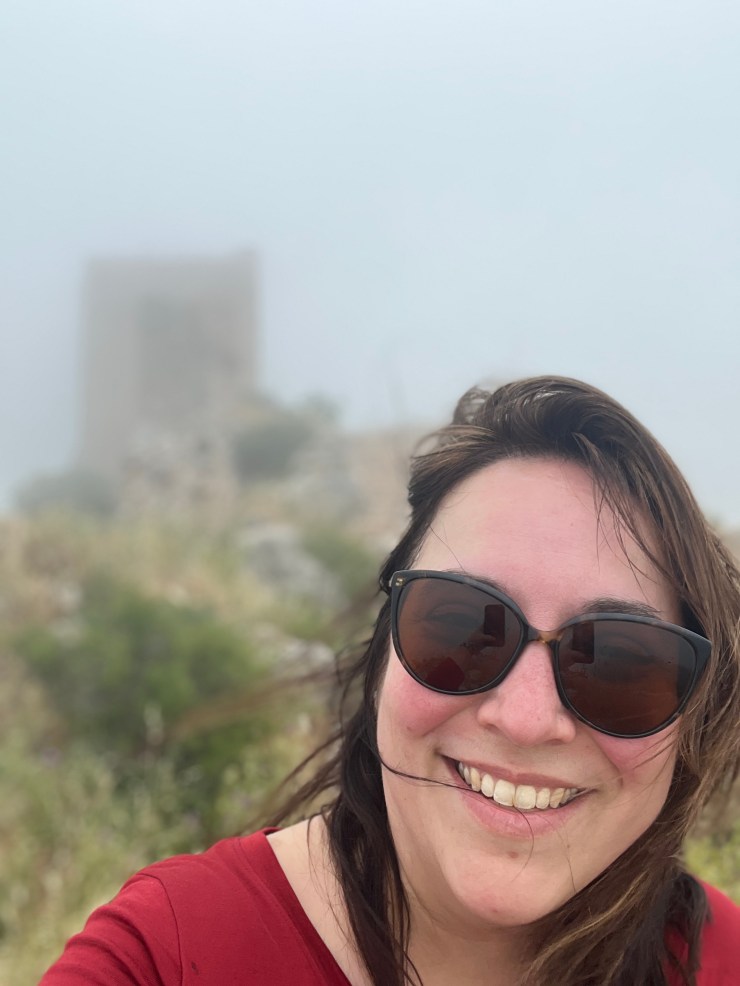
I decided to take his advice. When I got tired, I stopped and enjoyed the view or the wildflowers. I kept climbing. I visited the small chapel. There weren’t anymore fresh candles but several still burned in a soot covered corner. It was ancient and beautiful. I decided to climb a little higher to get a better view of Corinth below. I paused taking in the view and breathing deeply. I continued to climb. I paused at another view point. Spectacular, the breeze as cool and I wasn’t a sweaty mess, so I figured I would keep going. At each stopping point, I checked in with myself. Do I feel strong? Yes. Is this still fun? Yes. Even when it started to drizzle, the answers were still yes. And I was nearly at the top, it was starting to feel achievable. I was looking forward to seeing what I could from the final tall tower. But by the time I got there the clouds had obscured the view and the umbrella was more hindrance than help in the wind. I was soaking wet, and I couldn’t see anything below me. I joked with a couple nearby and said, “I thought there was a view up here”. We laughed. One of them said, “it was still worth climbing.” That’s when I realized something. I had enjoyed the climb. The self-critical voice hadn’t spoken a word the entire time. Not having a view to take a picture of, I took a selfie. I sent it to the pilgrimage group text to let them know I made it and I was on my way back. I was met at the van with cheers.
Reading psalm 26 again, the phrase from Merrill’s version, “May my heart be as your heart; may my mind be as your mind” resonates differently. My heart and my mind were filled with joy that day in the rain on top of the hill. Maybe this is what it feels like to align with God’s heart, to experience the joy of just… being.
As a pilgrim, I’ve waked many paths, some in reverent contemplation, others to test my body as I climbed steep stairs, and this time, to simply enjoy the flowers, the view, and God’s love. These pilgrimage paths lead to a transformed life and the choice to walk in God’s way forever.
I would choose a path that leads me into the heart of God.
I would choose a path that leads back home; a path of wholeness and peace.
I would choose a path with an intention of kindness and compassion.
I would choose a path worn into the ground with steadfast love.
I would choose a path filled with the joy of living.
Holy God, Guide my steps. Move me to love.
Check out other psalm reflections in the links below or find more of my writing published in Presbyterian Outlook or listen to my experiments in podcasting on the Period Pastor Podcast. Follow me @periodpastor
Past reflection links:
Psalm 26 Year B (2023-2024) Japan Pilgrimage story
Psalm 26 Year B (2020-2021)
I began writing Psalm reflections during Lent of 2020. Shortly after, we decided to close the church building, work from home, and worship via zoom. Many churches use the Revised Common Lectionary (RLC) that rotates scripture on a three-year cycle (A, B, and C). Starting in Advent 2019, the church decided to worship with the texts from Year D, which is still not circulated as are years A, B, and C. Year D was created with the goal of including scriptures that were left out or not used as frequently as others. While we were using Psalms in year D, most other lectionary followers were using Year A. In Advent of 2020 we rejoined those who use the lectionary in year B. Advent of 2021 year C. When we returned to in person worship, we took the psalm reflections out of the order of worship. I continued to write them for the blog. Advent of 2022 year A. I left church work in July of 2023 but continued the practice of writing psalm reflections. Advent of 2023 year B. Advent of 2024 year C. I finished year C early, so I began work on psalms I missed: Psalm 119, Year D and others not in the lectionary. By the end of 2025, I have written a reflection for each psalm.
Advent of 2025 year A.
I use the Vanderbilt Divinity Library’s resource for lectionary readings and the PCUSA planning calendar to make text selections.
Year A Psalms
1st Sunday in Advent Psalm 122, 2nd Sunday in Advent Psalm 72, 3rd Sunday in Advent Psalm 146, 4th Sunday in Advent Psalm 80, Christmas Psalm 96, Psalm 97, Psalm 98, 1st Sunday after Christmas Psalm 148, 2nd Sunday after Christmas Psalm 147, 1st Sunday after Epiphany Psalm 29, 2nd Sunday after Epiphany Psalm 40, 3rd Sunday after Epiphany Psalm 27, 4th Sunday after Epiphany Psalm 15, 5th Sunday after Epiphany Psalm 112, Transfiguration Sunday Psalm 2 or Psalm 99.
1st Sunday in Lent Psalm 32, 2nd Sunday in Lent Psalm 121, 3rdSunday in Lent Psalm 95, 4th Sunday in Lent Psalm 23, 5th Sunday in Lent Psalm 130, 6th Sunday in Lent Psalm 118 or Psalm 31.
Easter Psalm 118 or Psalm 114, 2nd Sunday of Easter Psalm 16 or Psalm 111, 3rd Sunday of Easter Psalm 116 or Psalm 34, 4th Sunday of Easter Psalm 23 or Psalm 100, 5th Sunday of Easter Psalm 31 or Psalm 119: 9-32, 6th Sunday of Easter Psalm 66 or Psalm 115, 7th Sunday of Easter Psalm 68 or Psalm 21, Pentecost Psalm 104.
1st Sunday after Pentecost Psalm 8, 2nd Sunday after Pentecost Psalm 33 or Psalm 50, 3rd Sunday after Pentecost Psalm 116 or Psalm 100, 4th Sunday after Pentecost Psalm 86 or Psalm 69, 5th Sunday after Pentecost Psalm 13 or Psalm 89, 6th Sunday after Pentecost Psalm 45 or Psalm 145, 7th Sunday after Pentecost Psalm 119: 105-112 or Psalm 65, 8th Sunday after Pentecost Psalm 139 or Psalm 86, 9th Sunday after Pentecost Psalm 105 or Psalm 128 or Psalm 119: 129-136, 10th Sunday after Pentecost Psalm 17 or Psalm 145, 11th Sunday after Pentecost Psalm 105 or Psalm 85, 12th Sunday after Pentecost Psalm 133 or Psalm 67, 13th Sunday after Pentecost Psalm 124 or Psalm 138, 14th Sunday after Pentecost Psalm 105 or Psalm 26, 15th Sunday after Pentecost Psalm 149 or Psalm 119, 16th Sunday after Pentecost Psalm 114 or Psalm 103, 17th Sunday after Pentecost Psalm 105 or Psalm 145, 18th Sunday after Pentecost Psalm 78 or Psalm 25, 19th Sunday after Pentecost Psalm 19 or Psalm 80, 20th Sunday after Pentecost Psalm 106 or Psalm 23, 21st Sunday after Pentecost Psalm 99 or Psalm 96, 22nd Sunday after Pentecost Psalm 90 or Psalm 1, 23rd Sunday after Pentecost Psalm 107 or Psalm 43, 24th Sunday after Pentecost Psalm 78 or Psalm 70, 25th Sunday after Pentecost Psalm 123 or Psalm 90, 26th Sunday after Pentecost Psalm 100 or Psalm 95.
Sources and notes:
“The petitions come in verses 1, 2, 9-10, and 11. The thematic supplication that all the others develop is the opening appeal that in Hebrew says literally, “judge me” (NRSV, “vindicate”; REB, “uphold my cause”). In Israel’s social life, this appeal would have been made by an innocent party who had been unjustly accused of had been injured by another and sought a decision to set things right, to order the matter justly. …. The prayer turns to God as the supremely authoritative judge of nations and individuals because he is the arbiter who knows not only the facts but what lies in the heart and mind, what is felt and intended (v2).” Mays p. 128
“Times may and do come when we need the help of remembering that God knows the mind and heart, even if others don’t, and of believing that God will vindicate faithfulness even if the world does not.” Mays p. 130
Referring to the first verse, “For I have walked in my wholeness/… I shall not stumble. The simple, and conventional, metaphor of walking secure is beautifully expressive in this poem. it is picked up at the end, again in an envelope structure, when the speaker proclaims , “My foot stands on level ground.”” Alter p. 88
Mine Kim-Kort writes, Her Table (Psalm 26:8)
“If I could be anywhere
in the world
I would always choose her table
her porch
her bed
her view.
This is not a love song–
a song about an obsession
or a crush–
maybe it should be:
a song about what love does to you
and how it makes you.
this could be a song about loyalty
and faith
and gratitude
or about how choosing love
is less like flying
and more like finally feeling the ground
beneath your feet.”
Spong, M. (Ed.). (2020). The words of her mouth: Psalms for the struggle. Cleveland, OH: The Pilgrim Press.
My reflection from Psalm 26 Year B (2020-2021):
Holy God, you know my heart, you know my pain, you know I need you now. I am hurt, I am oppressed, I am sinned against. Give me justice. Give me peace. Heal me. Restore me. I trust in you and I walk in your path towards peace and wholeness. I choose Love.
Loving God, you know all hearts, you know all pain; your people need you now. Be with those who are hurting, oppressed, and sinned against. Bring justice and peace. Heal us. Restore your kin-dom. May your righteousness and peace rule and your loving-kindness embrace all.
Merciful God, hear our prayers. Gracious God, heal us. Amen.
Alter, Robert. 2007. The Book of Psalms: A Translation with Commentary New York: W. W. Norton & Company
WBC Allen, Leslie C. 1983. Word Biblical Commentary: Psalms 101-150. Vol. 21. Waco, TX: Word Books, Publisher.
Bonhoeffer, Dietrich. 1974. Psalms: The Prayer Book of the Bible. 8th ed. Minneapolis, MN: Augsburg Press.
Bourgeault, C. (2006). Chanting the psalms: A practical guide Audio Book. New Seeds.
Brueggemann, Walter. 2007. Praying the Psalms: Engaging Scripture and the Life of the Spirit. 2nd ed. Eugene, OR: Cascade.
Brueggemann, Walter. 2014. From Whom No Secrets Are Hid: Introducing the Psalms. Edited by Brent A. Strawn. 1st ed. Louisville, KY: Westminster John Knox Press.
Brueggemann, Walter. Davis Hanskins, Editor. 2022. Our Hearts Wait: Worshiping Through Praise and Lament in the Psalms Westminster John Knox Press, Louisville KY.
Brueggemann, Walter. (2002). Spirituality of the psalms. Augsburg Pub. House.
Brueggemann, Walter. (1984). The Message of the Psalms: A Theological Commentary. Minneapolis: Augsburg.
Chilson, Richard, ed. You Shall Not Want: A Spiritual Journey Based on the Psalms. Ave Maria Press, 2009.
Chittister, Joan. (2011). Songs of the heart: reflections on the psalms. John Garratt Publishing.
Cudjoe-Wilkes and Wilkes Cudjoe-Wilkes, G., Wilkes, A. J., & Moss, O. (2022). Psalms for black lives: Reflections for the work of Liberation. Upper Room Books.
WBC Craigie, Peter C. 1983. Psalms 1-50–Word Biblical Commentary. Vol. 19. Waco, TX: Word Books.
Creach, Jerome Frederick Davis. 1998. Psalms: Interpretation Bible Studies. Louisville, KY: Westminster John Knox Press.
DAFLER, J. (2021). PSOBRIETY: A journey of recovery through the psalms. Louisville, KY: WESTMINSTER JOHN KNOX.
W de Claisse-Walford, Nancy L. WISDOM COMMENTARY: Psalms Bks. 4-5. Edited by Barbara E. Reid. Vol. 22. Collegeville, MN: Liturgical, 2020.
Green, Barbara. 1997. Like a Tree Planted: An Exploration of Psalms and Parables Through Metaphor. Collegeville, MN: Liturgical Press.
W Hopkins, Denise Dombkowski. WISDOM COMMENTARY: Psalms Bks. 2-3. Edited by Barbara E. Reid. Vol. 21. Collegeville, MN: Liturgical, 2016.
NIB Keck, Leander E. 2015. The New Interpreters Bible Commentary. Vol. 3. Nashville, TN: Abingdon Press.
Lewis, C. S. (2017). Reflections on the Psalms. Harper One, an imprint of Harper Collins Publishers.
Mays, James Luther. 1994. Psalms. Louisville, KY: John Knox Press.
McCann, J. C. (1993). A theological introduction to the book of Psalms: The Psalms as Torah. Nashville, TN: Abingdon Press.
McCann, J. C., & Howell, J. C. 2001. Preaching the Psalms. Nashville, TN: Abingdon Press.
Merrill, N. C. (2020). Psalms for praying an invitation to wholeness (10th Anniversary Edition ed.). London, England: Bloomsbury Publishing.
Miller, Patrick D. 1986. Interpreting the Psalms. Philadelphia, PA: Fortress Press.
Morgan, Michael. 2010. The Psalter for Christian Worship Revised Edition. Westminster John Knox Press.
Schlimm, Matthew Richard. 2018. 70 Hebrew Words Every Christian Should Know. Nashville, TN: Abington Press.
Spong, M. (Ed.). (2020). The words of her mouth: Psalms for the struggle. Cleveland, OH: The Pilgrim Press.
WBC Tate, Marvin E. 1990. Word Biblical Commentary: Psalms 51-100. Edited by David Allan. Hubbard and Glenn W. Barker. Vol. 20. Waco, TX: Word.
Weems, Ann. 1995. Psalm of Lament. Westminster John Knox Pres
OTL Weiser, Artur. 1998. Old Testament Library: Psalms. Translated by Herbert Hartwell. 3rd ed. New York, NY: Manchester University Press.


