The heavens declare the glory of the Creator;
the firmament proclaims the handiwork of Love.
Day to day speech pours forth and night to night knowledge is revealed.
There is no speech, nor are there words; their voice is not heard;
Yet does their music resound through all the earth,
and their words echo to the ends of the world.
In them a tent for the sun is set,
which is like a bride and groom on their wedding night
as they sing love’s song and celebrate the dance of life.
Its rising is in eternity, and its circuit to infinity;
Nothing is hidden from sunlight.
The law of Love is perfect, reviving the soul;
The testimony of Love is sure, making the wise simple;
The precepts of Love are right, rejoicing the heart;
The authority of Love is pure, enlightening the eyes;
The spirit of Love is glorious, enduring forever,
The rites of Love are true, awakening compassion.
More to be desired are they than gold, even much fine gold;
Sweeter also than honey and drippings of the honeycomb.
Moreover, by them are the loving guided; in keeping them there is great reward.
But who can discern their own weakness?
Cleanse me, O Love, from all my hidden faults.
Keep me from boldly acting in error;
let my fears and illusions not have dominion over me!
Then shall I become a beneficial presence,
freely and fully surrendered to your Love.
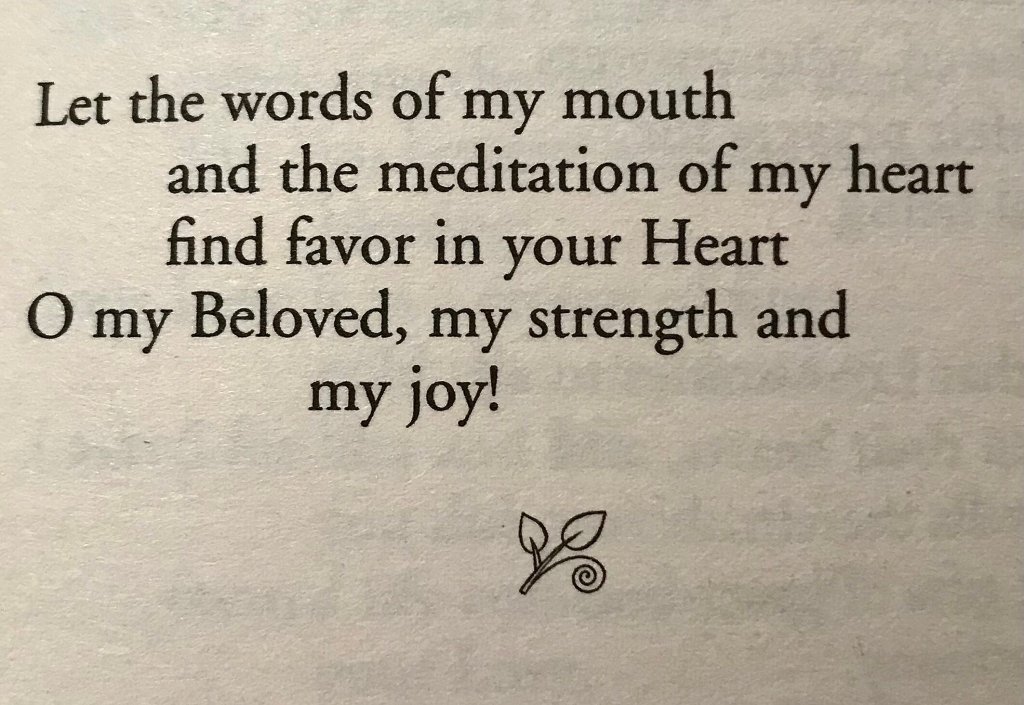
Let the words of my mouth and the meditation of my heart
find favor in your Heart O my Beloved, my strength and my joy!
Nan C. Merrill Psalms for Praying
Reflection:
There is a love song all around us, expressed with words and without words, in the earth and in scripture, in each individual’s heart and throughout the cosmos. It’s a love song about God’s connection with us and all of creation. Psalm 19 is part of that eternal love song. It is an offering, given with hope and assurance of restoration to communion with God. We are one with God and therefore one with each other. And we can experience the oneness of love in the holy moment of now.
Now is the only moment we have and it is a moment in which we can do the greatest good or cause the greatest harm, so we must fully surrender to Love. Being fully present and aware of God’s love for us and others can help us to be our best selves. My hope is that we can contribute love to the enteral oneness in our practices and policies. I hope that we can preserve the beauty of the natural world, respect the dignity of each person and creature, and infuse our interactions with love and justice and peace.
May all of the words that dwell in our hearts and pass through our lips be acceptable to our neighbors and to our Beloved God. And may the actions inspired by these words be full of Love.
Check out other psalm reflections in the links below or find more of my writing published in Presbyterian Outlook or listen to my experiments in podcasting on the Period Pastor Podcast. Follow me @periodpastor
Past reflection links:
Psalm 19 Year C (2024-2025)
Psalm 19 Year B (2023-2024)
Psalm 19 Year C (2021-2022)
Psalm 19 Year B (2020-2021)
I began writing Psalm reflections during Lent of 2020. Shortly after, we decided to close the church building, work from home, and worship via zoom. Many churches use the Revised Common Lectionary (RLC) that rotates scripture on a three-year cycle (A, B, and C). Starting in Advent 2019, the church decided to worship with the texts from Year D, which is still not circulated as are years A, B, and C. Year D was created with the goal of including scriptures that were left out or not used as frequently as others. While we were using Psalms in year D, most other lectionary followers were using Year A. In Advent of 2020 we rejoined those who use the lectionary in year B. Advent of 2021 year C. When we returned to in person worship, we took the psalm reflections out of the order of worship. I continued to write them for the blog. Advent of 2022 year A. I left church work in July of 2023 but continued the practice of writing psalm reflections. Advent of 2023 year B. Advent of 2024 year C. I finished year C early, so I began work on psalms I missed: Psalm 119, Year D and others not in the lectionary. By the end of 2025, I have written a reflection for each psalm.
Advent of 2025 year A.
I use the Vanderbilt Divinity Library’s resource for lectionary readings and the PCUSA planning calendar to make text selections.
Year A Psalms
1st Sunday in Advent Psalm 122, 2nd Sunday in Advent Psalm 72, 3rd Sunday in Advent Psalm 146, 4th Sunday in Advent Psalm 80, Christmas Psalm 96, Psalm 97, Psalm 98, 1st Sunday after Christmas Psalm 148, 2nd Sunday after Christmas Psalm 147, 1st Sunday after Epiphany Psalm 29, 2nd Sunday after Epiphany Psalm 40, 3rd Sunday after Epiphany Psalm 27, 4th Sunday after Epiphany Psalm 15, 5th Sunday after Epiphany Psalm 112, Transfiguration Sunday Psalm 2 or Psalm 99.
1st Sunday in Lent Psalm 32, 2nd Sunday in Lent Psalm 121, 3rdSunday in Lent Psalm 95, 4th Sunday in Lent Psalm 23, 5th Sunday in Lent Psalm 130, 6th Sunday in Lent Psalm 118 or Psalm 31.
Easter Psalm 118 or Psalm 114, 2nd Sunday of Easter Psalm 16 or Psalm 111, 3rd Sunday of Easter Psalm 116 or Psalm 34, 4th Sunday of Easter Psalm 23 or Psalm 100, 5th Sunday of Easter Psalm 31 or Psalm 119: 9-32, 6th Sunday of Easter Psalm 66 or Psalm 115, 7th Sunday of Easter Psalm 68 or Psalm 21, Pentecost Psalm 104.
1st Sunday after Pentecost Psalm 8, 2nd Sunday after Pentecost Psalm 33 or Psalm 50, 3rd Sunday after Pentecost Psalm 116 or Psalm 100, 4th Sunday after Pentecost Psalm 86 or Psalm 69, 5th Sunday after Pentecost Psalm 13 or Psalm 89, 6th Sunday after Pentecost Psalm 45 or Psalm 145, 7th Sunday after Pentecost Psalm 119: 105-112 or Psalm 65, 8th Sunday after Pentecost Psalm 139 or Psalm 86, 9thSunday after Pentecost Psalm 105 or Psalm 128 or Psalm 119: 129-136, 10th Sunday after Pentecost Psalm 17 or Psalm 145, 11th Sunday after Pentecost Psalm 105 or Psalm 85, 12th Sunday after Pentecost Psalm 133 or Psalm 67, 13th Sunday after Pentecost Psalm 124 or Psalm 138, 14th Sunday after Pentecost Psalm 105 or Psalm 26, 15th Sunday after Pentecost Psalm 149 or Psalm 119:33-40, 16thSunday after Pentecost Psalm 114 or Psalm 103, 17th Sunday after Pentecost Psalm 105 or Psalm 145, 18th Sunday after Pentecost Psalm 78 or Psalm 25, 19th Sunday after Pentecost Psalm 19 or Psalm 80, 20th Sunday after Pentecost Psalm 106 or Psalm 23, 21st Sunday after Pentecost Psalm 99 or Psalm 96, 22nd Sunday after Pentecost Psalm 90 or Psalm 1, 23rd Sunday after Pentecost Psalm 107 or Psalm 43, 24th Sunday after Pentecost Psalm 78 or Psalm 70, 25th Sunday after Pentecost Psalm 123 or Psalm 90, 26th Sunday after Pentecost Psalm 100 or Psalm 95.
Sources and notes:
“”Lord, my rock and my redeemer” are the last words of Psalm 19. On the way to that confessional conclusion the psalm speaks of the creation’s testimony to the creator (vv. 1-6), the incomparable value of the law of the LORD (vv. 7-10), and the hymn need for divine forgiveness and protection (vv 11-13). One must meditate on all three parts and make the whole the worlds of the heart in order to understand the devotion and trust expressed in the concluding confession.” Mays p. 96
“The sum of the first part of the psalm can be stated quite simply. The world witnesses to God. The creator manifests the glory of its creator.” Mays p. 97 “The second part of the psalm is a precisely constructed poetic passage exalting the virtues, benefits, and desirability of the torah of the LORD” Mays p. 98 “The third part of the psalm is a prayer for God’s help. In the prayer the psalmist acknowledges that he cannot be righteous through torah alone. [He is dependent on God for restoration].” Mays p. 99
“In a rare identification, the composer tells us what this psalm is and what it is for (v. 14). The psalmist calls it “words of my mouth and the meditation of my heart.” It is composed for the oral recitation in an act of worship. The words express the music of the heart, the seat of consciousness in which thoughts are formed. Through the words the heart finds voice and the self is presented to God. The prayer seres the purpose of sacrifice; “be acceptable” is a technical term for qualified offerings to God at the sanctuary. In the temple service, sacrifices were offered to seek God’s pardon and restoration (Leviticus 4-5; Num. 15:22-31). In the intention of the psalmist, this prayer poem is such an offering.” Mays p. 100
“…Psalm 19 affirms that love is the basic reality. According to the psalmist, the God whose sovereignty is proclaimed by cosmic voices is the God who has addressed a personal word to humankind–God’s torah. Furthermore, this God is experienced ultimately by humankind not as a cosmic enforcer but as a forgiving next of kin! God is love, and love is the force that drives the cosmos.” NIB p. 355
” The love that motivated God to create humankind and bear the burden of human disobedience (Genesis 1-11) is the same love manifested in the story of Israel (see esp. Exodus 32-34), in the life of the psalmist (vv. 11-14), and, as Christians profess, in the life, death, and resurrection of Jesus. Love is the basic reality of the universe.” NIB p. 355
“Generation after generations we tell ourselves the stories of the past, the tasks of the present and the promise of the future. Each of them is measured by the eternal truths in the human heart, the call of God that rumbles through the world. This tension between past experiences, the wisdom of the ages and the underlying urgency of now, leaves us with the spiritual balancing at of all time.” Chittister p. 105
From Jeff Dafler’s “Sobriety”: For many years, I clung to the dangerous idea that I made the rules. I was convinced of my uniqueness and beloved that I could–and must–bend the world to my will. The more tightly I held onto this false idea, the more frustration and disappointment I felt. As I built up my resentments and wallowed in self-pity, I began to drown myself in alcohol. Psalm 19 tells us about a better way. If we let go of our old idea ht we are in control or instead cling to our Higher Power’s plan for our lives, things can and will get better. If we can honestly and fully embrace God’s will for our lives, the psalmist tells us in verse 7 and 8 what is in store for us: God will revive our souls and make us wise. Our hearts will rejoice and we will (finally!) see clearly. How priceless are such gifts! They are offered to us free of charge. All we have to do is follow this simple program for our lives. That program is laid out in the Psalms and in the Twelve Steps. In both versions, it starts with a basic acceptance that turns our old idea on its head: We can’t. God can. We need to let him.
This reflection from “the words of her mouth” by Layton E. Williams: There is something in the stars that makes me believe in you: their vastness, yes, but also their steadfastness, their constant presence, whether I can see the shape of them or not; Something in the rising and the setting that shows me the beautiful goodness of dark and light, of new and old, of welcoming and letting go. In these most ordinary, everyday realities of your creation, made also astounding, I am reminded that you are at work in all things–and in me. Even in me. Let me be a witness like the sun and stars, an ordinary and astounding testament to Grace.
“… in the Psalter is the great Torah Psalms in which Israel celebrates, with joy, the the creator God has not left the wold as a formless blob but has instilled in the very structure of creation the transformative capacity for enacted fidelity. That is why Psalm 19 juxtaposes the glory of creation that attests the creator (vv. 1-6) with the commandments that are the source of life. The poet offers six parallel statements, six outcomes of Torah, six transformative verbs, six great new possibilities [vv. 7-9]. The product of an obeyed Torah is joy and well-being, as surely as the consequence of formlessness is an unsustainable jungle o power and threat. It is no wonder, then, that the psalmist can assert that the commandments are better than gold (v. 10) because what can gold of itself do for life? It is no wonder that another psalmist can exclaim.” Brueggemann, From Whom No Secrets are Hid pp. 25-26
“4. There is no utterance and there are not words. This seeming contradiction of verses 2 and 3 is, of course, only the underlining of a moving paradox. The heavens speak, but it is a wordless language, what the great twentieth-century Hebrew poet H. N. Bialik, in a poem akin to this one, would call “the language of images.” Thus the psalmist can go on from this affirmation of speechlessness and silken to the declaration in the next verse of speed going out to the ends of the earth.” Alter p. 60
“5. For the sun He set up a tent in them. The poet now proceeds to a grandly mythological image of the sun-residing in a celestial pavilion, emerging from it at down like a bridegroom from his wedding canopy, and then, in a switch of imagery, racing across the sky to the west like a warrior dashing across the battlefield. Some interpreters have viewed this section of the poem as a pagan hymn to a social deity simply borrowed by the monotheistic poet from a poem written in Egypt by Judea’s or Samaritans influenced by Egyptian religion. It makes better sense to view it as a monotheistic adaptation of mythological imagery. (The contemporary American scholar Nahum Sarna even suggests it may be a polemic agains paganism). Because the only plausible antecedent fro the verb “set up” is God, the poet does seem to be saying that it is God who has ordained the circuit of the sun, and that the images in which we cast this daily celestial road of light-the bridegroom emerging from his canopy, the warrior racing on his way-are but poetic expressions of how the heavens tell God’s glory day after day.” Alter p. 61
“15. Let my mouth’s utterances. This verse forms an apt formal coda to the psalm, or at least to its second half, and has appropriately been adopted as the conclusion to the silent prayer recited three times daily in Jewish worship.” Alter p. 64
Alter, Robert. 2007. The Book of Psalms: A Translation with Commentary New York: W. W. Norton & Company
WBC Allen, Leslie C. 1983. Word Biblical Commentary: Psalms 101-150. Vol. 21. Waco, TX: Word Books, Publisher.
Bonhoeffer, Dietrich. 1974. Psalms: The Prayer Book of the Bible. 8th ed. Minneapolis, MN: Augsburg Press.
Bourgeault, C. (2006). Chanting the psalms: A practical guide Audio Book. New Seeds.
Brueggemann, Walter. 2007. Praying the Psalms: Engaging Scripture and the Life of the Spirit. 2nd ed. Eugene, OR: Cascade.
Brueggemann, Walter. 2014. From Whom No Secrets Are Hid: Introducing the Psalms. Edited by Brent A. Strawn. 1st ed. Louisville, KY: Westminster John Knox Press.
Brueggemann, Walter. Davis Hanskins, Editor. 2022. Our Hearts Wait: Worshiping Through Praise and Lament in the Psalms Westminster John Knox Press, Louisville KY.
Brueggemann, Walter. (2002). Spirituality of the psalms. Augsburg Pub. House.
Brueggemann, Walter. (1984). The Message of the Psalms: A Theological Commentary. Minneapolis: Augsburg.
Chilson, Richard, ed. You Shall Not Want: A Spiritual Journey Based on the Psalms. Ave Maria Press, 2009.
Chittister, Joan. (2011). Songs of the heart: reflections on the psalms. John Garratt Publishing.
Cudjoe-Wilkes and Wilkes Cudjoe-Wilkes, G., Wilkes, A. J., & Moss, O. (2022). Psalms for black lives: Reflections for the work of Liberation. Upper Room Books.
WBC Craigie, Peter C. 1983. Psalms 1-50–Word Biblical Commentary. Vol. 19. Waco, TX: Word Books.
Creach, Jerome Frederick Davis. 1998. Psalms: Interpretation Bible Studies. Louisville, KY: Westminster John Knox Press.
DAFLER, J. (2021). PSOBRIETY: A journey of recovery through the psalms. Louisville, KY: WESTMINSTER JOHN KNOX.
W de Claisse-Walford, Nancy L. WISDOM COMMENTARY: Psalms Bks. 4-5. Edited by Barbara E. Reid. Vol. 22. Collegeville, MN: Liturgical, 2020.
Green, Barbara. 1997. Like a Tree Planted: An Exploration of Psalms and Parables Through Metaphor. Collegeville, MN: Liturgical Press.
W Hopkins, Denise Dombkowski. WISDOM COMMENTARY: Psalms Bks. 2-3. Edited by Barbara E. Reid. Vol. 21. Collegeville, MN: Liturgical, 2016.
NIB Keck, Leander E. 2015. The New Interpreters Bible Commentary. Vol. 3. Nashville, TN: Abingdon Press.
Lewis, C. S. (2017). Reflections on the Psalms. Harper One, an imprint of Harper Collins Publishers.
Mays, James Luther. 1994. Psalms. Louisville, KY: John Knox Press.
McCann, J. C. (1993). A theological introduction to the book of Psalms: The Psalms as Torah. Nashville, TN: Abingdon Press.
McCann, J. C., & Howell, J. C. 2001. Preaching the Psalms. Nashville, TN: Abingdon Press.
Merrill, N. C. (2020). Psalms for praying an invitation to wholeness (10th Anniversary Edition ed.). London, England: Bloomsbury Publishing.
Miller, Patrick D. 1986. Interpreting the Psalms. Philadelphia, PA: Fortress Press.
Morgan, Michael. 2010. The Psalter for Christian Worship Revised Edition. Westminster John Knox Press.
Schlimm, Matthew Richard. 2018. 70 Hebrew Words Every Christian Should Know. Nashville, TN: Abington Press.
Spong, M. (Ed.). (2020). The words of her mouth: Psalms for the struggle. Cleveland, OH: The Pilgrim Press.
WBC Tate, Marvin E. 1990. Word Biblical Commentary: Psalms 51-100. Edited by David Allan. Hubbard and Glenn W. Barker. Vol. 20. Waco, TX: Word.
Weems, Ann. 1995. Psalm of Lament. Westminster John Knox Pres
OTL Weiser, Artur. 1998. Old Testament Library: Psalms. Translated by Herbert Hartwell. 3rd ed. New York, NY: Manchester University Press.


